Phytophthora
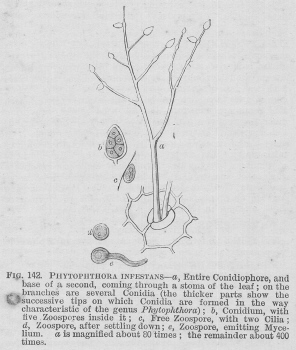
(from the Greek phyton, plant, and phthora, destruction). A small group of parasitic Fungi, very closely allied to Peronospora in all important points of structure (see Peronospora), except that the stems bearing conidia (conidiophores) do not, as in that genus, produce only a single conidium on the tip of each branchlet. Instead of this, after a conidium is formed at the tip, the branch grows on from just below it, and produces a new conidium (see Fig. 142); and this process may be repeated several times. The reproduction by zoospores formed in the conidia, and also by oospores, or "resting spores," is much like that of Peronospora nivea. Few species are known, but of these one is the dreaded Potato-disease Fungus (P. infestans), too often seen wherever Potatoes are cultivated. Another is P. Fagi (also called P. omnivora), the cause of very widespread and serious disease in Beech seedlings, in many parts of Europe. It also grows well in seedlings of most of the commonly-cultivated coniferous trees, in the commoner Maples, and in many low-growing plants, e.g., Sempervivum, Clarkia, &c. This latter Fungus has not yet caused damage in Britain; but, from its wide distribution, and its hurtfulness abroad, there is reason to dread its ravages should it appear in these islands. A short notice of it will, therefore, not be out of place here. It is injurious to trees only in the seedling stage, but, when it breaks out in a bed of seedlings of the kinds named above, the disease makes very rapid progress around the centres of infection. This progress is more rapid in warm, damp weather, and in shady situations, and, most of all, in beds crowded with young plants.
In the Beech, in which the disease has been most fully studied, the seedlings become black, and perish almost before germination; or they form the seed leaves and the first true leaves before the disease forms spots on the stems and on the various leaves. In damp weather, the diseased parts soon rot; in dry weather, they become dry and brown. All the diseased parts are penetrated by the threads of the Fungus; and numerous conidiophores, each producing two, or less often three, egg-shaped conidia, are pushed out through the skin of the stem or leaf. The conidia, if they fall into dewdrops, emit one or more mycelium threads, or they produce a number of "swarmspores" (zoospores) in their interior, and these readily emit mycelium threads, which push in through the surface cells of the host-plants, and give rise to the disease anew. The damage thus spreads very rapidly. The Fungus is propagated in the following spring by means of the resting spores. These are produced as in Peronospora, and are formed in the diseased tissues. When the latter decay, the spores are scattered in the soil, there to remain till the warmth of the following spring promotes their germination. If a suitable host is at hand, the Fungus bores into it, and runs the same course as before. It has been found, experimentally, that resting spores can retain their capacity for germinating even for four years. Seed-beds of forest-trees of the species liable to injury should be established in places free from shade, and airy, to allow of free evaporation of superfluous moisture. All dead or dying plants should be at once picked out and burned. The seedlings must not be crowded. Ground where a diseased seed-bed has stood must not be used for making a new bed for some time, lest disease should break out afresh from germinating resting spores left in the soil, thus perpetuating the evil.
The Potato-disease Fungus (P. infestans) is one of the most hurtful of all Fungi, because of the damage it inflicts on the Potato crop; in some years, a half, or more, of the yield is destroyed. In the year 1845, the disease produced by this Fungus first came prominently into notice, since, in that year, it spread over the West of Europe, including Britain and Ireland, and over the Northern United States of America. In the latter half of August, the crop in our own country was blighted, causing heavy losses to farmers; while severe and fatal famine and disease followed in Ireland. In years previous to 1845, the disease of Potatoes had been observed occasionally in various places; but, since 1845, it has never been wholly absent from any country where it has once appeared, though it is much more destructive in some years than in others. The Fungus attacks several plants belonging to the same order as the Potato (Solanaceae), such as the Bitter-sweet (Solanum Dulcamara), Schizanthus, and the Tomato (Lycopersicum esculentum). The damage done by it to the latter plant is sometimes considerable. Occasionally, it grows on plants of the order Scrophularineae. The appearance of the diseased Potato-plants is too well known to require a long description. On the leaves brown spots appear (see Fig. 143), rapidly extending, and becoming rotten towards the centre. The lower surface of the spot bears a thin, whitish coating, seen most distinctly on a watery-looking, discoloured border round the spot. This whitish coat consists of numerous conidiophores, emerging from the stomata in small groups. Each has a few branches, with conidia near the tips (see Fig. 142). The tissues of the leaf are full of the mycelium of the Fungus, pushed between, and lying in contact with, the cells of the leaf, and causing them to rot. Zoospores are formed in the conidia in water (e.g., a dewdrop), as described under Peronospora (which see). They are set free by the conidium bursting, and each moves, by means of two fine hairs (see Fig. 142, c) in the water on the leaf. Each settles down after a little while, and emits (see Fig. 142, e) mycelium, which, in a short time, penetrates the leaf, and gives rise in it to a new diseased spot. Any movement of the diseased plants, by wind or otherwise, however slight, is sufficient to spread the conidia all round; and thus, from a single plant, a whole field may be infected in a very short time. But the whole plant becomes filled with the mycelium, alike in leaves, stems, and branches; and the tubers also become infected, both in this way, and by the entrance of mycelium tubes emitted by zoospores, washed down upon them if they lie near the surface of the soil. In whatever way the mycelium reaches the tuber, the latter becomes rotten, in patches or entirely; and, on careful examination, the starch grains are found to be dissolved and fissured. Where the tuber has not passed beyond the first stage of disease, it shows little sign of injury externally; and such tubers are often used for planting for next year's crop, with the frequent result of diseased plants growing from them. So far it may be said that all mycologists are agreed in regard to the development of this Fungus; but what remains to be stated here is still hotly discussed. Globular cells, three or four times the diameter of the mycelium, possessing a thick, warty outer coat, and a thin inner one, were observed in diseased potatoes, even as early as 1845. Mr. W. G. Smith has found such bodies very abundantly in old potatoes, and in diseased leaves kept in a vessel over water (i.e., in moist air); and has observed, in regard to them, a process of development like that in Peronospora nivea, &c.; and he asserts that these brown, globular cells are the resting-spores of the Potato-disease Fungus. This is denied by Prof. De Bary, of Strasbourg, and by others. Mr. A. S. Wilson has brought forward a theory, with reasons in support of it, connecting with the Potato-disease Fungus numerous small, oval bodies (that are white by reflected, and dark by transmitted, light), which are very abundantly scattered through the tissues of Potato-leaves, &c. He and Mr. Smith believe that they have traced these small bodies into actual connection with the undoubted mycelium of P. infestans. The bodies, on analysis, are found to consist largely of particles of oxalate of lime, with a basis of protoplasm. Mr. Wilson regards them as a resting condition, analogous to the sclerotia of other Fungi, e.g., that of Peziza postuma, in its uses to the Phytophthora. The true nature of the bodies has been hotly discussed in the "Gardeners' Chronicle" during the years 1883-85. Mr. Wilson regards Potatoes as almost all infected throughout their tissues by these resting masses of the Fungus, which, he considers, emit mycelium, and give rise to disease, under conditions favourable to the growth of the Fungus. Much has been written on remedies for the Potato disease; yet it can hardly be said that any methods have been discovered really efficient in securing the Potato crop against this scourge. Beyond doubt, the unnatural conditions induced by continuous cultivation and propagation from the tubers, have rendered the plants a more easy prey to the Fungus, and more liable to suffer severely from its attacks, than uncultivated plants would be; and this is seen if the effects on the Potato are contrasted with those on the Bitter-sweet, a plant also occasionally attacked by the Fungus. Prevention is best promoted by selecting, as seed tubers, varieties known to resist disease, since some are much hardier than others in this respect. The soil should be well drained, and there should be free circulation of air around the plants, to promote evaporation, since moisture, confined air, and warmth, promote the rapid growth of the Fungus. The seed tubers should be planted uncut, or the cut surfaces should be allowed to heal, or may be seared with a hot iron, or otherwise coated over, before being put into the soil. All tubers that show traces of disease, and all dead stalks, leaves, &c., should be burned, to prevent the propagation of the disease through them. Of recent years, Mr. Jensen, of Copenhagen, has strongly advocated "protective moulding," and his views have been stated and supported at some length by Mr. C. B. Plowright, in the "Gardeners' Chronicle." The system was also suggested by Dr. Lang, in 1858; but it has not been generally adopted. Mr. Jensen's method may be briefly summarised as follows: The ground should be thoroughly worked and quite friable, and the potatoes should be planted in rows about 30in. apart. The first moulding should be about 4in. high, and flat on top. The protective moulding should be done as soon as diseased spots appear on the plants, and, in any case, should not be deferred later than the time of Wheat-harvest: it is effected, on a small scale, in gardens, by the use of a hoe; on a large scale, in fields, by a specially-formed plough. The layer of earth should be, when it has settled down, not less than 4in. thick along each side of the row, above the tubers. At the same time, the tops should be bent over to one side of the row, and allowed to wither; and they may then be cut off and removed. The tubers may be lifted in about a week after the removal of the tops. This system proceeds on the belief that the tubers are infected by conidia and zoospores washed by showers from the leaves and through the soil on to the tubers, and not by mycelium through the stalk. Mr. Jensen also recommends disinfecting the seed tubers by storing them for four or five hours in a dry-air chamber, at a temperature of from 100 deg. to 105 deg. Fahr. Of course, other host-plants of the Fungus, whether wild or cultivated, ought not to be grown in the neighbourhood of Potatoes. Attempts have been made to substitute some other species of tuber-forming Solanum for S. tuberosum, but without great success. The most promising seem to be S. Commersoni and S. Maglia, the former of which appears to be uninjured by P. infestans.