Polemonium
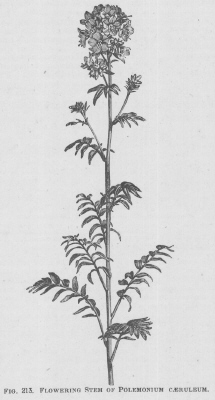
(an ancient Greek name, used by Dioscorides, from polemos, war; of doubtful application). ORD. Polemoniaceae. A genus comprising eight or nine species of ornamental, tall or dwarf, hardy, perennial or rarely annual herbs, natives of Europe, temperate Asia, North America, Mexico, and Chili. Flowers blue, violet, or white, generally showy; calyx campanulate, five-fid; corolla shortly funnel-shaped, broadly campanulate, or sub-rotate, with obovate lobes; cymes terminal, loosely corymbose or sub-capitate. Leaves alternate, pinnatisect. Rhizomes usually creeping, thick or slender. The best-known species are described below. They are all perennials, and are of easy cultivation in any good garden soil, but flourish best in a deep, rich, and well-drained loam. Propagated very readily by division. P. caeruleum (blue).* Charity; Greek Valerian; Jacob's Ladder. fl. normally blue, erect, corymbose, with roundish-oval, obtuse petals. Early summer. l. pinnate; leaflets ovate-lanceolate, acuminate, glabrous. Stem glabrous, angular and fistular. h. 2ft. Northern hemisphere (Britain). An elegant border perennial, of which there are numerous varieties, varying chiefly in the colour of the flowers. See Fig. 213. (Sy. En. B. 922.) A handsome form is that having variegated foliage and white flowers.
P. c. dissectum (dissected). l. bipinnate; leaflets petiolate, pinnatifid; segments linear. (S. B. F. G. 182, under name of P. sibiricum.)
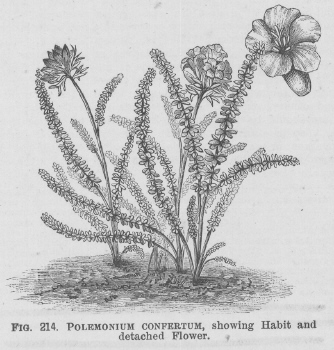
P. confertum (clustered).* fl. rich blue, funnel-shaped, about 1/2in. across, clustered on the ends of the stalks. Summer. l. linear, pinnate; pinnae very numerous and overlapping, varying from roundish-ovate to linear-oblong. h. 6in. Rocky Mountains, &c., 1885. See Fig. 214. (G. C. n. s., xxiv. 3.)
P. humile (dwarf).* fl. blue or purplish, in drooping, sub-corymbose panicles; segments of corolla ovate, acutish. July. l., leaflets ovate, obtuse, mostly radical, and with a faint smell of musk. Stems many, leafy, downy. h. 6in. Rocky Mountains, 1827. SYNS. P. Richardsonii (B. M. 2800) and P. villosum (S. B. F. G. 266).
P. h. pulchellum (pretty). fl. smaller than in the type; corolla lobes violet or lavender-blue, in some forms nearly white, only two to three lines long. l., leaflets often nearly glabrous and naked. SYN. P. pulcherrimum (B. M. 2979).
P. mexicanum (Mexican). fl. blue, few, corymbose; corolla sub-rotate-campanulate. April. l. pinnate, downy; segments ovate or oblong. Stem loosely branched. h. 9in. North America, 1827. Plant viscous-pubescent. (B. R. 460.)
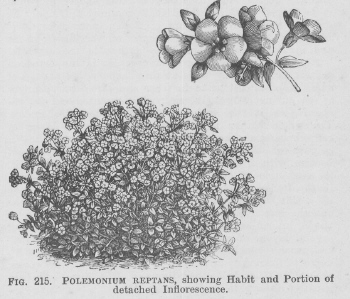
P. pulcherrimum (very pretty). A synonym of P. humile pulchellum. P. reptans (creeping).* fl. blue, sometimes white, drooping, disposed in a loose, panicled corymb; segments of corolla cuneate. April. l. pinnate; leaflets seven to eleven, ovate, acute, glabrous. Stems leafy, glabrous. Root creeping. h. 6in. North America, 1758. See Fig. 215. (B. M. 1887.)
P. Richardsonii (Richardson's). A synonym of P. humile.
P. villosum (villous). A synonym of P. humile.