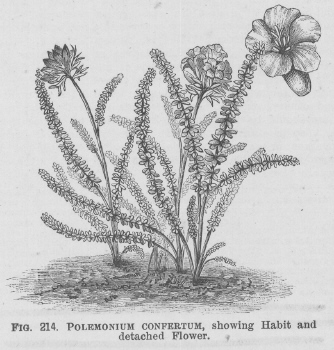
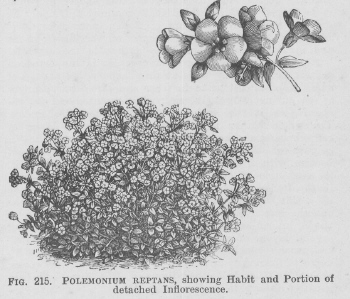
Polemoniaceae
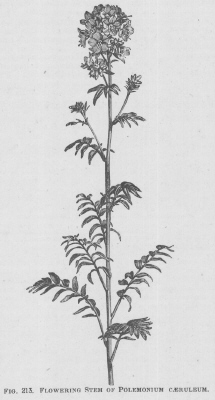
A natural order of glabrous, pubescent, or slightly viscid, erect or twining herbs, rarely shrubs, the majority of which are found in (mostly Western) North America and the Andes of South America, a few being natives of Europe and temperate Asia. Flowers variously coloured, hermaphrodite, usually showy, regular or scarcely oblique, at the tips of the branches, or sometimes solitary or twin in the axils, sessile or stalked, sometimes corymbose-cymose, capitate, or loosely paniculate; calyx campanulate or tubular, five-fid, with imbricated lobes, or rarely three to five-fid or valvate; corolla gamopetalous, funnel-salver or bell-shaped, or rotate, the limb of five twisted lobes; stamens five, alternate with the corolla lobes. Fruit a capsule. Leaves alternate or opposite, entire or variously dissected. "In some countries, the leaves of Polemonium caeruleum are applied to ulcers following contagious diseases, and the Russians give a decoction of it in cases of hydrophobia" (Decaisne and Le Maout). The order comprises eight genera and not more than 150 species. Well-known illustrative genera are; Collomia, Gilia, Phlox, and Polemonium.