Pittosporum
(from pitta, pitch, tar, and sporos, seed; in allusion to the resinous coating of the seeds). ORD. Pittosporeae. A rather large genus (fifty species have been described) of greenhouse or half-hardy, glabrous or tomentose, erect shrubs or small trees, occurring in Africa, the warmer parts of Asia, the Pacific Islands, Australia, or New Zealand. Flowers sometimes in terminal clusters, corymbose, sub-umbellate or paniculate, sometimes solitary or few, terminal, axillary, or lateral; sepals distinct or connate at base; petals connivent or cohering at base, or rarely spreading. Leaves entire, sinuate-dentate, in some species often sub-verticillate at the apices of the branches. All the species form very handsome subjects, and are well adapted for growing in conservatories. The half-hardy ones thrive in any common garden soil, but, except in the south-western counties, &c., require the shelter of a wall. The greenhouse ones succeed in a well-drained, fibry loam. P. Tobira is a favourite plant in the Paris flower-markets, and is largely grown for its very fragrant blossoms. All are readily propagated by means of cuttings of the half-ripened wood, inserted in sandy soil, under a bell glass, in a greenhouse, and kept shaded until roots are formed.
P. coriaceum (leathery-leaved). fl. bluish-white; peduncles umbellately branched, many-flowered, and, as well as the calyces, villous. May. l. obovate, obtuse, coriaceous, quite smooth. h. 8ft. Madeira, 1783. Greenhouse shrub. (A. B. R. 151; L. B. C. 569.)
P. cornifolium (Cornus-leaved). fl. dingy-red, polygamous, on very slender, terminal, one or two-flowered peduncles; sepals very narrow, subulate; petals as narrow, with slender tips. May. l. whorled, obovate or elliptic-lanceolate, shortly petioled, quite entire and glabrous, coriaceous. Branches forked or whorled. h. 2ft. to 4ft. New Zealand, before 1832. A small, slender, half-hardy shrub. (B. M. 3161.)
P. crassifolium (thick-leaved).* Parchment-bark. fl. dark chocolate-purple, freely produced in nodding, pedunculate umbels. April. l. alternate, narrow-obovate, linear-obovate, or oblong, obtuse, quite entire, light green, tomentose on the under surface. h. 4ft. to 10ft. New Zealand, 1872. A bushy-growing, half-hardy shrub, of erect branching habit. (B. M. 5978.)
P. elegans (elegant). A synonym of P. eugenioides.
P. eugenioides (Eugenia-like). fl. greenish-white, more or less diaecious, fragrant; sepals very variable, ovate, acuminate, glabrous; petals narrow and spreading, recurved. l. usually elliptical, acute, narrowed into long petioles, rarely broader and obovate, quite entire, undulated or crisped, rather coriaceous, with numerous fine veins. h. 20ft. to 30ft. New Zealand. Greenhouse tree. SYNS. P. elegans, P. microcarpum.
P. ferrugineum (rusty). fl. yellow, small; peduncles terminal, usually clustered several together above the last leaves. April to July. l. from obovate or ovate, and obtuse or scarcely acuminate, to oblong or almost lanceolate, acuminate, and 3in. to 4in. long, quite entire, narrowed into a petiole, rusty-tomentose on both sides when very young. h. 6ft., sometimes attaining 50ft. to 60ft. Australia, 1787. Greenhouse tree. (B. M. 2075.)
P. microcarpum (small-fruited). A synonym of P. eugenioides. P. revolutum (revolute). fl. yellow; peduncles terminal, few or solitary, usually decurved, bearing sometimes a single, rather large flower, but more frequently a dense, ovoid or corymbose raceme. February to April. l. ovate-elliptical or elliptical-oblong, shortly acuminate, 2in. to 4in. long, scarcely undulate, narrowed into a petiole. h. 4ft. to 6ft. Australia, 1795. Greenhouse shrub. (B. R. 186; S. F. A. 25, under name of P. fulvum.
P. sinense (Chinese). A synonym of P. viridiflorum.
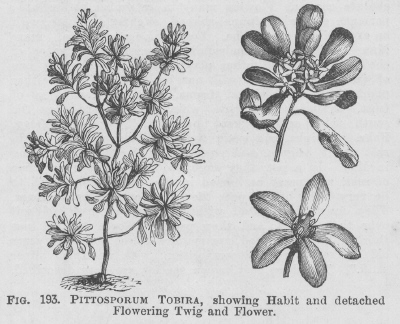
P. Tobira (its native name).* fl. white, fragrant; peduncles one-flowered, pubescent, disposed in aggregate umbels. March to August. l. obovate, obtuse, coriaceous, smooth. h. 12ft. Japan, 1804. Half-hardy shrub.(B. M. 1396.)
P. undulatum (wavy-leaved).* fl. white; peduncles terminal, aggregate, pubescent, branched, many-flowered. February to June. l. oval-lanceolate, undulated, tapering at both ends, glabrous. h. 10ft. Australia, 1789. Half-hardy shrub. (A. B. R. 383; B. R. 16.)
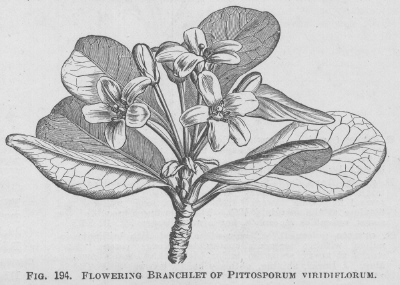
P. viridiflorum (green-flowered).* fl. greenish-yellow, Jasmine-scented; panicle somewhat globose, terminal, glabrous. May. l. obovate, retuse, cuneate at the base, shining, under surface reticulated. h. 6ft. Cape of Good Hope, 1806. Greenhouse shrub.(B. M. 1684.) SYN. P. sinense.