Placea
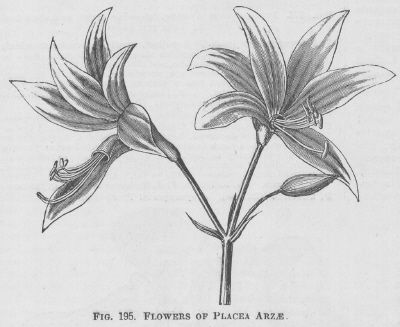
(said to be derived from the native name in Chili). ORD. Amaryllideae. A genus comprising (according to Mr. Baker) about five species of greenhouse, bulbous plants, natives of Chili, and closely related to Hippeastrum, from which they differ in having a perfect evolute corona. Flowers many in an umbel, pedicellate; perianth somewhat funnel-shaped, slightly declinate, with an exceedingly short tube. Leaves linear, carinate. Herr Max Leichtlin, a wonderfully successful cultivator of choice bulbous and other plants, says: "Placea is one of those bulbs which will not be pot-bound. I either plant them in a walled frame, which is kept free of frost, or in a low house which has a border on the south side, and is kept between 37 deg. and 40 deg. Fahr. at night, and leave them well alone. They go to rest about August, and push about December, flowering in May. In a pot, they ought to have their exact time of rest, and must be buried in the soil, which ought to be very rich; but in pots they are not certain to flower. They must be planted with at least an inch of soil over their necks, and they prefer a loose soil. I use thoroughly-decomposed cow-manure (three and four years old), mixed, during decomposition, with one-third silver sand." The three best known species are here described.
P. Arzae (Arza's). fl. pale yellow, lined with purple; corona monophyllous, base yellow, apex purple; umbel three to five-flowered; scape 1 1/2ft. high. l. two, glaucous, 9in. long, 1/6in. broad. Bulb 2 1/2in. in diameter.
P. grandiflora (large-flowered). fl. white, freely striped with bright crimson, large; scape erect, terminating in an umbel of several handsome flowers. l. few, linear, long, rounded and fistulose at the margin. 1869. This, the finest species of the genus, resembles P. ornata, but is much larger. (I. H. 574.)
P. ornata (adorned). fl. snow-white, lined with brilliant vermilion within; segments spathulate-oblong; corona white, scarlet at apex; scape 8in. to 9in. high, four to seven-flowered. May. l. linear, shining, obtusely keeled below. 1840. (B. R. xxvii. 50.)