Pleospora
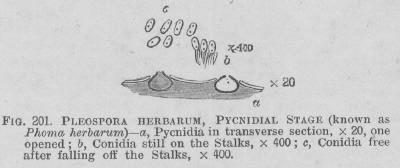
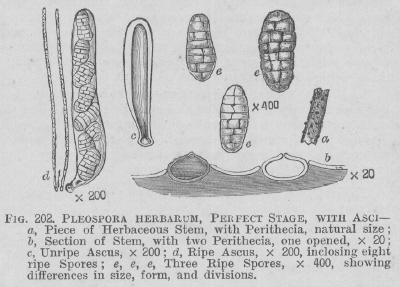
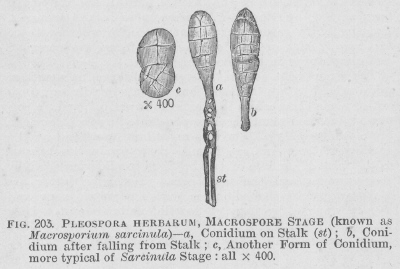
A genus of parasitic Fungi, belonging to the group of Pyrenomycetes, and to the sub-group Sphaeriaceae, in which the perithecia are globular or flask-shaped, and open by a circular pore or mouth to permit the escape of the spores. The perithecia are borne upon a mycelium, which penetrates the tissues of the host-plant; but they are quite separable from this mycelium. The genus is one of a section in which the perithecia are at first covered by the epidermis of the host-plant, through which, usually, they ultimately burst. The mycelium does not form an evident layer or mass (stroma). The perithecia are not very thick-walled, are dark brown, and generally smooth; the opening, or neck, usually projects from the stratum in which the bodies are sunk. Another form of spore (conidia) is usually produced on the surface on the same host. The spores produced in the asci, inside the perithecia, are divided by numerous cell-walls, crosswise and lengthwise, so as to resemble the arrangement of bricks in a wall, and they are usually some shade of brown, seldom colour-less. A number of species of Pleospora exist, some parasitic on one plant, some on another; but most of them seem to be found in the perfect condition only on dead or dying stems and leaves, and are thus, in this stage, not hurtful to garden or field produce. A large proportion of the species have been found only on wild plants or on grasses; and there is considerable doubt as to the number of really distinct species, since many of the named forms are only varieties of the extremely common P. herbarum. It will be well to give here a brief description of the conclusions of mycologists with regard to the life-history of this species, as it is believed to be injurious to various garden plants in its earlier conditions; and several of these stages differ so much from one another, and from the mature condition, that they have been described as distinct species under widely-separated groups. This Fungus is supposed to be the cause of a disease of Potato-plants, characterised by retardation of growth and curling of the leaves, which become yellowish-green. On the leaf-stalks and stems there appear brown spots, at first round, but widening out, and, after a time, the whole stalk, with its leaves, withers and dies. The formation of tubers is but small. Various other garden and field plants, and many wild plants, present diseased conditions that are generally referred to the action of P. herbarum. Some botanists are of opinion that experimental researches, by means of cultivation of the Fungus, show that two distinct species have been confounded under the name P. herbarum, and that these two can be distinguished in the earlier, though not easily, if at all, in the mature, state; and they have been named, by Gibelli, P. Sarcinulae and P. Alternariae. Practically, to gardeners, it matters little whether there are two species or only one, as both forms are common, and they agree in the mode of life. The Fungus can seldom, if ever, be observed in plants of quite a healthy appearance; but it undoubtedly exerts its action some time before it is externally visible, and, in this period, the food-plant becomes penetrated by its colourless, branched mycelium. On this mycelium, near and on the surface of the plant, are formed the reproductive organs, in the form of conidia of two or three kinds, succeeded by the pycnidia and the perithecia. Both the latter are globular or flask-shaped bodies, with a narrowed neck, and a membranous, leathery or brittle, cellular coat. They are usually scattered plentifully on the surface of dead stems and leaves. The pycnidia are full of minute, elliptical, transparent, one-celled bodies (see Fig. 201), borne on slender stalks from the inner surface of the walls. The perithecia are larger and darker than the pycnidia, and differ from these in the spores contained in them being inclosed in large, transparent, elongated, cells (asci). In each of these are eight spores (see Fig. 202). The latter are some shade of brown, elliptical, narrowed in the middle, and show numerous partitions, of which seven are across the length, and others divide the spaces so formed into smaller spaces or cells. They are very much larger than the spores contained in the pycnidia. The conidia are formed, not in special receptacles, as in the former cases, but exposed on the surface of the plant. One of the earliest Fungi to appear on sickly plants in general is a bluish or greenish-grey coast of erect filaments, each bearing on, or near, the tip one or two conidia of a cylindrical or elliptical form, and entire or two-celled. This Fungus, known as Clado-sporium herbarum has long been regarded as an ill-developed condition of Pleospora herbarum; but recently it has been denied that C. herbarum is a stage in the development of P. herbarum. Other forms of conidia also occur, intermingled with the Cladosporium, which are admitted to be conditions of P. herbarum. These latter forms (see Fig. 203) resemble, in their general appearance, the spores from the asci, e.g., in the forms Macrosporium sarcinula, Sporidesmium, and Alternaria Brassicae. Of these forms of conidia, Macrosporium and Sporidesmium are oblong, with blunt ends, and are divided, as shown in Fig. 203, both lengthwise and crosswise, by partition walls, and each conidium is produced on the end of a separate stalk. Alternaria has conidia produced on stalks, which may be sparingly branched; on the tip of each branch is a row of pearshaped, many-celled conidia, attached by the broader end, and these separate very readily. The two forms Macro-sporium and Alternaria are regarded by Gibelli as characteristic of the two species into which he divides P. herbarum, as mentioned above. All the forms of conidia now described germinate readily, and, in suitable conditions of moisture and nourishment, produce mycelium, which produces the Fungus anew. On the relationship of Cladosporium herbarum to the other forms greatly depends the view that must be taken of the disease-producing power of P. herbarum, and further investigations are required on this point.
Remedies. Unfortunately, these are hardly procurable, because of the wide diffusion and abundance of the Fungi, and the internal parasitism of the mycelium; but all diseased parts should be burned. The best method to prevent damage is to promote, in every way, healthy growth in the plants most liable to be attacked.