Plum
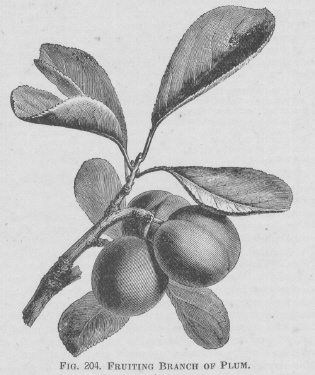
The origin of many of our cultivated Plums is quite unknown; several of them, no doubt, have sprung from Prunus domestica, but, in all probability, other wild types have contributed. According to some authorities, the Sloe, or Blackthorn (P. spinosa), the Bullace (P. insititia), and the Wild Plum (P. domestica) are merely sub-species, and are united into one species under the name of P. communis, which is found in a wild state throughout Europe and West Africa. "The Sloe is confined to Europe, the Bullace extends to North Africa and the Himalaya" (Hooker). The Plum is a deciduous tree, attaining a height of from 15ft. to 20ft., and forming a moderately spreading head. From the amount of information which is at command regarding Plums, it would seem that various sorts were introduced into this country from France and Italy during the fifteenth century. The fruit has, therefore, been grown from a remote period, and the date when its cultivation first began is very uncertain. Plums are the hardiest of stone-fruits, and the crop is one of the most remunerative, in all favourable seasons, from market gardens and cultivated orchards. In private establishments, the fruits of all the best varieties are much valued for dessert, and those of the coarser and less highly-flavoured ones prove invaluable for cooking and preserving. For the latter purpose, hundreds of tons of the fruit are, in a favourable season, sent from the surrounding market gardens to London alone. The crop is therefore one of the most important, both for market and for private consumption. A fruiting branch is represented at Fig. 204.
Propagation. Budding and grafting are the chief methods by which varieties of Plums are propagated. Young trees may also be readily raised from seeds, and from suckers. Suckers are only occasionally used, and should never be employed as stocks. The Plum is naturally inclined to spread its roots, and throw up numerous suckers; and, if these are replanted, or used as stocks, the tendency to be constantly throwing up other shoots from the base is afterwards apparent. Some sorts reproduce themselves nearly true from seeds, as, for instance, the Green Gage; but seedlings generally vary more or less from the original, and it is, therefore, best not to depend on this mode of propagation beyond the raising of seedlings as stocks, except, perhaps, with Damsons, which may be raised from the stones. Plum stocks are required in large numbers for Peaches, Nectarines, and Apricots, as well as for Plums. The seeds may be sown when taken from the fruit; or they may be stratified, and sown in autumn or early spring. In the autumn following, the stocks will be ready for transplanting into nursery lines; preparatory to budding or grafting when large enough. For Plum stocks, the varieties best suited are the Damson, Mussel, St. Julien, and White Pear. The Mussel answers well as a stock for standard trees. Shield-budding in July and August, and ordinary cleft-grafting in March, or just before the sap ceases to flow in September, are the most successful methods to adopt. In budding, it is most important that wood, and not blossom, buds be inserted; and, in grafting, wood-buds, which are sometimes very scarce on scions, must be carefully preserved. Stocks for grafting must be prepared by being headed-down early in the year, before growth begins; and the scions should be cut at the same time, or even earlier, and laid with their ends in the ground. Attention must specially be given to this particular, or a successful union of the parts at grafting-time will be out of the question. Standard Plums may be worked near the ground, and the scion allowed to make its own stem, or at the proper height, according as the variety may be a vigorous or a weak-growing one. New varieties are raised from seeds.
Soil and Situation. Plum-trees succeed in any fairly good loamy soil, provided the subsoil is open and properly drained. The ground should be well trenched previous to planting, although the roots of Plums are naturally disposed nearer to the surface than those of Apples and Pears. In a very rich soil, the growths usually made are too vigorous to become well ripened; in that which is moderately light, yet sufficiently moist, the trees succeed and produce the best-flavoured fruits. Respecting flavour, however, much depends on the amount of sunshine and light available. In market gardens, where the trees under notice are very extensively grown, they are planted in lines ranging from 15ft. to 20ft. apart, and the intervening spaces are occupied with Gooseberries and Currants. Standards and half-standards are generally favoured; but dwarf and bush-trees are also extensively planted in market as well as in private gardens. All the finer dessert sorts should, if possible, be favoured with wall space in private establishments, as their fruits are invariably of so much importance, and the crop is more certain with the protection of a wall than when the trees are fully exposed. A temporary covering, while the blossoms are open, may also be readily applied, should frost or unfavourable weather prevail. In a southern aspect, the fruits attain their highest flavour; but this position is usually required for Peaches and other trees that are less hardy than Plums, and the latter are relegated to the walls with an eastern or western exposure--positions in which they succeed admirably. As already noted, the roots of Plum-trees run near the surface, and especially is this the case when the soil is left undug. All the available border space is invariably required for numerous crops; and if a width of about 2ft. or 3ft. is left untouched next the wall, the other portion may be dug and cropped annually. The digging-over of this portion should not, however, be left longer than one season without being attended to, or the young roots will ascend, and the work cannot be performed without cutting them off.
Pruning, Training, &c. For Plum-trees against walls, the fan method of training is the best, as one or other of the branches is liable to die off occasionally, and its place can be more readily occupied by those next situated than would be possible with another method, as, for instance, horizontal training. For the open ground, standards, half-standards, pyramids, and bush trees, are available, as already stated. Mr. Rivers states that "Plums form most fertile oblique cordons; no matter how the shoots are pinched, they will produce large crops of remarkably fine fruit, and continue to bear in spite of excessive pinching, forming cylinders of fruit; their worst tendency is to excessive growth, which must be checked by root-pruning." Plums are admirably adapted for culture in pots: late sorts, which can only be ripened with difficulty outside, arrive at great perfection under glass. See Orchard House. The fruit of the Plum is produced on small spurs, which form in great quantities on the ends and along the sides of bearing shoots of from one to three years' growth--that is, supposing they are well ripened. In pruning, therefore, these spurs should be carefully preserved, and also a sufficient quantity of young wood kept annually to replace any which becomes old and unfruitful. The main branches on a fan-trained tree should be allowed plenty of space, and any irregular or misplaced ones removed, after provision can be made for filling their places with others of a better description. Summer pruning consists in shortening back the young shoots, treating the upper part of the tree first, to encourage the production of blossom-buds on the short spurs left. At the winter pruning, weak and un-ripened wood form the chief parts to be cut away. If Plum-trees become unfruitful, because of vigorous wood-growth, they should be lifted early in autumn, and root-pruned. It has been recommended that pyramid trees should be lifted and replanted, if necessary, every two years; this operation gives them a proper check, and greatly increases their fertility. Standard Plum-trees in the open ground, when once they are properly started, require but little pruning or training, unless the heads become too much crowded, when the weak wood should be cut out. If vigorous shoots appear, as they often will, in the centre of a young tree, they should be pinched at an early stage, in order to check the sap. Such shoots seldom ripen properly on any fruit-tree, and their production should not be encouraged. Sometimes excessive vigour may be materially checked by simply clipping off a quantity of the leaves, on shoots so disposed, across the centre, with a view to arresting the flow of sap to the leaves, and thus indirectly affecting its progress to unduly enlarge the shoot. Plums intended for dessert should be allowed to hang until they are nearly ready to drop from the tree; when only required for cooking, it is not of so much importance. The bloom on choice fruits should be carefully preserved, by handling only the stem when gathering them, and placing single layers in a shallow basket or box for transmitting to a cool fruit-room. Fruits with their bloom uninjured by rubbing are better able to withstand atmospheric changes than are those roughly handled, the bloom being their natural protection. Some few sorts, amongst which Coe's Golden Drop is a well-known example, will keep good for dessert a long time after being gathered, if wrapped in paper, and stood in a dry, airy place: these fruits attain their highest flavour when they become partially shrivelled. Plums and Damsons for cooking may be sent, before they get too ripe, very long distances, by being packed closely in a box, with a little soft chaff shaken in to fill up interstices between them. That cut from Oat straw is the best.
Sorts. The following list includes most of the best varieties of Plums, both for dessert and kitchen use, which ripen from the early until the latter part of the season. There are many others in cultivation which it is thought unnecessary to refer to here, but it is not unlikely that some are omitted which should have had their merits recognised. Plenty are, however, enumerated for all purposes.
Angelina Burdett. Fruit round, of medium size; skin dark purple, thickly covered with brown spots and a blue bloom; flesh very rich and juicy. A good dessert Plum, which ripens early in September, and may be kept until it shrivels, when the flavour is very rich.
Autumn Compote (Rivers'). Fruit oval, very large, bright red, and handsome, of first-rate quality for preserving. End of September. A valuable, late culinary variety.
Belgian Purple. Fruit medium or large, roundish, deep purple; flesh juicy and richly flavoured. Middle of August. Dessert or kitchen. Belle de Septembre. Fruit large and handsome, roundish-oval, reddish-purple, covered with yellow spots and a thin bloom. Early in October. An excellent kitchen sort. The tree is an enormous bearer.
Blue Imperatrice. Fruit medium, roundish-ovate, deep purple, with thick, blue bloom; flesh rich, but not very juicy. October. An excellent variety for preserving and for dessert; when allowed to hang, the fruits become very richly flavoured. The tree is an excellent bearer; is should be grown against a wall.
Bryanston Gage. Fruit large, round, green, blotched with red; flesh juicy and rich. September. A large and excellent variety of GREEN GAGE, which ripens about a fortnight later than the last-named. Dessert.
Coe's Golden Drop. Fruit very large, oval, pale yellow, with numerous dark red spots; flesh juicy, rich, and most delicious when well ripened. End of September. One of the finest late Plums for dessert or preserving. The tree deserves a wall, but bears well in the open; it is also well adapted for pot culture.
Cooper's Large. Fruit medium or large, oval, dark purple next the sun, with numerous brown dots; flesh juicy, and of rich flavour. End of September and beginning of October. Dessert
De Montfort. Fruit medium sized, roundish, dark purp'e, with thin, blue bloom; flesh juicy, rich, and excellent, particularly when the fruit shrivels. Middle of August. A first-rate dessert Plum which resembles ROYAL HATIVE, but the fruits are larger.
Denniston's Superb. Fruit rather large, nearly round, greenish yellow, marked with a few blotches, and covered with bloom; flesh juicy, rich, and deliciously flavoured. Middle of August. Dessert. The tree is very hardy, and a great bearer.
Diamond. Fruit very large, oval, deep purple; flesh juicy, and briskly flavoured. Middle of September. One of the finest culinary Plums known. Tree vigorous, and an excellent bearer.
Early Favourite (Rivers'). Fruit medium, roundish-oval, dark purple, covered with a thin bloom; flesh juicy, and of excellent flavour. Middle of July. Mr. Rivers states, in his catalogue, that it "requires a wall with south or south-west aspect, and is then the earliest of all early Plums."
Early Rivers (Rivers'). Fruit oval, medium sized, deep purple; flesh juicy, sweet, and brisk. End of July. A good, early Plum and a great bearer; valuable for preserving, because the fruits, though not large, are unusually heavy. This variety is also sometimes called EARLY PROLIFIC.
Goliath. Fruit very large, oblong, reddish-purple. End of August. A large, showy Plum, best suited for culinary purposes and preserving.
Grand Duke (Rivers'). Fruit very large, purple, with blue bloom. Middle of October. Kitchen. A seedling raised by Mr. Rivers from AUTUMN COMPOTE; a valuable addition to late varieties, either for market or private gardens.
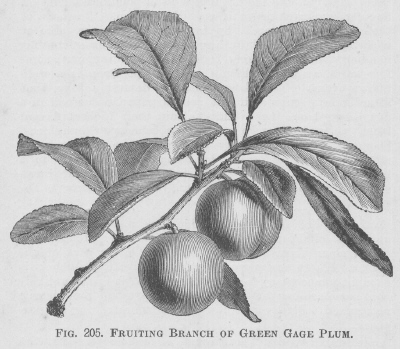
Green Gage. Fruit round, medium sized, yellowish-green, marked, when ripe, with faint crimson sports, and covered with a grey bloom; flesh tender, melting, and of a most delicious flavour. End of August. Well known as being one of the richest-flavoured of all Plums, invaluable for dessert, and amongst the very best for preserving. The tree is hardy, and an excellent bearer; it produces the largest fruits on a wall, but the most richly-flavoured ones are generally those from standards grown in the open ground.
Guthrie's Late Green. Fruit large, round, yellowish-green, covered with a thin bloom; flesh yellow, firm, and very rich. Middle and end of September. A valuable late dessert Plum. The tree is hardy, and very productive.
Huling's Superb. Fruit very large, roundish-oval, yellow; flesh rich, sugary, and highly flavoured. End of August. A fine large dessert Plum. Ickworth Imperatrice. Fruit medium or large, purple; flesh tender, juicy, and of rich flavour. October. An excellent late dessert variety; the fruits, if allowed to hang until they shrivel, attain a high flavour; after being gathered, they may be kept for a long time in a dry place, if wrapped in soft paper.
Imperiale de Milan. Fruit large, oval, dark purple, dotted with yellow; flesh yellowish, juicy, and rich. Beginning of October. Good for dessert and preserving; late.
Jefferson. Fruit large, oval, yellow, mottled with red; flesh firm, juicy, and deliciously flavoured. Beginning of September. One of the finest dessert Plums. The tree is an abundant bearer.
July Green Gage. Fruit similar in size and shape to the GREEN GAGE; it is also of equally good quality, and may be considered a very valuable early variety. End of July.
Kirke's. Fruit medium, round, dark purple, covered with a dense, blue bloom; flesh firm, juicy, very richly flavoured. Middle of September. A delicious dessert Plum, one of the best. The tree is very hardy and productive. Late Green Gage. Fruit smaller than the GREEN GAGE, round, greenish-yellow; flavour rich and good. A good late dessert Plum, which ripens at the beginning of October.
Late Rivers. Fruit medium or small, round, dark purple, almost black; flesh yellow, of very fine flavour. End of October and beginning of November. A valuable, extremely late variety, raised by Mr. Rivers.
Lawrence's Favourite. Fruit large, round, dull yellowish-green, covered with grey bloom; flesh tender, juicy, and rich. Beginning of September. Dessert. The tree is a free grower and bearer; it forms a beautiful pyramid. McLaughlin's. Fruit large, yellow, mottled with red, and covered with a thin bloom; flesh firm, sweet, very juicy and rich. Middle and end of August. A large and delicious dessert Plum of the GREEN GAGE race.
Mirabelle. Fruit very small, oval, yellow, covered with a light bloom, and marked with reddish spots next the sun; flesh deep yellow, firm, briskly flavoured. Middle of August. Valuable for preserving and culinary purposes. The tree often bears its fruit in clusters; it forms a beautiful pyramid, and is well adapted for pot culture.
Mitchelson's. Fruit medium-sized, oval, deep purple, almost black, covered with a thin blue bloom. End of August and beginning of September. A fine Plum for cooking and preserving. The tree is a prodigious bearer.
Orleans. Fruit medium, round, dark red or purple when fully ripe; flesh tender, and briskly flavoured. Middle and end of August. An old, well-known, and highly valued culinary sort, excellent for preserving, but only second-rate for dessert. It is an abundant bearer, and does best against a wall. There are also varieties known as the EARLY and LATE ORLEANS, in reference to their season of ripening.
Oullins Golden. Fruit very large, greenish-yellow, dotted with crimson where exposed, and covered with a delicate bloom; flesh very tender, juicy, and delicious. Beginning and middle of August. An excellent and very handsome early dessert Plum. Tree unusually fertile.
Perdrigon Violet Hatif. Fruit medium, purple, juicy, rich, and excellent. Middle of August. Dessert. Tree very hardy, and bears abundantly.
Pond's Seedling. Fruit very large, oval, bright dark red, with some grey spots, and covered with bluish bloom; flesh juicy and briskly flavoured. Beginning and middle of September. A great bearer, very valuable as a culinary variety.
Prince Engelbert. Fruit very large, oval, deep purple, with a remarkably dense bloom; flesh juicy, with a rich, brisk flavour. End of August, and September. One of the finest culinary Plums, delicious when preserved; it is also good for dessert when highly ripened. The tree is a great bearer.
Prince of Wales. Fruit medium or rather large, round, reddish-purple, with yellow dots and thick bloom; flesh juicy and sweet. Beginning of September. A good culinary sort. The tree is an abundant bearer.
Purple Gage. Fruit medium, round, purple, with pale blue bloom; flesh firm, and of the most delicious flavour. Beginning and middle of September. A dessert Plum of the greatest excellence; if allowed to ripen and shrivel, the fruit becomes a perfect sweetmeat. Tree hardy and productive; succeeds as a standard, and also against a wall.
Red Magnum Bonum. Fruit very large, oval, deep red; flesh firm, and briskly-flavoured. Middle of September. A very old culinary variety; it succeeds well as a standard.
Reine Claude de Bavay. Fruit large, round, greenish-yellow, mottled with green, and covered with a delicate bloom; flesh tender, rich and sugary. End of September and beginning of October. Dessert. A large, valuable variety of the GREEN GAGE race.
Royale de Tours. Fruit large, light purple, with small, yellow dots and blue bloom; flesh very juicy, and of rich flavour. Middle of August. Excellent either for dessert or preserving.
Royale Hative. Fruit medium-sized, round, light purple, with blue bloom; flesh yellow, melting, exceedingly rich. End of July. A good early dessert Plum.
Sultan (Rivers'). Fruit medium or large, round, deep red, with a thick bloom; flavour brisk and pleasant. Middle of August. A very productive and excellent culinary Plum, raised by Mr. Rivers from BELLE DE SEPTEMBRE. The Czar (Rivers'). Fruit very large, oval, dark purple, almost black when ripe; flesh tender, juicy, and agreeably flavoured. End of July and beginning of August. A very valuable early culinary Plum, raised by Mr. Rivers from PRINCE ENGELBERT, fertilised by another variety. The tree is hardy, robust, and very productive, and the fruits are not liable to crack with the rain.
Transparent Gage. Fruit large, round, much flattened, greenish-yellow, marbled with red; flesh transparent, rich, juicy, and of high excellence. Beginning and middle of September. One of the most delicious Plums for dessert, and considered the finest of the Gage tribe. Two seedlings have been raised by Mr. Rivers from this variety, and named EARLY TRANSPARENT and LATE TRANSPARENT GAGE., The first-named is said to ripen ten days before, and the other ten days after, the typical sort. "The two seedlings and the parent differ entirely in their growth, but are almost identical in the quality and size of the fruit. The EARLY TRANSPARENT is upright and compact, but vigorous; the LATE TRANSPARENT is dwarf and compressed" (Rivers).
Victoria. Fruit large, roundish-oval, bright red, covered with a thin bloom; flesh very juicy and sweet. September. A well-known and first-rate culinary Plum, very extensively cultivated in market gardens, and worthy of a place in every collection. The tree is a most abundant bearer, both as a standard and against a wall.
Washington. Fruit large and handsome, deep yellow when ripe, marked with crimson, and covered with pale bluish bloom; flesh firm, rich, and sugary. Middle of September. One of the best culinary Plums, also sometimes used for dessert.
White Magnum Bonum. Fruit very large, oval, deep yellow, with thin, white bloom; flesh firm, rather coarse, sub-acid. September. A very large and valuable variety for cooking and preserving; it is usually known as the EGG PLUM. The tree is vigorous, and generally bears well. Winesour. Fruit rather small, oval, dark purple; flesh juicy, sub-acid. Middle of September. A very valuable variety for preserving and for culinary purposes; much esteemed in some districts, but not so good in others.
Woolston Black. Fruit medium, round, deep purple, with blue bloom; flesh melting and richly flavoured, particularly after becoming shrivelled. Beginning of September. Dessert.
Of the Bullace (Prunus insititia) there are several varieties. The species grows wild in many parts of Britain, and the fruits are much like Damsons, except that they are round, instead of being oval. They are used for cooking and preserving. The sorts best known are named respectively BLACK, ESSEX, ROYAL, and WHITE. The trees are usually enormous bearers. Amongst Damsons the following are recommended:
Common. Fruit small, roundish-oval, dark purple or nearly black. Middle and end of September. A well-known variety, much esteemed for preserving.
Crittenden's, or Cluster. Fruit larger than other varieties of Damson, roundish-oval, black, with a thin bloom. Middle of September. This is considered the best sort of Damson; it was raised in Kent, and has recently been brought into prominent notice because of its extraordinary fertility. The tree forms a handsome pyramid.
Prune. Fruit oval, larger than the COMMON Damson, and considered better for preserving, but the tree is not generally so productive. September. Much esteemed in the North.
Rivers' Early. A seedling raised by Mr. Rivers from ST. ETIENNE PLUM. Early in August. It is very early, and a valuable addition.
White. Fruit oval, pale yellow, with a thin bloom; flesh yellow, agreeably acid. End of September.
FUNGI. The Fungi parasitic on Plums need not be greatly dilated upon, since few of them do much injury to any part of the tree. A considerable number of Pyrenomycetes have been found growing upon the dead branches; but they are not known to be injurious to the living plants, with a few exceptions mentioned below, and even these are scarcely dangerous, except under conditions that specially favour their growth. The leaves are sometimes thinly covered with a white coating, composed of filaments of the nature of those described under Oidium. After a time, there become visible, scattered over this coating, small, round, black particles, like grains of gunpowder. These, by the help of the microscope, are seen to be perithecia, in each of which is inclosed a single ascus, and in this lie eight colourless, oblong, very minute spores, which escape by the walls of the perithecium bursting when ripe. The latter body is provided on the top with from three to seven upright, stiff, slender outgrowths, each of which bifurcates four or five times near the tip. This Fungus has received the names Podosphaera Kunzei, and P. tridactyla. The latter name is now generally adopted. Reproduction is effected both by the spores described above, and by means of conidia, developed as described under Oidium. Through not uncommon, the Fungus is seldom very hurtful to Plum-trees; but, where desirable to check its growth, this may be effected by dusting the leaves with flowers of sulphur, or by syringing them with a mixture prepared from sulphur and quicklime, as recommended under Mildew, or with potassium sulphide solution (see Oidium).
Another Fungus parasitic on Plums, and named Exoascus Pruni, gives rise to a peculiar condition of the fruit, known as "Bladder Plums." The presence of this Fungus is easily recognised by the great increase in the size of the young fruits, as compared with healthy fruits of the same age, by their elongated, pointed form, by the greyish-green bloom on their surface, and by the diseased fruits being hollow, like bladders, with frequently barely a vestige of the seed. After a short time, these enlarged fruits turn to a dirty-yellow colour, fade, and shrivel up. The mycelium of this Fungus lives all the year round in the soft bast of the twigs, which often show distinct traces of its presence. From these it extends into the ovaries of the flowers, along the woody bundles, and thence spreads throughout the tissues, and comes to lie close below the skin of the ovary. Branches grow out from the mycelium, burst through the skin, and stand erect, side by side, over the surface. Each reaches a length of rather over 1/500in., with a breadth of about a quarter as much, and is supported on an oblong stalk-cell, about one-fourth of its length, which rests on the surface of the epidermis, not pressing between its cells. Each of the longer cells is an ascus, and has inclosed in it eight round spores, which are set free by the bursting of the ascus, about the time the fruit withers. The spores are scattered far and wide by the wind, and such as fall into favourable situations propagate the disease anew. The only remedy likely to prove useful is to cut off, and burn without delay, the fruits and branches that show traces of the Fungus.
The leaves of Plum-trees frequently show thickened. fleshy, orange-red spots, of irregularly-rounded outline, These are the work of a Fungus known as Polystigma rubrum. A section through one of these spots will probably pass through one or more flask-shaped spaces, some of which are perithecia, inclosing numerous asci, in each of which are eight minute, oval, colourless spores. Other of the flask-shaped bodies are pycnidia of the same Fungus; and in them lie numerous slender, curved, rod-like, colourless sporidia, each formed on the tip of a small stalk. Both kinds of flasks have the walls in-separable from the surrounding tissues, and both open by narrow mouths on the lower surface of the spots. On examination, with the microscope, of a thin slice from the leaf, the tissues are found crammed with the filaments of the Fungus, and much altered. However, the spots are rarely so numerous as to do much harm to the leaves, though they take nourishment from them, and prevent the proper fulfilment of their functions. This Fungus is widely spread, in Europe, Asia, and North America. Where the Fungus is doing harm to Plum-trees, it will be well to collect and burn the diseased leaves, and also those which have fallen. Sorauer recommends digging the latter into the ground in early spring, before the young leaves burst from the buds, to prevent risk of their being infected. As regards the prevention of diseases of Plum-trees, it is very desirable to remove from their neighbourhood Sloe-bushes and Bird Cherries, since the disease-producing insects and Fungi live on these species as well as on the Plum.
Plums frequently suffer badly from the action of Oidium fructigenum, for a full account of which, including remedies, see Pear (FUNGI). The Fungus sometimes covers the entire surface of the fruits, rendering them quite white, and causing them to dry up.
INSECT PESTS. These are not very hurtful in the British Islands except, it may be, in a few cases, under peculiar conditions. The roots are liable to be cut and eaten by Cockchafers, &c. Certain Bark Beetles injure the stems, especially of trees that are not otherwise quite healthy. Some Weevils also feed, as larvae, in winding galleries below the bark of diseased or weakly trees; among these, one of the more prominent is Magdalinus Pruni, a beetle about 1/12in to 1/7in. long, with black body and dull red antennae. The branches are attacked at times by Weevils of the genus Rhynchites. R. Alliariae, which is perhaps the most injurious species, is from 1/8in to 1/5in. long, and is blue, with coarsely-striated wing-cases, dusky antennae, and a moderately long beak. The female lays her eggs on the buds near the end of the young shoots, in spring, and then gnaws the branch a little below the tip. The part beyond the notch hangs down and withers, and is thereby rendered suitable for nourishing the larvae, which usually feed in the pith. This Weevil is at times very hurtful among young trees on the Continent. The perfect insects of this, and of certain allied species, do considerable harm by gnawing the young buds and leaves.
A considerable number of Moths, and one Butterfly, Aporia Crataegi, or the Black-veined White (see Hawthorn Caterpillars), feed, as larvae, upon Plum leaves; but most of those that call for notice are more hurtful to other trees, and will be found treated of under the following headings: Lackey Moth, Leaf-rollers, Li-paris, Moths, Tortricina, and Winter Moths. The larvae of certain species of Sawflies also prove destructive by devouring the leaves. The worst of these is Eriocampa limacina, the larvae of which feed on a great variety of cultivated trees and shrubs, and go by the name of Slugworms, because of their form, of their sluggish habits, and of a slimy excretion that covers the body. For an account of these larvae, and of the means to be used to destroy them, see Slugworms. The young branches and leaves are invaded, at times, by colonies of Aphides or Green Flies. Phorodon Humuli, var. Mahaleb, causes the young leaves at the tips of the twigs to become rather fleshy and wrinkled, the insects living in large colonies on their lower surface. Myzus Persicae has very similar habits; and one or two other species are not rare on Plum-trees.
The flowers and fruits are attacked chiefly by the Plum Weevil (Rhynchites cupreus) and the Plum Tortrix (Carpocapsa funebrana). The larvae of both these insects bore into the unripe fruit, and, by causing its premature fall, materially injure the crop. The Weevil is rather under 1/5in. long, bronze or coppery in colour, with a thin coating of scattered grey hairs, and a black beak and limbs. The wing-cases are deeply marked with dots or pittings. When the fruit is scarcely half grown, the female lays her eggs on it, and the larvae penetrate into it. The moth (Carpocapsa funebrana) is seldom seen, but it is very common, in the larval state, in unripe Plums. The fore wings are grey, clouded with darker shades; at the hinder angle of each is a spot of ash-grey, with a faint metallic lustre, surrounded by an indistinct border, in which lies a row of black dots. The spread of wings is rather over 1/2in. The larvae are reddish above, paler below, with the head brown-black. There are a few soft hairs on the body. The larvae of both beetle and moth feed in the Plums during early autumn, and, when the fruits fall, the larvae crawl out, burrow into the ground, and there become pupae, to emerge as perfect insects in the following spring.
Remedies. For the means to be adopted against insects on the roots, see Cockchafer and Mole Cricket; and for those against Bark Beetles, see Scolytidae. The leaf-feeding beetles and larvae of moths are best got rid of by shaking or jarring the branches over anything laid or held below, and collecting and killing the insects. In some cases, hand-picking is the most satisfactory method. The Slugworms or Sawfly larvae cannot be got rid of by this method, but require special treatment, for which see Slugworms. Aphides are best combated by the removal of all surplus young twigs, especially if attacked by the Aphides, and by applications syringed upwards below the leaves. See Aphides. The species that feed in the fruits are best kept under by collecting the prematurely fallen fruits, without delay, and burning them, or giving them to pigs.
Following up the above account of the insect pests on the Plum, it may be mentioned that Mite Galls, of the genus Phytoptus (see Mites), produce galls of two or three kinds on the leaves of the Plum, as well as on the Sloe and the Bird Cherry. Of these, the more conspicuous are Erineum Padi, in the form of irregular patches of velvety, close-set hairs, at first pale, but becoming rusty-brown, on the lower surface of the leaf; also outgrowths of a rounded or bullet-like form, and half a line to two lines long, and green or red, scattered over the surface of the leaf (Cephaloneon molle), or near the margins (C. hypocrateriforme and C. confluens). They also, at times, produce small galls in the bark of young branches (Cecidoptes Pruni). However, none of these mite-galls seriously affect the welfare of the tree, though rendering it unsightly. If from any cause it seems desirable to check the increase of the galls, hand-picking is the only remedy likely to be of use.
The fruits of the Plum-tree are very much injured, in the United States of America and in Canada, by the larvae of two kinds of Weevils, both living in the fruit. Though neither has proved hurtful to Plums in England, the habits of the larvae, and their abode in the fruits, render their introduction not unlikely; hence, the insects and the kind of injury done by them, are here shortly described. The Plum Curculio (Conotrachelus nenuphar) is about 1/5in. long, small, rough, and blackish, and has on each wing-case, in the middle, a black, shining hump, and behind this a clay-yellow band, variegated with white spots in the middle. The female settles on the young fruit, bores a hole in the skin to receive an egg, drops it in, and then makes a crescent-shaped cut about half round it. She repeats this process on one fruit after another. The larva hatches in a few days, and at once eats into the fruit, till it arrives at the stone, near which it feeds. It reaches its full size in from three to five weeks. The fruit becomes gummy, and falls prematurely and the larva remains, till it is full grown, in the fallen fruit; it then eats its way out, bores into the ground, changes into a pupa, and the perfect insect emerges in from three to six weeks. The beetles hybernate under bark and in other retreats. This insect often destroys a large part of the Plum and Cherry harvest, and it also feeds in other stone fruits. The best remedy is to jar the beetles into an inverted umbrella, or on to sheets spread below the tree, and to collect and destroy the fallen fruits without delay, or to turn pigs into the orchards to feed on them. Rubbish should not be left for shelter to beetles. The second species (Coccotorus scutellaris) is popularly called the Plum Gouger. It is very common in the valley of the Mississippi, but has not yet been found in the Eastern States. It is said to be less hurtful than the former species, which is fortunate, as its habits render it the more likely to be brought to Europe. In general appearance, it is somewhat like the Plum Curculio, but differs as follows: It is nearly 1/3in. long; the head and wing-cases are brown, with a leaden-grey tint; and the wing-cases are variegated irregularly with black and pale spots, and bear no humps; the thorax and legs are ochre-yellow; and the snout cannot be folded below the breast. The beetles appear in spring. The female bores holes in the young Plums, and pushes an egg into each, but she makes no cuts around them. The larva hatches in a few days, and bores at once to the stone, which it pierces while still soft. The larva feeds, till full grown, on the seed, and then bores a hole for its escape as a beetle; but it remains inside the stone, and there becomes a pupa. The beetle emerges usually in August or September, and hybernates in the perfect state. It feeds, in spring, on young Plums, into which it bores its beak. The plums exude gum, and become knotty and useless. This beetle is also known as Anthonomus prunicida. The remedies recommended are jarring the trees, to shake down the beetles, as with the Plum Curculio, and collecting and destroying fallen fruits. The beetles are active, and take flight readily; hence, jarring is less successful than with the former species.