Plumbago
(the old Latin name, used by Pliny, from plumbum, lead; the plant is said by him to be efficacious in curing the lead disease). Leadwort. SYN. Thela. Including Plumbagella. ORD. Plumbagineae. A genus comprising about half-a-score species of stove, greenhouse, or hardy perennial herbs, sometimes shrubby, rarely annuals (one species leafless), inhabiting the warmer regions of the globe. Flowers blue, rose-colour, violet, or white, spicate at the apices of the branches; calyx tubular, five-fid; corolla salver-shaped, the limb spreading, five-lobed. Leaves usually alternate, auriculate-amplexicaul, or dilated at base into an amplexicaul petiole, or naked and toothed. The tender sorts flower best in a moderately warm house, and are well adapted for growing against a wall. The most suitable compost is one of good fibrous loam and sand, and a little peat. They do very well when planted out in the borders of a warm conservatory, or in a warm greenhouse. Propagated by the rooted shoots from the base of the plants; or by nearly ripe cuttings, which root freely in a gentle bottom heat. The annual species are easily raised from seeds, sown in the open border, in spring. The majority of the species are, or have been, cultivated in our gardens. P. capensis is admirably adapted for training up a greenhouse rafter or pillar. It should be cut back hard after flowering, and allowed to rest through the winter by being kept rather dry. The beautiful pale blue flowers are produced in the greatest profusion on the shoots of the current year. This plant also succeeds in a warmer temperature, and, if grown in two or three positions differently affected in this respect, the flowering season collectively may be prolonged by the plants in one house succeeding those in the other. P. rosea is a fine winter-flowering plant, requiring more heat than P. capensis, except in the summer. It is adapted for pot culture, or for planting in a stove. The hardy perennial species thrive in ordinary soil, and may be increased by divisions.
P. capensis (Cape of Good Hope).* fl. pale blue, disposed in terminal, sub-secund, short, approximating spikes; corolla tube thrice as long as the calyx. Summer and autumn. l. oblong or oblong-spathulate, obtuse, mucro-nulate, entire. Stem angularly striate. h. 2ft. Cape of Good Hope, 1818. A stove or green-house, climbing or decumbent shrub, sometimes employed in bedding. (B. M. 2110; B. R. 417.) P. coerulea (blue). fl. blue, about 1/2in. long, disposed in loose, terminal spikes; corolla half as long again as the calyx tube, dilated above. Summer. l. ovate-oblong, sub-rhomboid, attenuated and slightly acute at both ends. Stem erect, flexuous, branched. h. 1 1/2ft. South America, 1826. Greenhouse annual. (B. M. 2917, under name of P. rhomboidea.)
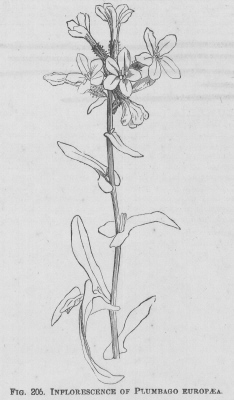
P. europaea (European). fl. violet-rose, spicate and somewhat headed at the tips of the branches; corolla tube nearly twice as long as the calyx, enlarged above. September. l. slightly powdery beneath, slightly gland-toothed at the margin; lowest ones shortly attenuated or sessile; intermediate ones ovate or oblong; uppermost ones lanceolate or linear, acute. Stem erect, much branched. h. 3ft. South Europe, 1596. Hardy herbaceous perennial.(B. M. 2139; S. F. G. 191.)
P. Larpentae (Lady Larpent's).* fl. violet, in close, terminal heads; sepals and bracts shining, ciliated, destitute of glands. October. l. obovate, acute, tapering to the base, minutely scaly, finely serrated, fringed. Stems slender, zigzag, scaly, hairy. h. 1ft. Shanghai, 1846. Hardy perennial. (G. C. 1847, 732.) The correct name of this plant is Ceratostigma plumbaginoides.
P. micrantha (small-flowered). fl. white, disposed in terminal or axillary, shortly pedunculate spikes. July. l., lower ones oblong, slightly toothed, attenuated into very short, amplexicaul petioles; the rest sessile, oblong-lanceolate, acuminate, cordateauriculate at the base. Stem angular-sucate, erect, or diffuse and much branched. h. 2ft. Siberia, &c., 1829. Hardy annual.
P. occidentalis (Western). A synonym of P. scandens.
P. pulchella (pretty). fl. bluish-violet, scarcely 1/2in. long, disposed in loose, terminal, elongated spikes; corolla tube scarcely half as long again as calyx. Summer. l. ovate-oblong, acuminate, attenuated at base into very short, amplexicaul petioles, Stem slender, erect, branched, striated. h. 2ft. to 3ft. Mexico. Stove sub-shrub. (L. B. C. 1536, under name of P. rhomboidea.) P. rosea (rose).* fl. rosy-scarlet, 1 1/2in. to 2in. long, axillary or disposed in long, terminal spikes; calyx slightly-reddish; corolla tube slender, four times as long as the calyx. July. l. large, oblong, attenuated and slightly obtuse above, shortly cuneate at base, and attenuated into very short, amplexicaul, exauriculate petioles. Stem erect, terete, slender, striated, simple beneath, branched above. h. 2ft. East Indies, 1777. Stove perennial. (B. M. 230.) coccinea is a splendid variety, with larger, more brightly-coloured flowers. (B. M. 5363.)
P. scandens (climbing). Devil's Herb; Toothwort. fl. white, disposed in loose, terminal, elongated spikes; corolla tube twice as long as the calyx. July. l. oblong or oblong-lanceolate, acuminate, on short petioles, amplexicaul at base. Stem somewhat climbing, slender, striated, much branched. h. 3ft. West Indies, 1699. Stove shrub. SYN. P. occidentalis.
P. zeylanica (Cingalese). fl. white, disposed in elongated, rather dense spikes; corolla tube twice as long as the calyx. June. l. ovate or oblong, slightly acute, very shortly and abruptly attenuated into an amplexicaul, short petiole. Stem somewhat climbing, angular-striate, much branched. h. 1 1/2ft. East Indies, 1731. Stove shrub. (B. R. 1846, 23.)