Plumeria
(named in honour of Charles Plumier, 1646-1706, a French traveller and writer on botany). SYN. Himatanthus. ORD. Apocynaceae. A rather large genus (about forty species have been described) of glabrous or pubescent stove trees, with thickish branches, natives of tropical America. Flowers white, yellowish, or rose-purple, large, in terminal cymes. Leaves alternate, often on long petioles, penniveined. The species thrive best in a compost of sandy loam and fibry peat. Propagated, in spring, by cuttings of ripe shots, inserted in sand, under a handlight. Very few species are now in cultivation.
P. acuminata (acuminate). A synonym of P. acutifolia. P. acutifolia (pointed-leaved).* fl. pink outside and white within, very fragrant, in compound, spreading cymes. June to September. l. scattered, lanceolate, acuminated, glabrous, flat. h. 20ft. Naturalised in India, &c., 1790. (B. M. 3952; B. R. 114.) SYN. P. acuminata.
P. bicolor (two-coloured). fl. white, with a yellow throat, a very long, thick, incurved tube, and obovate-oblong, oblique segments; peduncles thickened at top, corymbose. July. l. lanceolate-oblong, with revolute edges, acuminated, 1ft. long. h. 15ft. West Indies, 1733. (B. R. 480.)
P. Jamesoni (Jameson's). fl., corolla large, hypocrateriform; tube long, yellow, deeply tinged with red; limb of five rich yellow segments; peduncles terminal, 9in. to 12in. long; pedicels red. July. l. mostly confined to the tips of the branches, large, broadly-oblong, on rather long, nearly terete petioles (furrowed on the upper side), attenuated at base, acuminated at the extremity. h. 4ft. Guayaquil. (B. M. 4751.)
P. Kerii (Ker's). A synonym of P. tricolor.
P. Lambertiana (Lambert's). fl. white, with a yellow throat, and broad-rhomboid, obtuse segments. May to August. l. oblong, acuminated, flat. h. 10ft. Mexico, 1824. This differs from P. tricolor in having larger, inodorous flowers, and in the segments being broader and rounder. (B.R. 1378.)
P. lutea (yellow-flowered).* fl. very sweet-scented; corolla 4in. in diameter; lobes very pale pink, with a broad, pale golden-yellow base; tube hairy within; cymes terminal, sub-umbellate, about as long as the leaves. June. l. crowded at the ends of the branches, spreading, 8in. to 18in. long, narrowly oblong-obovate, tapering into the stout petiole, sub-acute. Branches and branchlets stout, scarred. h. 10ft. to 20ft. Peru, 1869. (B. M. 5779.)
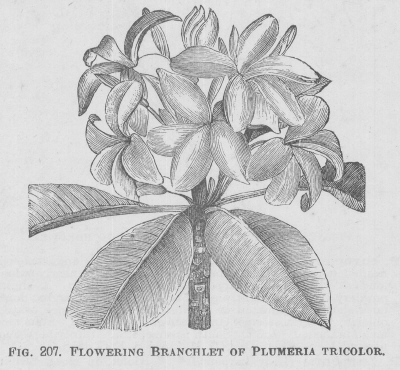
P. rubra (red).* Frangipani-plant. fl. red, crowded in fascicles, with a pilose throat, and obliquely obovate-oblong segments, which are rounded at the apex; peduncles elongated. July. l. obovate-oblong, acute, with flat edges. h. 12ft. to 20ft. Jamaica, 1690. (B. M. 279; B. R. 780.) P. tricolor (three-coloured). fl., corolla with a yellow throat, white above the yellow part, and red round the margins of the segments; peduncles terminal, cymose. July to October. l. obovate-oblong, tapering at both ends, entire. h. 15ft. 1815.(B. R. 510.) SYN. P. Kerii.
P. tuberculata (warty-stemmed). fl. white, scentless; peduncles axillary, much shorter than the leaves, many-flowered. August. l. coriaceous, narrow-oblong, obtuse, tapering a little way into the petioles, downy beneath. Branches tuberculate. h. 6ft. St. Domingo, 1812. (L. B. C. 681.)