Plusia
A genus of Noctuidae, the larvae of some of which do considerable injury to cultivated plants. The British species vary between 1 1/4in. and 1 3/4in. in spread of wings, and they almost all possess shining metallic, silvery, or golden spots and markings on the rather pointed front wings. The thorax and abdomen bear crests of hair-like scales. The moths generally fly during the day; when at rest, the wings are held like a roof over the hinder part of the body. The larvae are rather slender, tapering markedly towards the head, which is small; they have six true legs in front, but only six prolegs, being the last three pairs of the five usually present in larvae of Noctuae. Owing to the absence of the front prolegs, they "loop" in walking, like Geometer larvae. When full-fed, they spin loose cocoons among dead leaves, or on the food-plants, and in these become black pupae. Two, or even more, broods may be hatched in a year.
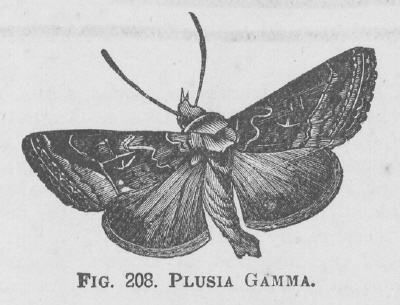
The larvae of several species feed on Groundsel, Nettles, and other low weeds, and may at times devour cultivated plants along with these; but the only species that is really dangerous to garden and field produce is P. Gamma, the too well-known Silver Y, or Gamma Moth. The larva of the moth is, indeed, one of the worst pests at times, alike in the garden and in the field. The moths may be seen, from June to the end of October in some years, flying in the bright sunshine, and not less in the twilight; nor do they cease to fly even at night. Frequently, they swarm in myriads in hay-fields, among Turnips, in gardens, and, in fact, everywhere. Some idea of the form, size, and markings, may be obtained from Fig. 208, in which, however, the characteristic silvery mark on the front wings, like the Greek letter gamma (y), or the letter y, is not well shown. It is plainest in the left wing near the middle. The front wings are grey or violet-grey, marbled with warm brown, which is darkest in a lozenge-shaped patch on the inner margin; in this patch lies the silvery y. The hind wings have a broad, dark band along the margin, and the basal space is pale grey. The eggs are laid on the lower surface of the leaves. The larvae are thickest at the twelfth segment, tapering forwards. They are bright green, with bluish-green dorsal line, bordered along each side with a white line; and there are four more narrow white lines and a yellow line on each side, near the spiracles or breathing pores. There are a good many scattered, fine bristles on the body. The larvae rest with the back arched, and move by looping. They feed upon all kinds of herbs, including.
Nettles and other weeds, as well as upon many low cultivated plants, such as Cabbages, Beets, Peas, Beans, &c. The best methods of effectively lessening their numbers are to destroy the larvae, either by hand-picking, or by sweeping them, or beating them, off their food, and destroying them at once; or ducks and hens may be turned in to feed on them. Dusting the plants with soot or caustic lime is also recommended, though not very safe for delicate plants. Among the points to be specially attended to is the removal of weeds from gardens and field crops alike, as they afford shelter for the insects.