Pollination
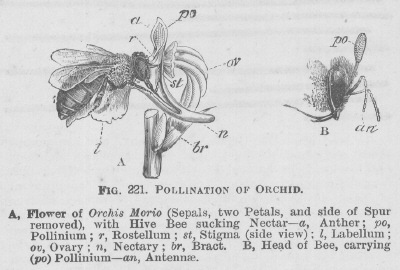
The dusting of the stigma of a flower with pollen grains, as distinguished from fertilisation, or the action of the pollen upon the ovule, which gives rise to the development of the seed containing an embryo. Pollination must precede fertilisation. It is effected in very different ways in different flowers, and the agents by which it is effected are manifold. The more important of these are here indicated; but the account must be brief, though volumes have been written upon the subject of Pollination. Full information of the present state of our knowledge of the matter will be found in Dr. H. Muller's "Fertilisation of Flowers," translated by Prof. W. D' A. Thompson; Darwin's "Fertilisation of Orchids;" and Kerner's "Flowers and their Unbidden Guests," translated by Dr. Ogle. Sir John Lubbock's "British Wild Flowers in Relation to Insects" contains much interesting information regarding the subjects indicated in the title. There are also many shorter works and articles upon Pollination published in most European languages of late years. A list of these, compiled by Prof. Thompson, is included in Muller's work referred to above, and includes almost all published up to 1883. The method of Pollination varies with the structure of the flower. In those plants in which the pollen and the ovules of the same flower ripen simultaneously, the pollen may be transferred directly from the anthers to the stigma either by the parts lying in contact, or by their lying in such a position that the pollen falls from the anthers upon the stigma. In cleistogamous flowers, or those (e.g., in Sweet Violets, Wood Sorrel) which, in certain plants, are formed in summer and autumn, and never open, but yet are often more productive of seeds than the conspicuous flowers, the pollen, while in the anthers, pushes pollen tubes to the stigma, which is thus Pollinated. In by far the greater number of hermaphrodite flowers, even of those in which the pollen and the stigma mature simultaneously, the pollen is prevented from falling upon or reaching the stigma by the arrangement of the parts. Necessarily, in those hermaphrodite flowers in which the pollen and the stigma do not mature simultaneously, the pollen cannot reach the stigma of the same flower (see Proterandrous and Proterogynous). In all these cases, the pollen must be transferred from the anthers to the stigmas by some agency from outside the flower; and this must be so yet more evidently in the case of unisexual flowers, whether male and female flowers be on the same plant or on different ones. The chief agents that effect Pollination in British plants are wind and insects. A few plants are adapted for conveyance of pollen by currents of water; and, in the tropics, humming-birds, and certain other birds, probably aid materially. It is unnecessary to refer further to these latter agencies, since they would probably not come under notice in gardening operations at all in the British Islands. Plants suited for fertilisation by wind are usually called "anemophilous," or wind-lovers (from anemos, the wind, and phileo, I love). Those adapted to have the stigmas Pollinated by insects, are called "entomophilous," or insect-lovers (from entomon, an insect, and phileo, I love). They differ from one another so widely that a practised observer can conjecture almost with certainty to which group any flower would belong, though previously quite unacquainted with the flower. The more distinctive characters of the two are as follows: Anemophilous flowers are seldom large or conspicuous individually; the sepals and petals are small, usually regular, often absent, or reduced to one row of small, scaly bodies (e.g., Oak); they seldom contain nectar, or afford other attractions for insect visitors; the stamens have long filaments, with versatile anthers, that turn with the least breath of wind, and thus shed readily the loose, powdery, smooth pollen, which is often produced in very great amount. The grains are very light, and are occasionally (e.g., in Firs) rendered relatively lighter by means of dilatations of the outer coat filled with air. The stigma in such plants is usually furnished at the end (Pellitory) or along the sides (Grasses, &c.) with a quantity of long, simple or branched hairs, which frequently hang out beyond the perianth, or other coverings, e.g., beyond the glumes in Grasses, and entangle the pollen grains when these are carried against them by the wind. Anemophilous plants are often social. Many trees under this group produce their flowers in spring, before the leaves, thus preventing great loss of pollen among the leaves, and favouring Pollination. Entomophilous flowers are the reverse of all this. They are almost always more or less individually conspicuous, with well-developed, coloured petals, and often also coloured sepals, or are crowded in showy masses. They are sometimes regular, but more generally are only bilaterally symmetrical--i.e., they have the two sides alike, as in most Orchids and Leguminosae. They very often have special structures, e.g., spurs or other modifications of parts, to form or to store up nectar. They also possess a pleasant scent, and attract numerous insect visitors by the varied inducements they offer. Some insects (e.g., Bees) also visit flowers to eat or to collect pollen, or to carry it away as food for their young progeny. Whatever the reason of the visit, the insect generally becomes dusted with pollen, which it transfers to the stigma of the next flower of the same species that it enters. The pollen in entomophilous flowers is less abundant than in the anemophilous ones; and the grains very frequently bear ridges or spines, so as to stick more readily to the insect, or they are joined together in groups of four or more, as in Heaths and Orchids The masses are furnished, in Orchids and a few other plants, with special contrivances to favour adhesion to the insect's body, and afterwards to place them in the best position to touch the stigma of the flower next visited (see Orchid Fertilisation). The stamens are usually inclosed in, or are not longer than, the perianth, and the anthers burst in such a way as to let free the pollen in the position most likely to insure its being dusted on to the insect. The stigma or stigmas do not often project beyond the perianth, and are generally small and rounded, or linear, down one side of the style. The surface is usually covered with a layer of erect cells, which secrete a viscid fluid, and in this the pollen grains are caught when any part of an insect's body dusted with them touches the stigmatic surface. The pollen grains absorb nourishment from this fluid, and are stimulated to emit pollen tubes between the cells of the stigma and down the tissues of the style to the ovules, to fertilise them.
Both anemophilous and entomophilous flowers are adapted to secure cross-fertilisation, or "allogamy"; while cleistogamous flowers, and a few others, are adapted for self-fertilisation, or "autogamy." Darwin and others have shown that allogamy secures the largest production of healthy seeds, and that the seedlings are stronger and healthier than when the stigmas are artificially fertilised with pollen from the same flower. The disadvantages of allogamy are that it entails on the plant a greater production of pollen, as by far the greater part never reaches a stigma; and, even with this, many stigmas may remain unpollinated, and no seeds be produced in these flowers. Moreover, such flowers as have been specially adapted for fertilisation by a certain kind, or kinds, of insects, may, in absence of these agents, remain unpollinated and barren. This occurs with certain greenhouse plants, which are fertile if Pollinated artificially, but, without human aid, remain barren, e.g., various Orchids. Under Nectary and Orchid Fertilisation several adaptations of flowers to benefit by visits of insects will be found discussed, and only one or two examples need here be added to those referred to under the above headings. By far the most interesting examples of adaptations for Pollination of the stigmas with pollen from another flower, are met with among entomophilous flowers. Many of these are suited to benefit by the visits of Beetles, Sawflies, and other insects, which do not possess a long proboscis; hence, the nectar or pollen that attracts them is situated almost on the surface, or, at least, is easily accessible, e.g., in the Strawberry. Such flowers may have the pollen transferred from the anthers to the stigma of the same flower; but this is, in general, prevented by the pollen and the stigmas not maturing simultaneously (dichogamy), or by the direction in which insects usually move on flowers, causing them to touch the stigmas before they touch the pollen. Flowers of this kind are often small individually, but are grouped into conspicuous masses, e.g., in Umbelliferae and Compositae; and, in such cases, the outer flowers often differ much from the inner in the inflorescence. This difference is extreme in such plants as the Guelder Rose (Viburnum Opulus), and in Hydrangea, where the outer flowers have the perianth large and showy, but the sexual organs abortive, and the inner flowers are small, but sexually perfect, except in such garden varieties as have all the flowers rendered showy and barren.
But even among open and regular flowers examples occur in which very perfect adaptations for cross-pollination are present. Kalmia latifolia may be selected as an example. In this plant, the style rises in the middle of the flower, bearing the small stigma on its tip. There are ten stamens, curved as shown in the figure, so that the anthers are situated each in a small pouch in the corolla. In these pouches they remain till the filaments are touched with a little force, and, if the flowers are protected under net or glass, they wither and fall without the anthers getting free or the stigma being Pollinated, and the flowers remain barren. But, in the natural condition, the flowers are freely visited by various Bees, and other insects, which usually alight on the style, and, in sucking the nectar, come into contact with the filaments, and set free the anthers one by one. The filaments straighten themselves, and the pollen is thrown out of the anther, from two small holes at the tip, against the insect's body, to be thus transported to the stigma of another flower. Such flowers as characterise the Labiatae, the Orchideae, and the papilionaceous Leguminosae, in possessing bilateral symmetry, are among the peculiarly entomophilous types, especially when the nectar is so placed as to be accessible only to insects possessed of a long proboscis, e.g., Bees. In addition to this, in some e.g., in Antirrhinum, the corolla is closed by the lower lip, which is pressed against the upper one, and excludes all but insects heavy enough to depress it, e.g., Humble Bees. In the strictly entomophilous flowers, very striking adaptations to favour the visits of insects of certain groups, or even of certain species, and to exclude other insects, are often met with. But the field is so wide, that to give examples would far exceed the space here available. Readers are therefore referred to the works noted above, and their attention is called to a subject of the utmost interest in itself, and of great practical value in its relations to hybridising plants, and to the development of new races of value for their beauty, or for other properties suited to commend them to gardeners and to amateurs.