Pollen
The coloured dust found in all mature flowers, except the few that are entirely female. It is found in the anthers, or thick heads of the stamens, and is set free, in the form in which it is best known, by the bursting of the walls that surround the spaces in which it is formed, and in which it is retained till ripe. In order to render this account of Pollen more clear, it is necessary to give a short account of the development and structure of anthers. The anther is the essential part of each stamen. In most cases, it is supported on a stalk or filament. It is at first made up of a mass of small cells, almost alike in form and size; but changes go on during its growth, and, when mature, one can recognise in it the various structures described below. The whole anther is covered with an outer layer of cells known as the epidermis. In the centre lies a column of thin-walled cellular tissue, called the connective, with a fibro-vascular bundle in the middle of it. At each side of this are two spaces or loculi, in which lie the Pollen grains till the spaces burst. Each is lined by a thin, dark layer of disorganised cells, known as the endothecium. Between these and the epidermis lies a tissue, known as the mesothecium, generally composed of several layers of cells. These cells, called "fibre cells," are usually peculiar in having the walls thickened with deposits, variously arranged in spirals, rings, networks, arches, and several other figures. The fibre cells are usually absent in a line near the thin partition between the loculi on each side; and the wall of each space is weakest where they are absent. Hence, when the spaces burst from pressure exerted on the walls of each in growth, the opening usually forms along the lines left unstrengthened. The amount and arrangement of the fibre cells vary greatly in different anthers, and the modes of bursting vary in agreement with these.
The Pollen grains are formed in the loculi as follows: In each of four places in the young anther, a group of cells becomes different from those lying around them in the larger size of the individual cells, which form others in the ordinary method by division. At last, a considerable number is formed, and they are called the "parent cells of the Pollen." In each parent cell, the contents group themselves together, and form four cells, the Pollen grains. There are differences in detail in different plants in the development of Pollen; but the usual course is that the walls of the mother cell waste away, and, it is believed, assist to nourish the grains, and to form the spines on the exterior of many kinds of Pollen. The Pollen grains at last lie in the loculi like a powder. The endothecium is, at first, a layer of thin-walled cells, with abundance of protoplasm; but the Pollen is nourished, in part, at the expense of these cells also; and there remains, to indicate its former existence, only the thin layer already noticed.
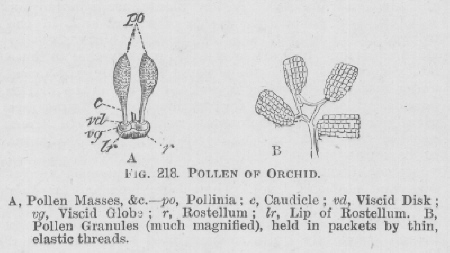
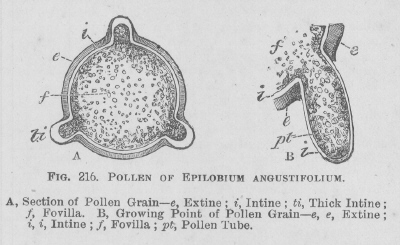
Pollen grains are usually free, but, in many plants, development seems arrested early; e.g., in Heaths, the four cells developed from each "parent cell" remain united together. In some Acacias, the Pollen grains are made up of from eight to thirty-two united cells. In Orchids, the grains in each loculus often stick together in pyriform masses, called pollinia. These peculiarities are the result of incomplete solution of the walls of the parent cells, since these remain and bind the Pollen grains together. The grains possess two coats (extine and intine) The inner consists of cellulose, is, in general, thin, and can be stretched, especially so in the form of a tube protruded from the grain, when it lies on the stigma of the same species of plant, or is placed in a drop of weak solution of sugar. There are no openings in this coat. The outer coat differs from the inner, inasmuch as it is not extensible, and consists of a substance like cuticle in its chemical composition. This coat is entirely absent from the Pollen grains of Zostera, and of a few other plants that flower under water. It is occasionally uniformly spread all over the grain, and must be burst off before the Pollen tube can be protruded; but, in general, it is pierced by pores, or slits, of definite form and number for each species of plant. Through these openings one or more Pollen tubes are pushed when conditions favour their growth. The surface of the extine is smooth in many Pollen grains, but in most it bears characteristic outgrowths in the form of ridges, e.g., in many Compositae, or of spines, e.g., in Mallow, Mistletoe, or of granules, as in many Dicotyledons. The nature of the surface in different Pollen grains is closely connected with the modes in which the Pollen is conveyed from the anthers to the stigma (see Pollination). In form, the Pollen grains differ very greatly in different plants. The most common forms are spherical, and oval with rounded ends; but many others exist, such as cubical, triangular, cylindrical, and polygonal. The form seems rather constant within the limits of genera, but varies greatly within certain families. Hence, the form of Pollen grains is of little value as an indication of affinities between plants, beyond genera: nor does similarity of form of grain necessarily indicate affinity. Zostera possesses one of the most curious forms, the grains in this plant being long, and extremely slender and thread-like. The colour, in most plants, is some shade of yellow, but in some it is deep orange (Lilium tigrinum), or red (Verbascum), or blue (Scilla), or deep purple, approaching black. The contents of the grain are known as the fovilla. They consist of viscid protoplasm, full of small starch granules and oil-drops. Amidst this mass, in general, lie two bodies, like nuclei, the nature of which has been made clear, by the researches of Elfving and of Strasburger, within the past few years, and is most easily understood if we look to the Pollen of Coniferae. In the Scotch Fir, the very light Pollen has the outer coat prolonged into two outgrowths containing air, which render the grain light. There is comparatively little difficulty in making out that there are three cells contained within the large cell seen in the middle, and the multicellular nature of the grain remains evident throughout its existence in the Fir.
In other Coniferae, e.g., the Yew, the Pollen is egg-shaped, and there is a small part cut off by a partition at the smaller end, rendering the grain two-celled; each cell has a nucleus. In Monocotyledons and Dicotyledons, the structure is less easily traced. In some (e.g., in Pollen grains of Orchids), a small part at one angle of the cell contents becomes separated from the rest, (though a cell wall does not form between), and is called the "vegetative cell." It draws itself away from the side wall, and becomes imbedded in the contents of the large cell. For a time, it remains different in form from the nucleus of the large cell, but ultimately it becomes quite like that nucleus, so that there seem to be two nuclei. The vegetative cell, in many Pollen grains, breaks up into two or more cells, and, in some (e.g., Scirpus palustris), the process becomes quite complex. When the Pollen tube is formed, the nucleus and the vegetative cell, or cells, pass into it, and have been traced into the end of it that passes down the micropyle and comes into contact with the helper cells (see Ovule). It is supposed that they perform some very important function in the formation of the embryo. The formation of the vegetative cells in the interior of the Pollen grains is generally regarded as representing the formation of the male prothallium in such Cryptogams as Selaginella. See Prothallium.