Polypodium
(the old Greek name, used by Theophrastus, from polys, many, and podion, a little foot; on account of the appearance of the rhizome and its appendages). Polypody. Including Aglaomorpha, Calymmodon, Campyloneuron, Colysis, Craspedaria, Cryptosorus, Cyrtomiphlebium, Dibblemma, Dictymia, Dictyopteris, Drynaria, Dryostachyum, Goniophlebium, Goniopteris, Grammitis (in part), Lecanopteris, Lepicystis, Lopholepis, Microgramme, Microsorium (in part), Monachosorum, Niphobolus, Niphopsis, Paragramma, Phegopteris, Phlebodium, Phymatodes, Pleopeltis, Pleuridium, Polycampium, Pseudathyrium, and some other less important so-called genera. ORD. Filices. The largest genus of the order, comprising upwards of 450 species. It includes plants of two different modes of growth, each series comprising a number of species of each of the different kinds of venation, and from all climates. Sori on the back of the lobes, round or rarely oblong, not more than twice as long as broad. Polypodiums are very handsome plants; they thrive under very varied conditions. Many of them, perhaps, do best in good fibrous loam and soil rich in humus; others thrive on blocks of fibry peat, on tree-fern stems, or treated as basket-plants. Some of them are eminently adapted for crevices on rockwork. Except where otherwise stated, the species described below thrive under stove treatment. For general culture, &c., see Ferns. P. acrostichoides (Acrostichum-like). rhiz. woody, wide-creeping, scaly, black in the centre. sti. 1in. to 3in. long, firm, erect. fronds 1ft. to 2ft. long, 1/2 in. to 1in. broad, ligulate, gradually narrowed below, naked above, dirty-white-tomentose beneath. sori bright-coloured, not immersed, small, close, covering the whole upper part of the frond. Ceylon, Queensland, &c. Greenhouse. SYN. Niphobolus acrostichoides.
P. adnascens (adnascent). rhiz. slender, firm, with linear, deciduous scales. sti. 1/4 in. to 1in. long, firm, erect. fronds dimorphous; the barren ones elliptical or spathulate, blunt; the fertile ones longer and narrower, 6in. to 12in. long. 1/4in. to 1/2in. broad, naked above, white-tomentose beneath. sori bright-coloured, small, immersed, occupying the whole of the contracted upper part of the frond. India, &c., 1824. SYN. Niphobolus adnascens (H. G. F. 19).
P. adnatum (adhering). sti. 6in. to 12in. long, naked, glossy. fronds 1 1/2ft to 12in. to 3ft. long, 1ft. broad, with an oblong-lanceolate, entire fertile pinna, 6in. to 9in. long, and 1 1/2in. to 2in. broad, and several similar lateral ones on each side, the upper ones broadly adnate to the rachis at the base. sori and areolae in rows of four to four to six between the midrib and edge. Guatemala, &c. SYN. Goniophlebium adnatum.
P. albo-punctatissimum (much dotted with white). A variety of P. crassifolium.
P. albo-squamatum (white-scaly).* rhiz. woody, with dark brown scales, sometimes 1in. long. sti. 6in. to 12in. long, firm, erect, glossy, fronds sometimes simple, usually pinnate, 1ft. to 2ft. long, 1ft. or more broad, with several distant, erecto-patent pinnae on each side, which are 6in. to 10in. long, and 1/2in. to 3/4in. broad, the apex acuminate, the edge slightly repand towards the point, the base narrowed, the lower ones stalked; upper surface with small, white dots at the edge or all over. sori in a single row midway between the edge and midrib. Malay Isles and Philippines. (H. G. F. 47.) SYN. Phymatodes albo-squamata.
P. alpestre (alpine). sti. 4in. to 6in. long, tufted, scaly below. fronds 1ft. to 2ft. long, 6in. to 8in. broad, oblong-lanceolate; pinnae lanceolate, 3in. to 4in. long, 1in. to 1 1/4in. broad; pinnules deeply pinnatifid, with toothed lobes. sori small, one to four to each lobe. Cold regions of Northern hemisphere (Britain, &c.). This species closely resembles Asplenium Filix-foemina. SYN. Pseudathyrium alpestre.
P. a. flexile (pliable). A variety of more flaccid habit; the pinnules oblong, with fewer lobes, and a broad, uncut centre. SYN. Pseudathyrium flexile.
P. amphostemon. A form of P. angustifolium.
P. androgynum (hermaphrodite). sti. 1ft. to 2ft. long, erect, naked or slightly villous. fronds 1ft. to 3ft. long, 1ft. or more broad; pinnae 6in. to 8in. long, 1/2in. to 1in. broad, numerous, spreading, lowest narrowed at base and sometimes stalked, cut a quarter to half way down into blunt lobes; rachis and under side sometimes slightly hairy. sori in rows near the midrib. Cuba to Peru, 1843. SYNS. P. tetragonum, Goniopteris tetragona. In the form megalodus, the pinnae are 1 1/2in. and the lobes 1/4in. broad, the latter sub-falcate.
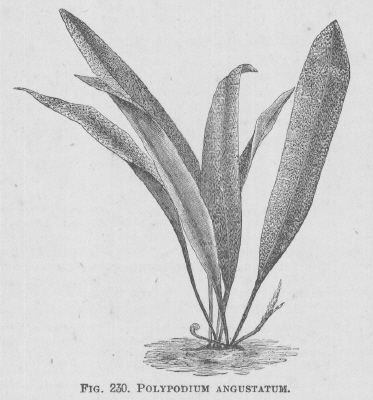
P. angustatum (narrowed). rhiz. stout, wide-creeping, clothed with whitish, linear, deciduous scales. sti. 2in. to 4in. long, strong, erect. fronds 6in. to 12in. long, 1/2in. to 1 1/2in. broad, ligulate, entire, very coriaceous; upper surface naked, the lower clothed with adpressed, cottony, sub-ferruginous tomentum. sori large, prominent, in rows near the edge of the contracted upper part, and sometimes confluent. North India, New South Wales, &c. Greenhouse. See Fig. 230. (H. G. F. 20.)
P. angustatum (narrow), of Blume. A synonym of P. palmatum. P. angustifolium (narrow-fronded). rhiz. stout, epigaeous, brown-scaly. fronds 1ft. to 1 1/2ft. long, only 1/4in. broad, quite entire, with an acute point; the lower part gradually narrowed into a generally short stem; edges often revolute. sori and areolae in from one to four rows between the midrib and edge; the former in two rows between the main veins. Cuba, Brazil, &c., 1820. SYN. Campyloneurum angustifolium. A very variable species. The broadest form, amphostemon, has fronds 1in. broad, with four rows of sori; the variety ensifolium has narrow, sessile fronds, with the areolae and sori in one row between the edge and midrib.
P. argutum (pungent). rhiz. 1/8in. thick, firm, wide-creeping, with minute, dark brown scales. sti. 3in. to 6in. long, naked, castaneo-stramineous. fronds oblong-lanceolate, sub-erect, 1ft. to 2ft. long, 8in. to 12in. broad, simply pinnate; pinnae ten to twenty-jugate, ligulate, acuminate, faintly inciso-crenate, 1/2in. to 3/4in. broad, many free and distant, the lowest not reduced. sori and areolae uniserial, the former not close, nearer the midrib than the edge. Himalayas, 1843. Greenhouse.
P. asperulum (rather rough). sti. brownish, firm, terete, pubescent. fronds 1 1/2ft. to 2ft. long, 1ft. or more broad lower pinnae 6in. to 9in. long, 1/2in. broad, unequal-side, cut down to the rachis below into oblong, pinnatifid segments; both surfaces villous. sori copious, one to each ultimate lobe. Philippines, 1842. SYN. Phegopteris asperula.
P. asplenioides (Asplenium-like). A variety of P. reptans.
P. attenuatum (thin), of Robert Brown. A synonym of P. Brownii.
P. aureum (golden).* rhiz. stout, wide-creeping, clothed with bright, ferruginous scales. sti. 1ft. to 2ft. long, stout, erect, glossy. fronds 3ft. to 5ft. long, 9in. to 18in. broad, with a long, linear-lanceolate, terminal lobe, and cut throughout within about 1/2in. of the rachis into numerous, undulated, lateral pinnae, 4in. to 9in. long, about 1in. broad, with a rounded sinus between. sori irregularly one to three-seriate. areolae copious. Tropical America and Australia, 1742. SYN. Phlebodium aureum. P. a. areolatum (areolate). A variety with smaller, more coriaceous, and very glaucous fronds, closer lobes, and uniserial sori. SYNS. P. sporadocarpum, Phlebodium areolatum.
P. a. pulvinatum (cushion-like). This resembles P. a. areolatum, but the fronds are hardly at all glaucous, and the terminal lobe is very small. SYN. Phlebodium pulvinatum.
P. auriculatum (eared). sti. tufted, 1 1/2ft. to 2ft. long, deciduously villous. fronds 3ft. to 4ft. long, 1ft. or more broad; pinnae 6in. to 8in. long, 1in. broad, cut down nearly to the rachis into close, spreading, entire, blunt lobes; lower pinnae reduced to mere auricles, furnished with a prominent gland at the base beneath. sori borne about the middle of the veinlets. Himalayas, 1824.
P. bifrons (two-fronded). rhiz. woody, slender, branched, tortuous, nearly naked. fronds, barren ones 3in. to 4in. long, 1in. broad, sessile, elliptical, narrowed at both ends, with blunt lobes, reaching nearly half way down; fertile ones 4in. to 6in. long, about 1/4in. broad, entire, short-stalked. sori large, oblong, placed end to end in a row on each side, close to the midrib. Ecuador. SYN. Phymatodes bifrons.
P. Billardieri (La Billardiere's). rhiz. woody, wide-creeping, with scales black in the centre. sti. 4in. to 8in. long, firm, erect, glossy. fronds varying from oblong-lanceolate and quite entire to 18in. long and 9in. broad, deeply pinnatifid, with lanceolate or linear lobes. sori large, uniseriate, medial or sub-marginal, distinctly immersed. South Australia, &c., 1823. Greenhouse. SYN. Phymatodes Billardieri.
P. biserratum (twice-serrated). A form of P. subpetiolatum. P. brasiliense (Brazilian). rhiz. stout, with grey scales. sti. 6in. to 12in. long, firm, erect, glossy. fronds 1ft. to 2ft. long, frequently 1ft. broad, cut to the rachis into numerous entire, erecto-patent pinnae, which are 4in. to 6in. long, 3/8in. to 3/4in. broad, dilated at base. sori slightly immersed, in one or two rows. areolae in three or four rows. Brazil, &c., 1837. SYN. P. neriifolium.
P. Brownii (Brown's). rhiz. woody, wide-creeping, with dull brown scales. fronds scattered, 6in. to 18in. long, 1/4in. to 1/2in. broad, ligulate, with a blunt point, entire or slightly repand edges, and the lower part gradually narrowed to a base or short stem. sori large, immersed, arranged in a single row, end to end, with a space between each, midway between the midrib and edge. areolae uniform. Australia, &c., 1823. Greenhouse. SYNS. P. attenuatum (H. G. F. 30), Phymatodes Brownii.
P. californicum (Californian). rhiz. wide-creeping, with spreading, ferruginous scales. sti. 3in. to 6in. long, firm, erect, naked. fronds 6in. to 9in. long, 3in. to 5in. broad, oblong-deltoid, cut down nearly or quite to the rachis into entire or finely-toothed pinnae, 1 1/2in. to 2 1/2in. long, 3/8in. to 1/2in. broad, the lowest not reduced. sori large, in single rows near the midrib. California. Greenhouse. SYN. Goniophlebium californicum.
P. cameroonianum (Cameroons). sti. 4ft. long, glossy. fronds 3ft. to 4ft. long, 2ft. broad, the upper part pinnatifid, with deep, lanceolate lobes; lower pinnae deltoid, upwards of 1ft. long, 6in. to 8in. broad, cut down below nearly to the rachis into lanceolate, pinnatifid lobes. sori in rows near the main veins. areolae copious. Cameroon Mountains. SYN. Dictyopteris camerooniana.
P. capitellatum (small-headed). A synonym of P. juglandifolium. P. Catharinae (St. Catherine's). rhiz. wide-creeping, with dark brown scales. sti. 4in. to 6in. long, erect, glossy. fronds 6in. to 12in. long, 3in. to 5in. broad, cut down to the rachis into close, blunt, sub-entire, spreading pinnae, 1 1/3in. to 3in. long, 1/4in. to 1/2in. broad, the lowest pair shorter and deflexed. sori large, in two rows close to the midrib. Brazil, 1824.
P. ciliatum (ciliated). A variety of P. piloselloides.
P. colpodes (embosomed). A synonym of P. plesiosorum.
P. conjugatum (mixed). rhiz. very thick, densely matted, with light brown scales. fronds 2ft. to 4ft. long, 1ft. to 1 1/2ft. broad, arranged in a circle, the stem with a lobed wing, 2in. to 4in. broad, on each side at the base, which is narrowed and more deeply lobed upwards, passing gradually into the frond, which is cut down nearly to the rachis throughout into entire, erecto-patent pinnae, 4in. to 8in. long, 1in. to 1 1/2in. broad. sori in a single row close to the anterior main vein, sometimes confluent. India, &c. SYNS. P. coronans, Drynaria conjugata.
P. coronans (crowned). A synonym of P. conjugatum.
P. corymbiferum (corymbose). A form of P. Lingua.
P. crassifolium (thick-fronded).* rhiz. woody, short-creeping, with dull brown scales. sti. 2in. to 6in. long, strong, erect. fronds 1ft. to 3ft. long, 1in. to 5in. wide, gradually narrowed to both ends, the edge entire, upper side with scattered small, white, dots; texture very coriaceous. sori in single rows between the main veins, two to nine in a row between the edge and midrib. West Indies, &c., 1823. SYN. Pleuridium crassifolium. The variety albo-punctatissimum is a much-dotted form, with less distinctly raised veins than usual. SYN. Pleuridium albo-punctatissimum.
P. crassinervium (thickly-nerved). A synonym of P. platy-phyllum. P. crenatum (scolloped). sti. 1ft. to 2ft. long, erect, naked or pubescent. fronds 1ft. to 2ft. long, 1ft. or more broad, with an oblong-lanceolate, terminal pinna, 6in. to 8in. long and 1 1/2in. to 2in. broad, the edge a little bluntly lobed or nearly entire, and two or four opposite pairs of similar ones. sori in rows near the main veins. Cuba, &c., 1823. SYN. Goniopteris crenata.
P. curvatum (curved). rhiz. stout, scaly. sti. 3in. to 4in. long, naked, glossy, dark brown. fronds 1ft. to 1 1/2ft. long, 2in. to 3in. broad, pendent, cut down to the rachis into close, crenated, linear pinnae, which are decurrent at base. sori bright yellow, in two long rows. Jamaica, &c., 1823.
P. cuspidatum (pointed). A synonym of P. persicaefolium.
P. cyatheaefolium (Cyathea-fronded). sti. 1ft. to 1 1/2ft. long, firm, naked, stramineous. fronds 1 1/2ft. to 2ft. long, 1ft. or more broad; pinnae 6in. to 9in. long, 2in. or more broad, cut down to a broadly-winged rachis into falcate, entire lobes, 1/4in. to 3/8in. broad, the lowest pair rather smaller and deflexed. sori about the centre of the veinlets. Mauritius and Bourbon. SYN. P. Sieberianum.
P. decumanum (tall). rhiz. stout, with soft, bright, ferruginous scales. sti. 1ft. to 2ft. long, stout, erect, glossy. fronds 1ft. to 3ft. long, 1ft. to 2ft. broad, cut down nearly, or below quite, to the rachis into ligulate, nearly entire pinnae, often 1ft. long, 2in. to 3in. broad. sori each terminating two or three free veinlets. Tropical America, Brazil, 1818. SYNS. P. dictyocallis, Phlebodium decumanum.
P. decurrens (decurrent). rhiz. wiry, rather slender, with deciduos scales. sti. 6in. to 12in. long, firm, naked. fronds usually with several erecto-patent pinnae on each side, which are 8in. to 12in. long, 1 1/2in. to 2in. broad, with an acuminate point, a narrowed base, and nearly entire edges. areolae about six, between the edge and midrib, with two or three sori in each. Brazil and Peru. SYN. Campyloneurum decurrens. P. decussatum (decussate). sti. 2ft. to 3ft. long, stout, erect, polished upwards, scaly at base, sometimes slightly muricated. fronds 3ft. to 4ft. or more long, 1ft. to 1 1/2ft. broad; pinnae 8in. to 12in. long, 1in. to 1 1/2in. broad, cut down nearly or quite to the rachis into close, spreading, entire, blunt lobes, with a large, subulate gland at the base beneath. sori in rows near the midrib. West Indies, &c. SYN. Phegopteris decussata.
P. deflexum (bent-down). cau. erect, with dull brown scales. sti. 2in to 3in. long, slender, naked, stramineous. fronds 8in. to 12in. long, 2in. broad; pinnae 1in. long, 1/4in. broad, lanceolate, acuminate, cut down to the rachis into linear-oblong, pointed lobes; lower pinnae deflexed, gradually dwindling to mere auricles; both sides slightly hairy. sori nearer the midrib than the edge. New Grenada, 1830. SYN. Phegopteris deflexa.
P. Dianae (Diana's). A synonym of P. molle.
P. dictyocallis (beautifully-netted). A synonym of P. decumanum.
P. difforme (deformed). sti. tufted, erect, 1ft. or more long, scaly below. fronds 3ft. to 4ft. long; upper pinnae lanceolate, entire, or with broad, blunt or falcate lobes reaching half way or more down to the rachis; lower pinnae often deltoid, with the lobes of the lower side prolonged and pinnatifid. sori scattered, very copious. areolae also copious. Malay Peninsula and Isles. SYNS. P. irregulare, Dictyopteris irregularis.
P. dilatatum (dilated). rhiz. woody, thick, with large, dull brown scales. sti. 1ft. or more long, with a narrow wing reaching nearly to the base. fronds 1 1/2ft. to 3ft. long, 1ft. or more broad, cut down within about 1/2in. of the rachis into entire, acuminate, erecto-patent lobes, 4in. to 8in. long, 1/2in. to 1 1/2in. broad. sori small, copious, irregularly scattered. areolae fine, copious, with free veinlets. North India, &c. SYN. Colysis dilatata. P. diversifolium (variable-fronded). sti. 1ft. to 2ft. long, tufted, slender, naked. fronds 1ft. to 2ft. long, 6in. to 9in. broad; pinnae 3in. to 5in. long, 3/4in. to 1in. broad, the apex acuminate, the lower ones narrowed at base, the edge nearly entire. sori in contiguous rows. South Brazil, &c. SYN. P. fraxinifolium.
P. diversifolium (variable-fronded), of R. Brown. A synonym of P. rigidulum.
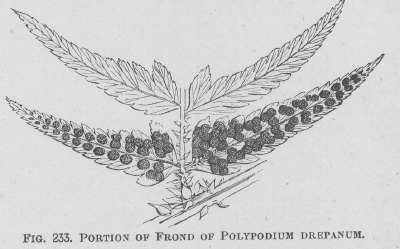
P. drepanum (sickle).* sti. tufted, 1ft. to 1 1/2ft. long, with dark scales below. fronds 1 1/2ft. to 3ft. long, 8in. to 12in. broad; lowest pinnae the largest, 6in. to 8in. long, 1 1/2in. to 2in. broad; pinnules lanceolate, unequal-sided, auricled on the upper, truncate on the lower, side at the base, with a broad, uncut centre and copious, spinous teeth, the lowest stalked. sori medial. Madeira. Greenhouse. SYN. Phegopteris drepana.
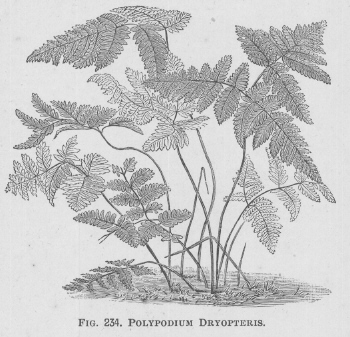
P. Dryopteris (Dryopteris).* Oak Fern. rhiz. slender, wide-creeping. sti. 6in. to 12in. long, slender, stramineous, scaly below, naked upwards. fronds 6in. to 10in. each way, deltoid; lower pinnae much the largest; pinnules lanceolate, only the lowest free, oblong, slightly crenate. sori sub-marginal. Northern hemisphere (Britain).
P. D. Robertianum (Herb-Robert scented). A variety with a thicker rhizome, the whole plant being more rigid than in the type, and finely glandular. (H. B. F. 5.)
P. elasticum (elastic). rhiz. stout, woody, short-creeping or sub-erect, with brown scales. fronds 9in. to 18in. long, 2in. to 4in. broad, lanceolate, cut down to the rachis into patent, adnate, ligulate, entire, blunt forty to one hundred-jugate pinnae, the lower ones gradually reduced. sori minute, superficial, medial. Mexico, &c., 1824. SYNS. P. Plumula, P. Schkuhri.
P. ensifolium (sword-fronded). A form of P. angustifolium.
P. Filipes (thread-footed). A young state of P. tenellum. P. fraternum (fraternal).* rhiz. wide-creeping, with bright ferruginous scales. sti. 4in. to 8in. long, firm, erect, naked. fronds 1ft. to 1 1/2ft. long, 6in. to 9in. broad; lower pinnae 1in. apart, 4in. to 5in. long, narrowed at both ends, and with obscurely crenated edges. sori slightly immersed, medial, uniseriate. Mexico. SYN. P. Henchmanni.
P. fraxinifolium (Ash-leaved). rhiz. stout, with dark brown scales. sti. 1ft. to 2ft. long, firm, erect, naked. fronds 2ft. to 4ft. long, 1ft. to 1 1/2ft. broad; pinnae numerous on each side, distinct, 4in. to 9in. long, 1in. to 2in. broad, the apex acuminate, the base narrowed, and the edge entire. sori and areolae in series of six to eight. Columbia, &c. SYN. Goniophlebium fraxinifolium.
P. fraxinifolium (Ash-leaved), of Jacquin. A synonym of P. diversifolium.
P. Gardneri (Gardner's). rhiz. short-creeping; scales black, bordered with brown. sti. 3in. to 4in. long, firm, naked. fronds 1ft. to 1 1/2ft. long, 1in. to 1 1/2in. broad, narrowed gradually towards both ends, with entire edges; lower surface densely grey-tomentose. sori in close rows of about four each between the main veins. Ceylon. (H. E. F. 68.) SYN. Niphobolus Gardneri.
P. geminatum (paired). rhiz. very wide-creeping, stout, with ferruginous scales. fronds sub-sessile, usually in distant pairs, entire, uniform, 3in. to 6in. long, 1/2in. to 1in. broad, narrowed towards both ends, but the point often blunt. sori in a row midway between the edge and midrib, distinctly immersed. Brazil. SYN. Anapeltis geminata.
P. Ghiesbreghtii (Ghiesbreght's). sti. 1ft. or more long, firm, erect, densely villous. fronds 1ft. to 1 1/2ft. long, with a terminal pinna 6in. to 9in. long. 1 1/2in. to 2in. broad, the edge slightly lobed, and three to six similar ones on each side; rachises and under surface densely villous, upper surface slightly so. sori in dense rows close to the main vein. South Mexico. SYN. Goniopteris crenata.
P. glaucophyllum (glaucous-fronded). rhiz. wide-creeping, firm, deciduously scaly. sti. 2in. to 6in. long, scattered, firm, erect, glossy. fronds 4in. to 10in. long, 1in. to 2in. broad, uniform, oblong-lanceolate, entire, with a rounded base and an acuminate point. areolae four to six in a series between the edge and midrib, with one sorus in each. Tropical America, &c., 1874. SYN. Goniophlebium glaucophyllum.
P. gonatodes (angled). A synonym of P. plesiosorum.
P. grandidens (large-toothed). A variety of P. persicaefolium.
P. grandifolium (large-fronded). A variety of P. membranaceum.
P. guatemalense (Guatemalan). sti. 6in. to 12in. long, naked, stramineous. fronds 2ft. to 3ft. long, 1ft. or more broad, with an entire, terminal pinna 6in. to 8in. long, 1in. to 1 1/4in. broad, and several similar ones on each side, the upper ones narrowed, but adnate at the base. areolae in series of three or four, with the large, uniseriate sori in the first or second row. Guatemala. SYN. Phlebodium inaequale.
P. harpeodes (scimitar-like). A synonym of P. loriceum latipes.
P. hastaefolium (spear-fronded). sti. tufted, 1in. to 2in. long, wiry, deciduously scaly. fronds 6in. to 9in. long, 1 1/2in. to 2in. broad; pinnae blunt, entire, 1/8in. broad, with a sharp, distinct auricle on both sides at the base, those of the lower half of the frond gradually reduced. sori below the middle of the veinlets. West Indies. SYN. Phegopteris hastaefolia.
P. hemionitideum (Hemionitis-like). rhiz. hypogaeous, woody. sti. 1in. to 6in. long, firm, woody. fronds 9in. to 18in. long, 2in. to 3in. broad, narrowed to both ends, with entire edges. sori in an irregular row between each main vein, often confluent. India and China. SYN. Colysis membranacea.
P. Henchmanni (Henchmann's). A synonym of P. fraternum. P. Heracleum (Cow-Parsnip-like).* rhiz. stout, with light brown, silky scales. fronds 3ft. to 6ft. long, 2ft. or more broad, with a cordate lobed wing, 3/4in. broad, at the base; upper part cut down to a broadly-winged rachis into entire, acute lobes, which are often 1ft. to 1 1/2ft. long and 3in. to 4in. broad, sori small, copious, slightly immersed, scattered. Java and Philippines.(H. G. F. i.) SYNS. P. morbillosum, Drynaria Heraclea.
P. hexagonopterum (six-angled-winged). rhiz. wide-creeping. sti. 1ft. to 1 1/2ft. long, slender, glossy, stramineous. fronds 8in. to 12in. long, and nearly as broad, deltoid; lower pinnae 4in. to 6in. long, the lowest pair deflexed, often 2in. broad; pinnules reaching down nearly to the rachis, those of the lower side 1in. to 1 1/2in. long, pinnatifid half way down with broad, blunt lobes; under side slightly villous. sori marginal. North America, 1811. Hardy. SYN. Phegopteris hexagonoptera.
P. himalayense (Himalayan). rhiz. wide-creeping, woody, with long, yellowish-brown scales. 8ti. 6in. to 9in. long, firm, erect, naked. fronds 1ft. to 2ft. long, 8in. to 10in. broad; pinnae in distant pairs, 4in. to 8in. long, 1 1/2in to 2in. broad, with an acuminate point, scarious, wavy edges, and the base rounded or cordate; under surface pubescent. sori in one or two rows, of three or four each, between the main veins. areolae close, fine. North India. SYNS. P. venustum, Phymatodes himalayensis.
P. incanum (hoary). rhiz. wide-creeping, woody, with dense, dull brown scales. sti. 1in. to 4in. long, erect, firm, furfuraceous. fronds 2in. to 4in. long, 1in. to 1 1/2in. broad, cut down to the rachis into entire, spreading, somewhat distant pinnae, 1/8in. broad, dilated at base; under side densely scaly. sori uniseriate. Temperate America and South Africa, &c., 1840. Greenhouse. SYN. Lepicystis incana.
P. incurvatum (incurved). rhiz. woody, with adpressed scales. fronds dimorphous; barren ones 6in. to 9in. each way, deltoid, ternate, or pinnatifid, with broad, lanceolate, acuminate, entire lobes, and a firm, glossy stem, 6in. to 9in. long; fertile ones larger, cut almost, or below quite, to the rachis into distant, erectopatent, entire lobes, 4in. to 8in. long, about 1/4in. broad, the lowest occasionally forked. sori uniseriate, quite immersed, and forming prominent papillae on the upper surface. Malaccas. SYN. Phymatodes incurvata.
P. irregulare (irregular). A synonym of P. difforme.
P. juglandifolium (Walnut-leaved).* rhiz. woody, stout, with bright ferruginous scales. sti. 1ft. or more long, erect. fronds 1 1/2ft. to 2ft. long, 1ft. or more broad; pinnae 4in. to 8in. long, 1in. to 1 1/2in. broad, in pairs about 2in. apart, with an acuminate tip, thickened and wavy edges, and a rounded base. sori large, one between each main vein, forming a row nearer the midrib than the edge. areolae copious, hidden. North India. SYNS. P. capitellatum, Pleuridium juglandifolium.
P. lachnopodium (downy-footed). sti. densely hairy at the base (as is also the rachis). fronds 2ft. to 5ft. long, bi-tripinnatifid; pinnules 9in. to 12in. long, lanceolate. Jamaica, 1843. A rare species in cultivation.
P. lanceolatum (lance-shaped). rhiz. wide-creeping, wiry, with bright ferruginous scales. sti. 1in. to 3in. long, distant, erect. fronds 3in. to 9in. long, about 1/2in. broad, gradually narrowed at both ends; both sides coated with peltate scales. sori large, immersed, uniseriate, sometimes reaching from the edge to the midrib. West Indies, &c., 1812. (H. E. F. 62, under name of Pleopeltis ensifolia.) P. leiorhizon (smooth-rhizomed). rhiz. very thick, with adpressed scales. sti. 1ft. to 2ft. long, erect, firm, fronds 2ft. to 4ft. long, 1ft. to 2ft. broad; pinnae narrowed at base, the lower ones stalked, 6in. to 12in. long, 3/4in. to 1 1/2in. broad, with an acuminate apex and entire edge. sori slightly immersed, in a row near the midrib on each side. areolae fine, uniform. North India. SYN. Phymatodes leiorhiza.
P. lepidopteris rufulum (scaly-winged, reddish). rhiz. stout, with bright reddish-brown scales. sti. 1in. to 4in. long, erect. fronds 6in. to 8in. long, 1 1/2in. to 3in. broad, cut down to the rachis into horizontal, entire pinnae, 3/8in. broad, blunt, much twisted, the lower gradually reduced. sori copious. Mexico, &c. SYN. P. rufulum.
P. l. sepultum (inclosed). fronds ovatelanceolate; lower pinnae scarcely reduced. Otherwise similar to P. l. rufulum SYN. P. sepultum.
P. Lindleyanum (Lindley's). A form of P. palmatum.
P. lineare (linear). rhiz. woody, widecreeping, with dull brown scales. sti. from almost none to 1in. to 2in. long. fronds 6in. to 12in. long, 1/2in. to 2in. broad, entire, narrowed gradually to both ends, sori distinctly immersed, large, prominent, forming a single row nearer the midrib than the edge, scaly when young. North India. (H. G. F. 14, under name of Pleopeltis nuda.) In the variety simplex, the fronds are sometimes 1 1/2ft. long and 2in. broad.
P. Lingua (tongue-like).* rhiz. widecreeping, with ferruginous scales. sti. 3in. to 6in. long, firm, erect. fronds uniform, 4in. to 8in. long, 1in. to 4in. broad, the apex often cuspidate, the edge entire, the base narrowed or rounded; lower surface matted with close, cottony, some-what ferruginous down. sori in close rows of four to six each between the main veins, rather large and prominent. North India, Japan, &c. SYN. Niphobolus Lingua. The variety corymbiferum has fronds much divided at the apex, forming a cluster.
P. L. Heteractis (Heteractis). This form differs from the type in having broader, oblong-lanceolate fronds. Himalayas. SYN. Niphobolus latus. P. longifolium (long-fronded). rhiz. short-creeping, woody, with nearly black scales. fronds 1ft. to 2ft. long, 1/2in. to 1 1/2in. broad, with an acute apex and an entire, revolute edge, the lower part gradually narrowed into a short stem. sori oblong, immersed, in a line near the edge. Malaccas and Philippines, 1819.
P. longipes (long-stalked). A garden form of P. Phymatodes.
P. longissimum (very long). rhiz. wide-creeping, with brown, adpressed scales. sti. 3in. to 4in. long, firm. fronds 1ft. to 4ft. long, 6in. to 12in. broad, cut nearly to the rachis into numerous sub-entire, erecto-patent lobes, 4in. to 8in. long, 1/4in. to 1/2in. broad. sori in close, single rows near the midrib, forming distinct papillae on the upper surface. North India, &c. SYN. Phymatodes longissima.
P. loriceum (armour-clad). rhiz. wide-creeping, stout, with black scales. sti. sometimes ebeneous, 4in. to 6in. long. fronds 1ft. to 1 1/2ft. long, 4in to 6in. broad; pinnae close, 2in. to 3in. long, 3/8in. to 1/2in. broad, sub-entire, dilated at base on the upper side. areolae usually in two distinct rows, with the small sori often in both. Mexico, &c. SYN. Goniophlebium loriceum.
P. l. latipes (broad-stalked). A larger but less rigid form, having dense, dull brown scales, and pinnae much dilated on both sides at the base. SYNS. P. harpeodes, P. vacillans.
P. lucidum (shining). rhiz. short-creeping. sti. erect, firm, short. fronds 6in. to 12in. long, 1/2in. to 3/4in. broad, edge entire, both ends narrowed, both sides very glossy. sori confined to the upper part of the frond, not copious. areolae in two or three irregular rows. Venezuela and Brazil. SYNS. P. nitidum, Campyloneurum rigidum.
P. lycopodioides (Lycopodium-like). rhiz. firm, wide-creeping, with ferruginous scales. fronds dimorphous, distant, either sessile or shortly stalked; barren ones 2in. to 4in. long, 1/2in. to 1in. broad, entire, frequently blunt, gradually narrowed at base; fertile ones narrower and longer. areolae in several rows, those containing the uniseriate sori being largest. Tropical America, &c., 1793. SYN. Anapeltis lycopodioides.
P. l. owariense (Owara). This variety only differs from the type in the shorter, oval, bluntly-pointed frond.
P. macrocarpum (large-fruited). rhiz. wide-creeping, stout, densely scaly. sti. 1in. to 3in. long, wiry, often flexuous, deciduously scaly. fronds 3in. to 4in. long, 1in. or more broad, lanceolate, cut nearly to the rachis into blunt, entire or obscurely toothed pinnae, 1/8in. broad, dilated at base, and with a rounded sinus between them; lower surface densely scaly. sori copious, large. Bolivia to Chili.
P. macrodon (large-toothed). rhiz. decumbent. sti. 1ft. or more long, scaly below. fronds 2ft. to 3ft. long, 1ft. to 1 1/2ft. broad, apex deeply pinnatifid; pinnae below the apex numerous, lanceolate, the lowest sometimes 1ft. long and 6in. to 8in. broad, cut down to a narrow wing on the rachis into close, lanceolate, pinnatifid pinnules. sori small, in rows near the main veins. areolae copious. Philippines, &c., 1840. SYN. Dictyopteris macrodonta.
P. macropterum (large-winged). Trunk somewhat arborescent. sti. 2ft. or more long, strong, glabrous, angular. fronds 4ft. to 6ft. or more long; pinnae lanceolate, 6in. to 9in. long, 2in. broad, with entire, oblong-falcate lobes, 1/4in. to 3/8in. broad, reaching down three-quarters of the way to the midrib. Brazil.
P. madrense (Sierra Madre). rhiz. wide-creeping, stout, densely scaly. sti. 2in. to 4in. long, firm, erect. fronds 3in. to 5in. long, 1 1/2in. to 2in. broad, cut nearly to the rachis into horizontal, entire, blunt pinnae, 1/8in. broad, with a rounded sinus between them; under side and ebeneous rachis scaly. sori copious, large. North-west Mexico, &c.
P. marginellum (slightly-margined). sti. densely tufted. fronds 3in. to 6in. long, about 1/8in. broad, blunt, gradually tapering into the short stem, naked or slightly hairy on both sides, margined with a distinct, black line. sori close, copious, oval or oblong, in rows nearer the midrib than the edge. West Indies. SYN. Grammitis marginella.
P. Martensil (Martens'). rhiz. wide-creeping, stout, with bright ferruginous scales. sti. 1in. to 2in. long, erect, firm. fronds 8in. to 12in. long, 3in. to 4in. broad, cut down to the rachis into numerous horizontal, entire pinnae, 1/6in. broad, distant their own breadth; both surfaces and rachis finely villous. sori medial, twelve or more on each side. Mexico.
P. megalodus (picture-like). A variety of P. androgynum.
P. membranaceum (membranous). rhiz. stout, with luridgreen scales. sti. 1in. to 4in. long, erect, firm. fronds 1ft. to 3ft. long, 2in. to 6in. broad, with an entire or repand edge, both ends being gradually narrowed. sori mostly in two rather irregular rows near the main veins. North India to Ceylon. SYN. Colysis membranacea. The variety grandifolium has larger fronds, and more copious and irregularly-scattered sori.
P. menisciifolium (Meniscium-leaved). sti. 1ft. to 2ft. long, erect, firm, naked. fronds 2ft. to 3ft. long, 1ft. or more broad, with an entire, terminal pinna, 6in. to 9in. long, 1 1/2in. to 2in. broad, and numerous similar ones on each side, all narrowed at base, sori and areolae in rows of about four, the former immersed and prominent on the upper side. Brazil, &c., 1840. SYN. Goniophlebium menisciifolium.
P. molle (soft). sti. 1ft. or more long, stout, with deciduous scales. fronds 2ft. to 3ft long, 1ft. to 1 1/2ft. broad; lower pinnae not reduced, 6in. to 9in. long, 1 1/2in. to 2in. broad, cut to a broadly-winged rachis into oblong, entire or crenated, blunt lobes; under surface finely villous. sori small, copious, distant from the midrib. St. Helena. SYNS. P. Diana, Phegopteris mollis.
P. morbillosum (diseased). A synonym of P. Heracleum.
P. musaefolium (Musa-leaved). rhiz. woody, with dull brown scales. fronds 1ft. to 3ft. long, 3in. to 4in. broad, with an acute or rather blunt point; lower part broadly winged to the base. sori small, numerous, sometimes covering nearly the whole surface. Malay Isles. SYN. Phymatodes musaefolia.
P. myriocarpum (many-fruited). A variety of P. pellucidum.
P. neriifolium (Oleander-leaved). A synonym of P. brasiliense.
P. nigrescens (blackish). rhiz. stout, adpressedly scaly. sti. 1ft. to 1 1/2ft. long, erect, glossy, firm. fronds 2ft. to 3ft. long, 1ft. or more broad, cut within 1in., or less, of the rachis into numerous linear-oblong, entire, acuminate lobes, 6in. to 12in. long, 1in. to 2in. broad. sori in a single row nearer the midrib than the edge, sunk in a deep cavity, which is prominent on the upper side. India, &c. SYN. Phymatodes nigrescens.
P. nigripes (black-stalked). rhiz. stout, with black, rigid, ferruginous-edged scales. sti. almost 1ft. long, firm, erect, slightly scaly. fronds 1ft. long, 6in. to 7in. broad, cut nearly, or below quite, to the rachis into pinnae, which are about 1/2in. broad, and slightly crenate towards the bluntish point; under surface furfuraceous. sori in single rows on each side the midrib. Venezuela. SYN. Phlebodium nigripes.
P. nitidum (shining). A synonym of P. lucidum.
P. obliquatum (oblique). sti. 1in. or more long, rigid, tufted, naked or villous. fronds 8in. to 12in. long, 1 1/2in. to 2in. broad, cut down throughout to the rachis into horizontal or decurved, acute, slightly-sinuated pinnae, 1/8in. broad, dilated at base, the lower ones being blunt and shorter; edges of the fertile pinnae sometimes undulated. sori sunk in a cavity, four to six on each side. India, &c., 1841.
P. Otites (Otites). A synonym of P. tenuifolium.
P. oxylobum (sharply-lobed). A synonym of P. trifidum.
P. palmatum (palmately-lobed). rhiz. stout, brown-scaly. sti. 6in. to 12in. long, erect, firm, glossy. fronds 6in. to 18in. long, 8in. to 12in. broad, with a linear or oblong, repand or entire, terminal lobe, and one to six similar ones on each side, 4in. to 6in. long, 1/2in. to 1 1/2in. broad, narrowed or dilated, slightly adnate at base, those of the barren frond broadest. sori in a single row midway between the edge and midrib. Malaccas and Philippines. SYNS. P. angustatum, Pleuridium palmatum. P. Lindleyanum is merely a form of this species.
P. papillosum (nippled). rhiz. wide-creeping, stout, scaly. sti. 4in. to 6in. long, slender, rigid, erect. fronds 1ft. or more long, 2in. broad, cut to the rachis into horizontal, close, blunt, entire or slightly crenated pinnae, 1/4in. broad; veins black. sori deeply immersed in rows near the edge, the cavities prominent on the upper side. Java and Philippines.
P. Paradiseae (Paradise). fronds 1ft. to 4ft. long, 3in. to 8in., or more, broad, slightly pubescent, deeply pinnatifid, upright, slightly arched at top. sori bright golden-yellow, imparting a charming appearance to the plant. Brazil, 1841.
P. pectinatum (comb-like).* rhiz. tibrillose, stout. sti. 2in. to 6in. long, erect, rigid, naked or finely villous. fronds 1ft. to 3ft. long, 2in. to 6in. broad, naked or finely villous, cut down to the rachis; pinnae about 1/6in, broad, close, horizontal, blunt, entire or slightly toothed, the lower ones much reduced. sori in long rows. Mexico, &c., 1793. (H. G. F. 10.)
P. pellucidum (pellucid-veined). rhiz. wide-creeping, stout, densely scaly. sti. rigid, erect, 3in. to 6in. long, glossy. fronds 3in. to 12in. long, 3in. to 5in. broad, cut nearly to the rachis into entire or sub-acute, close, blunt pinnae, 1/4in. to 3/8in. broad; veinlets beautifully pellucid. sori prominent, large. Sandwich Isles. The variety myriocarpum is a form with pinnatifid pinnae.
P. peltideum (shield-like). A garden form of P. Phymatodes.
P. pennigerum (feathered). sti. 6in. to 12in. long, tufted, slightly scaly. fronds 1 1/2ft. to 2ft. long, 8in. to 12in. broad; pinnae 4in. to 6in. long, nearly 1in. broad, cut half-way down into slightly crenated, blunt, falcate lobes, about 1/6in. broad; lower pinnae gradually reduced. sori in rows near the midrib. New Zealand, 1835. Greenhouse. SYN. Goniopteris pennigera.
P. percussum (sharp-pointed). rhiz. wide-creeping, wiry, with adpressed scales. sti. distant, 2in. to 3in. long, firm, erect. fronds 6in. to 12in. long, 3/4in. to 1 1/2in. broad, entire, gradually narrowed towards both ends, with the under side scaly. sori round, distinctly immersed, forming a row midway between the edge and midrib. areolae fine, distinct. Brazil, &c. SYN. Pleopeltis percussa.
P. persicaefolium (Peach-leaved). rhiz. wide-creeping, with dull brown scales. sti. 6in. to 12in. long, firm, naked. fronds 2ft. to 3ft. long, 8in. to 12in. broad, decurved; pinnae 3in. to 6in. long, nearly 1in. broad, distant, with an acuminate apex, a slightly-toothed edge, and the base gradually narrowed, the lower ones being distinctly stalked. sori immersed, uniseriate. areolae in about three rows. Java. SYNS. P. cuspidatum, Goniophlebium persicaefolium. The variety grandidens is a more deeply-toothed form.
P. Phegopteris (Phegopteris).* Beech Polypody. rhiz. wide-creeping, slender. sti. slender, 6in. to 9in. long, maked, except towards the base. fronds 6in. to 9in. long, 4in. to 6in. broad, almost deltoid slightly hairy beneath; lower pinnae 2in. to 3in. long, 1/2in. to 3/4in. broad, cut three-quarters of the way to the rachis into close, entire or slightly-toothed, blunt lobes, 1/8in. broad, the lowest pair deflexed. sori nearer the edge than the midrib. Northern hemisphere (Britain).
P. Phyllitidis (Phyllitidis). rhiz. hypogaeous, stout, brown-scaly. sti. short, scattered or slightly tufted, or none. fronds 1ft. to 3ft. long, 1in. to 4in. broad, with an acute point and an entire or slightly sinuated edge, the lower part gradually narrowed; upper surface often cretaceous-dotted. areolae in rows of six to twelve, between the edge and midrib, usually with two sori in each. Florida to South Brazil, 1793. SYN. Campyloneurum Phyllitidis.
P. Phymatodes (Phymatodes). rhiz. woody, wide-creeping, with dark brown scales. sti. 3in. to 12in. long, glossy, firm, erect. fronds varying from simple, oblong-lanceolate, to 2ft. to 3ft. long and 1ft. broad, cut down to the broadly-winged rachis into numerous lanceolate-oblong, entire, acuminate lobes, 4in. to 8in. long, and 1in. to 1 1/2in. broad. sori large, immersed, scattered, or one or two-seriate. East Indies, &c., 1823. SYN. Phymatodes vulgaris. P. longipes, P. peltideum, and P. terminale, are merely garden varieties of this species.
P. piloselloides (Pilosella-like).* rhiz. very wide-creeping, scandent, with squarrose scales. fronds dimorphous; barren ones 1in. to 3in. long, 1/2in. to 3/4in. broad, obolong, entire; fertile ones narrower and longer; both on short, ciliated stems, naked, hairy, or scaly. sori large, uniseriate, confined to the large costal areolae. Tropical America, 1793. (H. G. F. 18.) SYNS. Goniophlebium piloselloides, Lopholepis piloselloides. In the variety ciliatum, the fertile fronds are so narrow that the sori project along the edge.
P. platyphyllum (broad-leaved). rhiz. woody, with nearly black scales. sti. 3in. to 4in. long, erect, strong. fronds 1ft. to 1 1/2ft. long, 2in. to 4in. broad, the edge entire, the point acute, upper surface dirty-white dotted. sori immersed, in single rows between the main veins, eight or nine between the midrib and edge. Java. SYN. P. crassinervium.
P. plebeium (plebeian). rhiz. wide-creeping, stout, grey-scaly. sti. strong, erect, 4in. to 8in. long, castaneous. fronds 6in. to 12in. long, 3in. to 6in. broad, deltoid-ovate, cut nearly or quite to the rachis; pinnae spreading, entire or obscurely crenated, 1/4in. to 3/8in. broad, the lowest not reduced; under side and rachis scaly. sori copious. Mexico to Peru.
P. plectolepis (plaited-scaled). rhiz. stout; scales ferruginous, squarrose. sti. firm, glossy, stramineous, 6in. to 12in. long. fronds 1ft. to 2ft. long, 1ft. broad; pinnae spreading, numerous, 4in. to 6in. long, about 1/2in. broad, gradually narrowed from base to point, the edge crenate; both sides finely pubescent. sori and areolce in a single series. Mexico and Guatemala. SYN. Goniophlebium plectolepis.
P. plesiosorum.* rhiz. stout, reddish-scaly. sti. firm, erect, 2in. to 4in. long, glossy. fronds 6in. to 12in. long, 4in. to 6in. broad, cut to the rachis; pinnae close, entire, about 1/2in. broad, gradually narrowed upwards, slightly dilated on both sides at the base. sori prominent, in a single row close to the midrib (whence the specific name). areolae usually in two rows. Mexico to Venezuela. SYNS. P. colpodes, P. gonatodes, P. rhodopleuron.
P. Plumula (feathered). A synonym of P. elasticum.
P. proliferum (proliferous). rhiz. stout, creeping. sti. 2in. to 8in. long, spreading. fronds 1ft. to 2ft. or more long, 6in. to 12in. broad, erect or decumbent, often elongated and rooting at the point, and copiously branched from the axils; pinnae 4in. to 6in. long, 1/2in. to 3/4in. broad, broadest at base, truncate or cordate, the edge bluntly lobed; under side and rachis sometimes slightly pubescent. sori medial, oval, sometimes confluent. India, China, &c., 1820. SYN. Goniopteris prolifera.
P. propinquum (allied). rhiz. wide-creeping, woody, with bright ferruginous scales. fronds dimorphous; barren ones 4in. to 9in. long, 3in. to 4in. broad, cut half or three-quarters of the way into acute or bluntish lobes; fertile ones 1 1/2ft. to 3ft. long, often 1ft. broad, with a distinct stem, and lobes 4in. to 6in. long, 1/2in. to 3/4in. broad, reaching nearly or quite to the rachis. sori in a row near the midrib, placed at the junction of several veinlets. areolae copious. India, &c. SYNS. P. Wildenovii (H. G. F. 35), Drynaria propinqua.
P. pruinatum (frosted). Basal scales ferruginous. fronds sessile, densely tufted, oblanceolate, erect, 1/2in. long, 1/4in. broad, blunt, deltoid at base, cut more than half way to the rachis into five or six-jugate, blunt lobes; surfaces hairy, the lower slightly pruinose. sori round, four to the central lobes, medial. Chontales, Nicaragua.
P. punctatum rugulosum (dotted, slightly wrinkled). rhiz. wide-creeping, firm, villous. sti. scattered, 1ft. to 2ft. long, firm, erect, polished, viscid. fronds 1ft. to 4ft. long, 6in. to 2ft. broad; lower pinnae sometimes 1ft. to 2ft. long, deltoid; pinnules close, lanceolate; rachis deep purplish-brown, and densely viscid; under side slightly hairy. sori copious, marginal. New Zealand, Australia, &c. Greenhouse. SYNS. P. rugulosum, Phegopteris rugulosa.
P. pustulatum (blistered).* Scented Polypody. rhiz. muchbranched, wide-scandent, woody, with dark brown, squarrose scales. sti. 1in. to 3in. long. fronds varying from entire, 3in. to 9in. long, and 1/4in. to 1/2in. broad, narrowed to both ends, to 1ft. to 1 1/2ft. long, and 3in. to 4in. broad, cut down to a broadlywinged rachis throughout into lanceolate lobes. sori immersed, uniseriate, sub-marginal. areolae rather large, irregular. New Zealand and Australia. Greenhouse. SYN. Phymatodes pustulata. P. quercifolium (Oak-leaved).* rhiz. stout, with bright brown scales, nearly 1/2in. long. fronds dimorphous; barren ones 3in. to 12in. long, 2in. to 6in. broad, sessile, brown, rigid, bluntly lobed often half way down; fertile ones on long stalks, 2ft. to 3ft. long, 1ft. or more broad, cut nearly to the rachis into erecto-patent, entire lobes, 6in. to 9in. long, 1/2in. to 1 1/2in. broad; main veins distinct to the edge, with four to six quadrangular areolae between them between the midrib and edge, inclosing each two large sori and copious lesser areolae. India, Queensland, &c., 1824. SYN. Drynaria quercifolia.
P. Reinwardtii (Reinwardt's). A variety of P. subauriculatum.
P. repens (creeping). rhiz. wide-creeping, tortuous, firm, slender, with deciduous scales. sti. 1in. to 5in. long, firm, scattered. fronds 6in. to 18in. long, 1in. to 3in. broad, slightly sinuated or entire, the base gradually narrowed, the point acute; both sides opaque. areolae in rows of five to ten between the edges and midrib, with two sori in each. West Indies, &c., 1810.
P. reptans (creeping). sti. 1in. to 8in. long, slender, wiry. fronds 4in. to 12in. long, 1in. to 3in. broad, spreading, often decumbent and rooting; pinnae 1/2in. to 1 1/2in. long, about 1/2in. broad, entire or bluntly lobed, often auricled at base, the lower ones stalked; under side and rachis sometimes slightly hairy. West Indies. A very variable species. SYN. Campyloneurum repens. The form asplenioides is more erect, and larger.
P. rhodopleuron (red-veined). A synonym of P. plesiosorum. P. rigidulum (slightly rigid). rhiz. wide-creeping, stout, with glossy-brown scales. fronds dimorphous; barren one sessile, 6in. to 9in. long, 3in. to 4in. broad, cut about half way to the rachis into blunt lobes; fertile one 2ft. to 4ft. long, 1ft. to 1 1/2ft. broad, long-stalked, pinnate; pinnae 6in. to 12in. long, 1/4in. to 3/8in. broad, 1in. or more apart, narrowed or stalked at base, point acuminate, edge inciso-crenate. sori in a single row half way between the midrib and edge. areolae copious. Queensland, &c. (H.G.F.5.) SYNS. P. diversifolium, Drynaria rigidula.
P. rufescens (reddish). rhiz. short-creeping. sti. 1ft. to 1 1/2ft. long, erect, firm, naked. fronds length of stipes, 9in. to 12in. broad, almost deltoid; lower pinnae largest, deltoid, 6in. to 8in. long, 3in. to 4in. broad; pinnules lanceolate, unequal-sided, bluntly lobed, the lowest nearly down to the rachis. sori medial. Java, Queensland, &c. SYN. Phegopteris rufescens.
P. rufulum (reddish). A synonym of P. lepidopteris rufulum.
P. rugulosum (wrinkled). A synonym of P. punctatum rugulosum.
P. rupestre (rock-loving).* rhiz. woody, with dark brown scales. sti. 4in. to 8in. long, firm, erect. fronds 4in. to 8in. long, 1in. to 1 1/2in. broad, with an entire or obscurely repand edge, and an acuminate apex. sori in two rows between the main veins, not immersed, six to eight between the edge and midrib. Java and Philippines. SYN. Pleuridium rupestre.
P. rupestre (rock-loving), of R. Brown. A synonym of P. serpens.
P. sandvicense (Sandwich Isles). A synonym of P. stegno-grammoides.
P. Schkuhri (Schkuhr's). A synonym of P. elasticum.
P. Scouleri (Scouler's).* rhiz, wide-creeping, stout, with dull brown scales. sti. firm, erect, naked, 3in. to 4in. long. fronds 6in. to 12in. long, 4in. to 8in. broad, cut to the rachis into close, sub-entire, blunt pinnae, 1/2in. to 3/4in. broad. sori very large, in a single row close to the midrib. North-west America. SYN. Goniophlebium Scouleri.
P. sepultum (inclosed). A synonym of P. lepidopteris sepultum.
P. serpens (creeping). rhiz. firm, wide-creeping, clothed with ferruginous scales. sti. firm, erect, 1/2in. to 3in. long. fronds dimorphous; barren ones round or elliptical; fertile ones longer and narrower, 4in. to 6in. long, 1/2in. to 3/4in. broad; under surface tomentose. sori large, prominent, scattered, at length covering the whole upper portion of the frond. Australia and New Zealand. Greenhouse. SYNS. P. rupestre, Niphobolus rupestris.
P. serpens (creeping), of Swartz. A synonym of P. Swartzii.
P. serrulatum (slightly saw-edged). rhiz. fibrillose, wide-creeping. sti. slender, naked, short, tufted. fronds 3in. to 6in. long, about 1/4in. broad, the upper part, occasionally the whole, almost entire, but generally pectinato-pinnatifid, with erecto-patent, rigid lobes. sori oblong, confluent. West Indies, &c., 1823. (H. G. F. 44, under name of Xiphopteris serrulata.)
P. Sieberianum (Sieber's). A synonym of P. cyatheaefolium.
P. sinuosum (sinuate). "rhiz. forming a crust which enwraps the matrix, clothed with peltate scales, black in the middle, and white round the edge, the stem arising from a conical protuberance, 1in. to 2in. long, firm, naked" (Baker). fronds dimorphous; barren ones 3in. to 6in. long, 1/2in. to 1in. broad, with an entire edge; fertile ones longer, and with a repand edge. sori round or oblong, large, marginal, or nearly, so, immersed. Malaccas, &c. (H.S.F. 274.) SYN. Phymatodes sinuosa.
P. sororium (related). rhiz. wide-creeping, stout, with pale brown scales. sti. firm, naked, erect, 6in. to 12in. long. fronds 1ft. to 2ft. long, 6in. to 9in. broad; lower pinnae largest, sessile, 4in. to 6in. long, about 1/2in. broad, with an entire or obscurely undulated edge, and an acuminate apex. sori in distinct rows, nearer the midrib than the edge. Cuba to Peru.
P. spectabile (remarkable). A synonym of Nephrodium villosum.
P. spectrum (spectral). rhiz. wide-creeping, woody, with deciduous, black scales. sti. 3in. to 4in. long, erect, naked, firm, distant. fronds cordate-hastate, 6in. to 9in. each way, the apex acuminate; lateral lobes rounded or acute; basal lobes deep, occasionally imbricated; edge not toothed. sori irregularly scattered, small, not copious. Sandwich Isles. SYN. Colysis spectra.
P. sporadocarpum (spore-fruited). A synonym of P. aureum areolatum.
P. squamatum (scaly). rhiz. wide-creeping, stout, clothed with adpressed scales. sti. erect, 6in. to 12in. long, rigid, scaly. fronds 6in. to 12in. long, 2in. to 4in. broad, cut nearly or quite to the rachis into entire, bluntish pinnae, 1in. to 2in. long, about 1/6in. broad, with a good space between them, dilated, and frequently united at the base; rachis and under surface densely scaly. sori large, copious. West Indies and Mexico to Peru. SYN. Lepicystis squamata.
P. stegnogrammoides (Stegnogramma-like). cau. sub-arborescent. sti. 1 1/2ft. to 2ft. long, erect, firm, pubescent upwards. fronds 2ft. to 3ft. long, 1ft. or more broad; pinnae 6in. to 9in. long, 1 1/2in. broad, the edge bluntly lobed about a quarter the way down, the apex acuminate; rachis and veins beneath slightly hairy. sori in rows near the midrib. Sandwich Isles. SYNS. P. sandvicense, Goniopteris stegnogrammoides.
P. stigmaticum (dotted). rhiz. slender, wide-creeping, fibrillose. fronds sub-sessile, 4in. to 5in. long, 1/2in. to 3/4in. broad, entire, gradually narrowed towards both ends, both sides naked. sori uniserial. areolae fine, copious, with distinct, free veinlets. Columbia. SYN. Anapeltis venosa.
P. stigmosum (dotted). rhiz. short-creeping, with ferruginous scales. sti. somewhat tufted, firm, erect, 1in. to 6in. long. fronds 1 1/2ft. to 2ft. long, 1in. to 3in. broad, the lower part gradually narrowed, the apex acuminate, the edge entire; lower surface tomentose. sori very small, in several rows between the transverse veinlets, continuous, occasionally covering the whole frond except the base. North India, &c., 1823. SYN. Niphobolus costatus.
P. subauriculatum (slightly-eared). rhiz. wide-creeping, with dull brown scales. sti. firm, erect, 6in. to 12in. long, naked, glossy. fronds 2ft. to 3ft. long, 8in. to 12in. broad, decurved, oblong-lanceolate; pinnae 4in. to 6in. long, 1/2in. to 1in. broad, sessile, the base rounded or auricled, the edge slightly toothed or entire. sori distinctly immersed, uniserial. areolae in two or three rows. Himalayas, &c. SYN. Schellolepis subauriculata. The variety Reinwardtii is crenate instead of dentate.
P. subfalcatum (slightly sickle-shaped). sti. less than 1in. long, hairy, densely tufted. fronds 6in. to 9in. long, 1in. to 1 1/2in. broad; pinnae close, spreading, toothed one-third to half way down, decurrent at base, the lower ones gradually reduced; both surfaces slightly villous. sori in rows, one to each tooth. Malay Isles, 1839.
P. subpetiolatum (shortly-stalked). rhiz. wide-creeping, stout, with ferruginous scales.sti. 4in. to 6in. long, stramineous, firm. fronds 1ft. or more long, 6in. to 8in. broad; pinnae 3in. to 4in. long, 1/2in. broad, with a slightly crenate edge and a blunt point, the lower ones rounded at base, sub-petiolate; rachis and both surfaces finely villous. sori in rows nearer the midrib than the edge. Mexico, & c., 1845. P. biserratum is, according to Mr. Baker, merely a form of this species, with much more elongated fronds, more numerous pinnae, and more distant sori.
P. surrucuchense (Surruchu). rhiz. stout, densely grey-scaly. sti. firm, 6in. to 12in. long, glossy. fronds 1ft. to 2ft. long, 8in. to 12in. broad; pinnae 4in. to 6in. long, about 1/2in. broad, erectopatent, numerous, the base sub-cuneate, the edge entire. sori prominent, in a single series with the areolae. West Indies to Ecuador. SYN. Goniophlebium surrucuchense.
P. Swartzii (Swartz's). rhiz. slender, wide-creeping, with ferruginous scales. sti. slender, 1/2in. to 1in. long, naked. fronds 2in. to 4in. long, 1/8in. to 1in. broad, nearly or quite uniform, gradually narrowed to both ends, with a slightly lobed or entire edge. sori uniserial on free veinlets. areolae fine, copious, irregular. West Indies and Cayenne. SYNS. P. serpens, Anapeltis serpens.
P. tenellum (tender). rhiz. woody, wide-creeping, scaly when young. sti. firm, 2in. to 3in. long, nearly naked, jointed near the base. fronds 1ft. to 2ft. or more long, 2in. to 4in. broad, pendent; pinnae 2in. to 3in. long, 1/2in. broad, entire or obscurely crenated, narrowed towards both ends. sori in rows near the edge. Australia, &c., 1823. Greenhouse. SYN. Arthopteris tenella. P. Filipes is a young state of this species.
P. tenuifolium (slender-fronded). rhiz. stout, with reddish-brown, fibrillose scales. sti. slender, erect, 2in. to 3in. long. fronds 8in. to 12in. long, 1 1/2in. to 2in. broad, cut to the rachis; pinnae distant, entire or slightly crenated, linear, blunt. sori slightly immersed, in two rows of six to ten each to a pinna. SYN. P. Otites.
P. terminale (terminal). A garden form of P. Phymatodes.
P. tetragonum (four-angled). A synonym of P. androgynum. P. thyssanolepis (fringed-scaled). rhiz. 1/8in. long, firm, slender, wide-creeping, with dense, pale brown scales. sti. erect, 3in. to 12in. long, stiff, scaly. fronds 3in. to 9in. long, 2in. to 4in.broad, lanceolate, simply pinnate; pinnae 1/4in. to 1/2in. broad, blunt, entire, distant, ligulate, ascending, all except lowest (which are not reduced) dilated at base; lower surface densely clothed with minute, ciliated, brown, lepidote scales. sori and areolae uniseriate. Mexico to Peru. SYN. Goniophlebium thyssanolepis.
P. trichodes (hair-like). sti. scaly at base, and hirsute. fronds 1ft. to 4ft. or more long, bi-tripinnate; segments finely divided, covered with minute, white hairs. East Indies, 1840. Greenhouse. SYN. Phegopteris trichodes.
P. trichomanoides (Trichomanes-like).* sti. short, densely tufted, deciduously hairy. fronds 3in. to 6in. long, about 1/4in. broad, cut to the rachis; pinnae less than one line broad, close, linear-oblong, blunt; surfaces sometimes hairy. sori one in each pinna, near the base. West Indies, &c., 1822.
P. trifidum (thrice-cut). rhiz. stout, with bright ferruginous scales. sti. 3in. to 6in. long, firm, erect, glossy. fronds 6in. to 12in. long, 6in. to 8in. broad, with a large, linear, terminal lobe, and one to five similar ones on each side, which reach down within 1/4in. of the rachis, and are 4in. to 6in. long, 1/2in. to 1 1/4in.broad, narrowed to the point, the edge obscurely repand or entire. sori uniseriate, and one only between each main vein. areolae copious, between the transverse veinlets. India, &c. SYNS. P. oxylobum, Pleuridium oxylobum.
P. trifurcatum (thrice-forked). rhiz. creeping, stout, densely scaly. sti. 3in. to 5in. long, close, villous, frequently bent. fronds 6in. to 9in. long, 1in. or more broad, with blunt, entire, broad lobes reaching from one-third to half way down. sori copious, mainly in two rows in each lobe, immersed. West Indies to Peru, 1820.
P. triquetrum (three-sided). rhiz. woody, stout, with dense, almost scarious scales. sti. 4in. to 8in. long, distant, firm, erect. fronds, barren ones 6in. to 9in. long, 2in. to 3in. broad, with an entire edge, and an acuminate apex; fertile ones rather narrower and longer. sori in two close rows between the main veins, five to eight between the midrib and edge, not immersed. Java. SYN. Pleuridium triquetrum.
P. unidentatum (once-toothed). sti. 1ft. long, tufted, with dark brown scales. fronds 2ft. to 3ft. long, 1ft. or more broad, deltoid; lower pinnae largest, deltoid, 6in. to 9in. long, 4in. to 5in. broad; pinnules lanceolate, the lower segments distinct, ovate-oblong, deeply pinnatifid, with slightly-toothed lobes. sori sub-marginal. Sandwich Isles. This species is rather rare in cultivation. SYN. Phegopteris unidentata.
P. vacciniifolium (Whortleberry-leaved).* rhiz. very wide-creeping, slender, clothed with grey or ferruginous scales. fronds dimorphous, almost sessile, entire; barren ones 1in. to 2in.long, 1/4in. to 1/2in. broad, roundish or elliptical, obtuse; fertile ones linear or ligulate. sori large, uniseriate. Jamaica to Paraguay. SYN. Lopholepis vaccinifolia.
P. vacillans (changing). A synonym of P. loriceum latipes.
P. venosum (veined). A synonym of P. lycopodioides.
P. venustum (charming). A synonym of P. himalayense.
P. verrucosum (warted).* sti. firm, erect, 1 1/2ft. to 2ft. long, terete, naked. fronds 3ft. to 4ft. long, 1ft. broad; pinnae 6in. to 8in. long, 1/2in. to 3/4in. broad, entire; rachis and both surfaces sometimes slightly hairy. sori confined to the inner row of areolae, firm, immersed, forming very distinct papillae on the upper side. Philippines and Malaccas. (H.G.F. 41.) SYN. Schellolepis verrucosa.
P. vulgare (common). Adder's Fern; Brake-root; Golden Maidenhair; Wall Fern; Wood Fern. rhiz. stout, with bright ferruginous scales. sti. firm, erect, 2in. to 4in. long, stramineous. fronds 6in. to 12in. long, 3in. to 6in. broad, cut nearly or quite to the rachis; pinnae 1/4in. to 1/2in. broad, close, entire or slightly toothed, usually blunt. sori large, uniseriate. Temperate regions (Britain, &c.).Of this species, there are many varieties. The following are the most desirable.
P. v. auritum (eared). This differs from the type in being auriculate at the base of the pinnae, on the upper, the lower, or both, margins. The fronds are 10in. to 15in. long, and over 2in. wide.
P. v. bifidum (twice-cut). A variety with fronds 10in. to 15in. high and 3in. wide, with the lobes forked, or sometimes bifurcate.
P. v. cambricum (Welsh).* fronds 12in. to 20in. long, 4in. to 8in. wide, broadly ovate, bipinnatifid; pinnae ovate-lanceolate; pinnules imbricated, and serrated on the margins. One of the earliest-known, best, and most distinct, forms.
P. v. compositum (compound). fronds 1ft. to 1 1/2ft. long, about 4in. wide; some of them furcate on the points of the pinnae, others partly forked and partly serrate, others much enlarged, and sometimes eared.
P. v. cristatum (crested). fronds about 15in. long, 3in. to 4in. wide, the apex bifid, each branch again forking, and often becoming crested; points of all the pinnae crested and curled. A handsome and very distinct variety.
P. v. elegantissimum (most elegant).* A form with very finely-divided fronds.
P. v. marginatum (margined). fronds about 1ft. long, linear-lanceolate; pinnae unequally, sometimes deeply, serrate.
P. v. multifido-cristatum (multifid-crested). A form with fronds 6in. to 10in. long, 3in. of which have only a narrow wing on each side of the stipes, but they are much forked upwards, and produced in a dense, multifid crest.
P. v. omnilacerum (wholly-torn). fronds pinnatifid; pinnae deeply lobed, similar to cambricum, but the lobes are not imbricated, and the tip of each pinna is more lengthened out. A handsome and rare variety.
P. v. pulcherrimum (very beautiful). fronds 1ft. or more long, about 6in. wide, very similar to those of cambricum, the apex deeply serrated. a grand variety.
P. v. semilacerum (half-torn). fronds 1ft. to 1 1/4ft. long, 5in. to 6in. wide, below deeply bipinnatifid, pinnate towards the apex; pinnae irregularly toothed. Ireland. A handsome form.
P. v. suprasoriferum (sori-bearing above). fronds 10in. to 12in. long, narrow. sori frequently produced at the margins of the upper surface. South of England. A very singular and rare plant.
P. v. variegatum (variegated). A pretty, but somewhat uncertain, form, distinctly spotted and striped with whitish-yellow.
P. Wildenovii (Wildenow's). A synonym of P. propinquum.