Important: Safety Warning
This page recommends pest-control substances such as arsenic compounds, strychnine, or cyanide — in some cases applied to food crops. These substances are lethal to humans and animals, and their use is now banned or strictly controlled.
This information has been left in for historical purposes but should not be acted upon.
Potato
(Solanum tuberosum). The product of this valuable and well-known plant may safely be designated, as an article of food, one of the most important and essential of any obtained from the vegetable kingdom; indeed, it would be difficult to imagine how the present population could, for any length of time, be adequately fed and provided for without it. The species from which the extremely numerous varieties have originated is a native of South America, chiefly Chili and Peru, where it is found under variable conditions regarding soil and climate. The date of its introduction into Britain is a matter which has undergone much discussion, but the plant is generally believed to have been brought from Virginia to Ireland, in 1585 or 1586, by Thomas Herriott, who accompanied Sir Walter Raleigh in several voyages. The Potatoes introduced by Herriott were planted near Cork; but the value of the tubers for food does not appear to have been recognised for a very long period afterwards. In some French works, Parmentier is given the credit of having introduced the Potato, but his role in the matter was simply that of rendering its cultivation more popular. There are six tuberbearing Solanums out of the total of 700 which Bentham and Hooker estimate as distinct species. Mr. Baker's investigations, however, in Sutton's trial grounds, led him to believe that "all the numerous varieties in cultivation had originated from S. tuberosum. . . . As far as climate is concerned, it cannot be doubted that S. Maglia (or the Darwin Potato, as we might suitably christen it in English) would be better fitted to succeed in England and Ireland than S. tuberosum, a plant of a comparatively dry climate. We have indisputable testimony that S. Maglia and S. Commersoni yield readily an abundant supply of eatable potatoes. What I would suggest is, that these should be brought into the economic arena, and thoroughly tested as regards their economic value, both as distinct types, and when hybridised with the innumerable tuberosum forms." The following are the most important contributions to the history, &c., of the Potato: "A Review of the Tuber-bearing Species of Solanum," by J. G. Baker, F.R.S., F.L.S. in Linnean Society's Journal, Botany, Vol. XX.; "On the Cultivated Potato," by Earl Cathcart, in the "Journal of the Royal Agricultural Society of England," Vol. XX., s.s., Part I.; and "Nouvelles Recherches sur le Type Sauvage de la Pomme de Terre," by Alph. de Candolle, in the "Archives des Sciences Physiques et Naturelles," Tome XV. (Geneva, 1886).
Potato culture seems to owe its extension more to the industry and attention paid to it by the poorer classes of Irish inhabitants for the provision of food in a time of sheer necessity, than to the recommendations of professional men respecting a new source of food supply. In Scotland, a state of great destitution and famine prevailed about the middle of the eighteenth century, and this had the effect of calling general attention to agricultural subjects, and causing Potato cultivation to receive considerable impetus. It progressed rapidly afterwards, as farmers began to include Potatoes amongst their field crops, and the plant's requirements soon became better known, and new varieties began to be raised. About the middle of the seventeenth century, measures were taken by the Royal Society to encourage the general cultivation of Potatoes throughout the kingdom for preventing famine; but still their enormous value for food was only imperfectly recognised until about a century later, when attention was devoted to the subject which has since become of such vast importance. Potato crops received a serious check when the destructive disease (a full reference to which will be found subjoined) appeared amongst them. This has never been altogether eradicated, but much has been done, by way of raising new varieties, and growing only such as are, to a certain extent, disease-proof. Much also depends on the seasons being favourable or unfavourable to the development of the disease, regarding the crop that may be annually expected; but, notwithstanding these drawbacks, the Potato must still be regarded as one of the most valuable commodities for food supply, more especially in the British dominions. Besides the value of Potatoes for this purpose, the constituent parts of the tubers may be turned to account in other ways, as, for instance, in making Potato starch, which is applicable for use as true arrowroot, and is often called English arrowroot. A powerful spirit is produced by distillation, and wine by a process of fermentation. The Potato may be cooked as a vegetable in an endless variety of ways, in all of which it is usually much esteemed.
PROPAGATION. This is effected by seeds or by cuttings of the stem, but chiefly by the planting of tubers either whole or cut into pieces, each of which must contain at least one growing point, which is generally termed an eye. Potato seeds are only sown, as a rule, with a view to raising new varieties. This may be done in early spring, using pans of light soil, which should afterwards be placed in a little heat. The seedlings require pricking off before they become crowded; they may be transferred to a warm border, in the open, about the middle of May, and treated in a similar way to an ordinary crop. Only small tubers will be produced the first year; these, lifted in autumn, and preserved from frost, will bear others of larger growth the following season. Propagating from cuttings is not much practised, but is available for increasing the stock of any special variety. It consists in planting tubers in a little heat during early spring, and in inserting shoots as cuttings when they are about 3in. long. Tubers intended for planting are often termed "seed," to distinguish them from those required for other purposes. It is a matter of opinion whether they are injured by cutting into pieces, and also as to the suitability of large or small tubers for planting. Generally, it is not advisable to cut Kidney varieties, if they are of a medium size, and a sufficient quantity can be procured for planting. These have often a less number of eyes than Round ones, and, as the ends are pointed, the eyes are situated more closely together, and are not so readily divided. It has been found, from the mean product of two experiments, that cut tubers, used as sets, yielded a greater average than whole ones; but this is not to be accepted as a rule for general application. The advantage of large, or moderately large, sets over small ones, is obvious when we consider that the strength of the eyes and shoots which proceed therefrom is in proportion to the strength of the tuber. All the strongest eyes are situated on what may be called the top end of the tuber, and, when cutting is resorted to, it is a matter of importance to divide so that two, or at least one, of these prominent eyes are secured for each set. When the supply of Potatoes is very limited, both for culinary purposes and for planting, the tubers might be cut in half crossways, the upper portion being reserved as a set, and the other utilised for food. Potatoes intended for planting, particularly the early Kidney varieties, are considered much better for being exposed to the influence of light and sunshine in autumn until they become green throughout, and then stored in a dry shed through the winter. Early in the year, they may with advantage be set on end close together in shallow boxes, and allowed to start very gradually by keeping the boxes, in a light but cool place. The exclusion of frost is all that is requisite; artificial heat will have an injurious effect in encouraging the young shoots to grow fast and become weakened, instead of being short and vigorous. This preparation of sets for planting is requisite for frames, and for early crops outside, in order that the growth may be advanced before-hand, and their after-success so far insured: main crops inserted at a later and more favourable season seldom receive so much attention in advance.
It is generally admitted that an occasional change of sets is beneficial in cultivating Potatoes in any district. These should be procured from a different part of the country, where the soil is also of a different description. The product of any given variety, for instance, may be of an indifferent quality in a heavy soil; transfer sets from this to another locality, where the conditions are altogether changed, and the results will, doubtless, be of a favourably marked description. In the changing of sets for planting, attention should therefore be directed to procuring them from a soil and neighbourhood where the surroundings are such as to effect a change as widely varied as may be practicable.
PLANTING AND GENERAL CULTIVATION. Potato planting is most extensively practised in spring, from February until towards the end of April, when the work should be completed for the year. Much depends on the locality and the state of the soil in different seasons; this latter would be found very variable at any given date, and the sets never start and grow evenly unless the soil is in a proper working condition at planting-time. From the beginning until the end of March, according as circumstances may permit, is the best period for inserting the main crops; those which are forwarded by being allowed to sprout first in a cool shed or room, must be reserved until towards the last, unless the situation in which they are placed is safely protected from frost. Autumn planting has been recommended, the tubers to be inserted deep in the soil; but this is now generally believed to be disadvantageous, and is seldom resorted to. Respecting the distance apart, both in rows and between the sets, much depends on the variety, the rich or poor nature of the soil, and the amount of exposure to light which the plants are afterwards likely to receive. For dwarf sorts, a distance of about 15in. between rows, and 9in. between sets, will be found ample; tall, strong-growing sorts, in good ground, will often cover all the space, if planted in rows from 2 1/2ft. to 3ft. apart; but it is best not to allow more than about 8in. or 9in. between the sets, and these should be placed at a uniform depth of from 4in. to 6in. The sets are planted in various ways, but mostly in trenches cut with a spade, or in holes made with a dibber; in field culture, they are often placed in furrows made with a plough. Trenches are the best for garden crops; but the work by this system does not proceed so rapidly as it does when dibbers are used. A tolerably uniform depth may be secured by cutting a trench for each line as planting proceeds; the soil is left loose and open around the tubers, which is much preferable; and, when the whole is completed, all trampling on the newly-dug ground has been avoided. The use of a dibber affords a more expeditious mode of planting, and is extensively practised. When trenches are to be cut, a sufficient width of ground is prepared for each row; a line is then laid, and the ground cut out to the proper depth; this is filled in, after the sets are arranged in the bottom, and another space similarly prepared. By the other method of planting, holes are made next the line, with a dibber, at the proper distance apart. Another plan adopted with the dibber, is to use a strong one, about the length of a spade, and provided with a cross tread at about 6in. from the pointed end; this is chiefly practised in fields, or in large, open spaces, which have been prepared by ploughing or digging beforehand; a second person follows, and drops in the sets, and the holes may be filled in afterwards with a hoe. Amongst the chief objections to the use of dibbers, are those of treading the ground in making holes and planting, and the rendering of soil around the sets too compact by the necessary pressure; the sets are also invariably situated at unequal depths. Dibber-planting is less objectionable in light than in heavy or moist lands; but it may be noted that the last-named situations are not so preferable for the crop generally.
The subsequent culture consists chiefly in keeping the ground loose and free from weeds by lightly forking or hoeing amongst the plants, and in earthing-up the soil in due course. The chief use of earthing-up is that of covering the tubers, which are, in reality, a sort of underground stems, and are formed on roots quite away from the set which was inserted. Where close planting is adopted, there is insufficient soil between rows to allow of a good ridge being drawn to each. Tubers also require covering to keep them from being exposed to light, which renders them unfit for food, although well adapted for planting. For this reason, therefore, the ridges should be made as wide on the top as possible, in order that the tubers may not protrude; by this arrangement, too, the top surface will be well situated for collecting rain water, and transmitting it to the roots, instead of allowing it to pass off. Earthing-up must be attended to so soon as the plants are sufficiently advanced; if delayed, the young tubers will have formed, and these will scarcely escape without injury.
Soil, Manure, &c. A good, friable loam, rather dry than otherwise, is that best suited for Potatoes. Wherever the land is naturally wet and heavy, or improperly drained, the quality of tubers is sure to be unfavourably affected. From rich garden ground, frequently and heavily manured, the quality is seldom so good as from a situation more exposed, such as an open field. In connection with many gardens, provision is made for growing the main crops on farm land, and limiting the garden to early supplies; where this is impracticable, late varieties should be relegated to the most open position at command, such as may often be selected inside a garden inclosure, yet outside the portion surrounded by walls. Dry and wet seasons have a material influence in connection with soils and the Potato crop; in heavy lands, the latter may be abundant and of good quality after a hot, dry summer; while in a wet one the plants will succumb very readily to the disease, and the tubers will be of a close, non-floury nature. On the other hand, a crop procured from soil comparatively light, will invariably be of good quality in any season, but will be less in quantity when the seasons are dry. Early varieties have, of necessity, to be grown in kitchen gardens, because of the requisite shelter being afforded, and borders where the soil is rather light and partially elevated afford the best position for meeting their requirements. A newly-turned-up soil is admirably adapted for a crop of Potatoes; much better, in fact, than when it has long been worked and highly manured. The tubers require a considerable quantity of moisture, but it must on no account be of a stagnant nature. In elevated land for example, which has been devoted to grass, and then has been put under cultivation, the possibilities of stagnant water accumulating are remote, and the soil becomes naturally friable and open from aeration.
There are many manures which are in constant use for the Potato crop, and, unless the ground is fairly good in itself, one at least has to be used; but the produce is considered of better flavour, and less likely to suffer severely from the attacks of disease, where the application of manures is not necessarily of too frequent occurrence. The manure most commonly used is that obtained from a farmyard; it may be dug in equally all over the surface, or where the ground is very poor; the spreading of some in trenches, either beneath or above the sets, is the method more generally practised. One of the several manures which are mixed together in the farmyard is often the only one procurable by cultivators, especially cottagers, for their Potato crops. Of these, perhaps, pigdung is most commonly met with; this should be well intermixed with the soil, or previously incorporated with a heap of refuse, &c., to be added as a compost for digging in when planting. Partially-decayed leaf soil is an excellent ingredient for improving heavy land which has of necessity to be devoted to Potato culture, and so are also burnt substances, such as wood and peat ashes, wood and peat charcoal, burnt clay, &c. Common salt is sometimes used beneficially as manure where the soil is unusually light and dry. Lime used occasionally for Potatoes has a marked effect, particularly on land already rich in decayed vegetable substances, the constituent parts of which require to be set free. Lime is also of use in killing slugs of various descriptions, which live in the earth, and frequently eat holes in, and partially destroy, the tubers. Guano, gypsum, bone-dust, nitrate of soda, and various other manures, have also been employed for the Potato, with more or less satisfactory results.
Digging and Storing the Crop. Before the destructive Potato disease made its appearance, the main crops could be allowed to ripen naturally, and their produce lifted for storing, in any suitable weather, and at any convenient opportunity, before the appearance of frost. Of late years, however, it has often been necessary to lift the successive crops, from the earliest onwards, so soon as the foliage indicates that the ripening process is approaching completion. After the appearance of disease in anything like an extensive form, the quicker lifting is commenced, the better, provided the produce is sufficiently matured to insure its keeping afterwards. Exposure to light has a very injurious influence on Potatoes intended for food. It causes them to assume at first a yellowish tinge, and then a green colour, and materially impairs their flavour. The crop should, therefore, never be allowed to lie in the open air after being dug, except, perhaps, for an hour or two to dry; even this is unnecessary if the ground is in proper working order, and the weather fine; and from wherever the tubers are stored for the winter, or until required for use, light must be rigidly excluded. The most common plan of storing a stock of Potatoes is that of keeping them in pits; these, preferably, should never be made very large. A dry situation, or, at least, one where there is no possibility of water collecting, should be selected, and the soil dug out about 9in. deep, and 3ft. wide at the base. The Potatoes may then be piled up in a ridge as high as convenient, and covered with 9in. of soil, dug out from either side. The ridge, after being beaten flat with a spade, will be complete; it is then a good plan to thatch it with straw or dry fern, with a view to excluding frost and wet. It is advisable to make Potato pits with their ends pointing north and south. Thus arranged, a part of the contents may be taken out from the southern end, on a frosty day, without injury, when the sun shines, and the remainder made secure. Culture in Pots, Frames, &c. An early supply of new Potatoes is always considered an essential in the kitchen garden, and various methods are adopted to secure it--first, from under glass; and next, from the most favoured positions outside which the garden affords. Pots 8in. in diameter are sufficiently large for one set each; they may be filled half full of soil at first, and top-dressed when the plants have grown. Potatoes grown under glass must not be subjected to much heat, nor must they be kept in a confined atmosphere. A light position in a frame, or on a shelf in a house where there is a little warmth, and plenty of air is admitted during favourable weather, is that best suited. Ordinary hotbeds in deep pits are well adapted for early Potato culture; to utilise all the space, the sets may be planted in rows 12in. or 15in. apart, and additional soil provided when earthing-up becomes requisite. Only dwarf, compact varieties should be grown under glass, and so soon as the weather allows, and after the plants are up, the sashes may be pulled off during the best part of the day, and put on again at other times. Potato plants are extremely tender. It is essential, in forwarding early crops, that protection from frost should always be secured. To succeed those grown under glass, other supplies should be brought on in warm, sheltered spots outside, choosing the same dwarf varieties for the first, and protecting them with fern, dry litter, or other substance, should unfavourable weather occur.
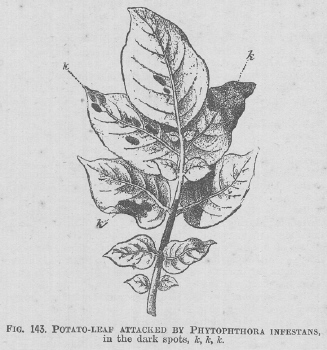
FUNGI. By far the most destructive of the Fungi parasitic on Potatoes is that which causes "Potato Rot," and which is described under the heading Phytophthora infestans (which see). It is unnecessary to repeat what has already been said, and therefore the reader is referred to the above-named article for an account of this Fungus. The tubers suffer greatly from its action on them, though the action is less speedy than it is on the green parts of the plants. But even where the Fungus has not itself severely affected a tuber, the latter is rendered a suitable food for various species of Fungi which grow on it, and cause its decay by either Dry Rot or Wet Rot. The Fungi that grow on Potatoes under these conditions have been carefully studied by the German botanists, Reinke and Berthold; and they, in 1879, published an account of their researches ("Zersetzung der Kartoffel durch Pilze"). Of the many Fungi that they found on rotting Potatoes, they attribute the chief share to a few--viz.: in Dry Rot, to Fusisporium (Hypomyces) Solani, Nectria Solani, Verticillium cinnabarinum, Choetomium crispatum, and c. bostrychodes; and, in Wet Rot, to Bacteria (Bacterium navicula and Baccillus amylobacter), although the Fungi of the Dry Rot were also present. They recommend exposure to air and heat, either of the sun or of artificial origin, to check the decay, by drying the substance, and to save as much of the starch as possible for conversion into dextrine, in which form it is now largely used. But other Fungi besides Phytophthora infestans attack growing Potatoes. One of the more dangerous of these is described in W. G. Smith's "Diseases of Field and Garden Crops" (pp. 15-29) under the name of Peziza postuma; but this Fungus is so like some others (Peziza ciboroides, P. sclerotiorum, &c.) that its specific rank is doubtful. Mr. Smith states that Potatoes in the West of Ireland were observed, in 1880, to suffer from a peculiar disease; but this was not fully traced to its cause in that year. It appeared at Stavanger, in Norway, in 1883, and also in the North of Scotland, where Mr. A. S. Wilson has grown the Fungus to maturity, i.e., till the production of the Peziza. The diseased plants become covered with a dense coat of white mycelium; and, in a week or two from its first appearance, this kills the plants, withering up and drying the leaves. In the mycelium upon the stems there appear very many oval or rounded, hard masses, of all sizes up to 1/2in. across. They become black externally, but remain white inside. These bodies are sclerotia, and consist of very compact masses of mycelium, and the black coat is made up of small, angular cells, with dark, thickened walls, closely united in growth. The sclerotia pass the winter unchanged, but the following summer there grow, from those lying on or under the soil, from one to three Pezizoe, which have very long, slender, twisted stalks, each of which ends in a cup, which very soon becomes flat on top, and may reach 1/2in. across. The upper surface bears the very numerous asci standing side by side; each ascus incloses eight smooth, oval spores, which are ejected from it if the air is at all dry. If the spores fall on a suitable food-plant, they reproduce the Fungus.
All Potato haulms, and other rubbish, should be burned, instead of being left to infect the crop of next year. Deep ploughing or digging would bury the sclerotia too deep to allow the Peziza cups to reach the surface of the soil.
Potato Curl is a puzzling disease, since no evident cause could be detected by some observers, while Fungi have been discovered by others in the diseased plants. It was first observed in England in 1764, and soon afterwards was noticed in Rhenish-Germany and elsewhere. It has become less hurtful since 1820, or thereabouts. The young stems and leaves curve or curl up; the whole plant becomes sickly and stunted, and extremely brittle; the stems branch little, if at all; the leaves are small, and almost sessile; and the flowers and fruit often fall off prematurely, and all the green parts become mottled. Tubers are either not produced, or they are very small, and so watery as to be unfit for food. If used as seed potatoes, the disease usually, if not always, appears in the plants grown from them. Careful microscopic examination of the diseased plants has led to very different conclusions as to the cause, some observers (e.g., Kuhn) failing to detect any trace of Fungi, while others (e.g., Hallier and Reinke) have found them in the interior of the diseased tissues. Hallier asserts, and Reinke agrees with him, that the disease is hereditary, or that diseased tubers produce diseased plants, and that these plants are not capable of forming tubers; that mycelium of Fungi is present in the inner tissues of the plants; and that infection with this mycelium will produce the same disease in previously healthy plants. Reinke and Berthold give the following account of the disease. The mycelium is present, they say, in the woody bundles of plants as soon as they begin to wither, and in badly-affected plants it may be traced throughout from the roots to tips of the leaf-stalks. It may also often be found in plants that show no outward sign of disease. If the plants are kept in a damp atmosphere, their whole surface becomes covered with a white coat of conidiophores, or spore-bearers, of Fungi, pushed out from the mycelium through the epidermis. These are, at first, colourless; and each bears two or three circles of short branches at the ends of the cells, which, in a single row, form the erect stem. There are from two to five branches in each circle, and one or more of them may bear one or two smaller branches. On the tip of each branchlet there grows a small, oval spore, which falls off on being wetted. They suggest for this Fungus the name of Verticillium atro-album. Mycelium was found in the tubers, even on plants that appeared moderately healthy.
In a second form of Potato Curl, the plants grow to full size, but then the edges of the leaves begin to curl backwards, and to become brown; and this extends to the whole of each leaf, and gradually back to the stems. Microscopic examination shows no Fungi in the leaves, or in the upper part of the stems; but underground the stems are marked with large, brown spots, and in the cortex of these spots the cells are traversed by mycelium, while the vessels show no trace of it. The roots also are brown and diseased, and the seed-tubers are often rotten. Cultivation of the Fungus showed it to be V. atro-album. At times, both forms of disease occur in the same plant. Tubers produced by plants affected in either of the above ways are almost always diseased, and produce shoots that, from their first appearance, are evidently diseased. These shoots develop slowly, and remain small, stunted, and of an unhealthy colour. Dark spots appear on the leaves and on the leaf-stalks, and the leaves gradually wither from below upwards; and similar changes go on in the stems. The plants perish without being able to form new tubers. No Fungi have been detected in the leaves or stems of shoots produced by diseased tubers; but all the subterranean parts have the bark permeated by mycelium, though there is none visible in the woody bundles. The diseased tubers show an abundant mycelium in the corky layers of the skin. Cultivation of the mycelium, in each case, has yielded V. atro-album. Inoculation from diseased plants rendered previously healthy plants diseased; and healthy tubers planted in soil impregnated with conidia of V. atro-album produced diseased shoots. Reinke and Berthold suggest that V. atro-album may be an imperfectly-developed condition of some Pyrenomycetous Fungus of the genus Nectria, or closely allied to it, and oppose the view advocated by Hallier, that the cause of Potato Curl is Pleospora polytricha; nor do they think the disease is caused by any species closely allied to the genus Pleospora. Schenck, in a series of observations and cultivation of the diseased plants, obtained from some of them Fungi which were much like one form of conidia attributed to Pleospora herbarum, and which he called Sporidesmium exitiosum var. Solani. It is evident that there is need of further observations, since there may be more than one cause of this disease, and true parasites may be confounded with Fungi that grow only on tissues already dead. No cure is known; hence, prevention is the aim to be kept in view. Diseased plants should be pulled up and removed as soon as detected; and all the Potato-stalks should be collected into heaps and burned. Care should also be taken to prevent unsound tubers from being made use of as seed. In short, the means employed to limit the spread of Potato Rot, and of Peziza postuma, are equally applicable against Potato Curl.
In common with other herbaceous plants, the Potato affords, in its dead stems and leaves, an abundant food supply to many kinds of Micro-fungi; but, as none of these are known to be injurious to the plants during life, they do not require even to be enumerated here.
Potato tubers are rendered unsightly, at times, by the skin being more or less covered with brown patches or scabs. These may be due to various causes. In some cases, a microscopic examination shows that the scab is due to the growth of a Fungus, named Tubercinia scabies, the spores of which are formed of small cells, grouped into a globe around an air space. Each spore has a slender stalk at one side. There is often no trace of this Fungus at harvest-time; but, during the winter, it develops, and the spores form a layer beneath the skin, often extending over a great part of the tuber. After a time, the spores are set free by the bursting of the skin. In other forms of scale, the cells are filled with mycelium of Fungi, and the formation of the scab is probably due to the irritation caused by its presence in the tissues. In others, there is no trace of the action of Fungi; and it has been conjectured that the cracks, followed by scabbing, are due to contact with irritant or corrosive substances in the soil, and that the scabs are due to efforts at healing the injury; but new cracks form in them, and so the mischief goes on. The raw surfaces of the cracks render the tubers more liable to injury from Fungi, insects, frost, and other external causes. Scabbed Potatoes are diminished in value because of their unsightliness; but they do not seem unfitted for food when the skin is removed. They should not, however, be used as seed. When the cause is in the soil, it should be either removed or counter-acted. Potatoes should not be grown in soil known to give rise to scabbing. INSECT PESTS. There are no insects, in the British Islands, absolutely confined to the Potato as their food; but several occasionally devour this, as well as other cultivated plants. To begin with those that eat the roots and tubers. Amongst the worst are the larvae of several kinds of Skipjack Beetles, which bore holes in the tubers, to which they are very partial (see Wireworms). The larvae of Cockchafers (Melolontha vulgaris) and Mole Crickets (Gryllotalpa vulgaris) also gnaw them, and the roots at times (see Cockchafer and Mole Cricket). The larvae of certain Noctuae, or Night Moths (see Noctua and Turnip Moth), are sometimes very destructive to the tubers, but do comparatively little harm to the other subterranean organs, since, as a rule, they do not feed at the season of growth of Potato-plants. Among the most harmful are the Heart-and-Dart Moth (Agrotis exclamationis), the Turnip Moth (A. segetum), and nearly-allied species. The larvae of Crane Flies (Tipula oleracea and allies), commonly known as the Grub, or as Leather Jackets, because of the toughness of their skins (see Crane Fly), frequently injure the roots of growing Potatoes, and may also feed on the young tubers, though most destructive to grasses. Many kinds of small Diptera live, as larvae, in decaying Potato tubers, and Curtis, in his "Farm Insects," has recorded ten species reared by himself from this food; but there is no evidence to show that they injure healthy tubers. Millipedes, including Polydesmus complanatus, and one or two species of Julus (see Millipedes and Myriapoda), are often found feeding in the tubers, but they hardly seem to bore into them if quite healthy, and, in general, appear to take advantage of holes scooped out by the larvae already mentioned, or to bore into tubers which are softened by disease. Centipedes also (see Myriapoda) are often found in holes in the tubers, but they are all carnivorous, and probably assist in reducing the number of destructive larvae. Last of the animals that destroy the tubers, must be mentioned the various kinds of Slugs, which eat large holes in them, and continue to feed in these till, occasionally, there is little left of the smaller tubers (see Slugs). Slugs do not seem to do much harm to the green parts of Potato-plants.
The green stems and the leaves are not, as a rule, liable to severe insect attacks with us, though in North America they suffer much damage from this cause. The more injurious of these American insects will be here briefly referred to after mention has been made of such as have been observed in Britain.
Curtis records finding a beetle (Macrocnema exoleta), allied to the Turnip Flea, feeding on the leaves of Potatoes, and still more abundantly on the Bitter-sweet Solanum Dulcamara). The beetle has the head black, the thorax deep ochreous, the elytra pale ochreous, except a pitchy line down the suture, and the limbs pale. It is from 1/12in. to 1/8in. long. These pests can scarcely be ranked as a serious danger to the Potato crop, but, should they become dangerous to it, they may be reduced in numbers by the same methods as are employed against the Turnip Flea
Of moths, few live, in the larval state, on Potato leaves; but one species is almost restricted to this plant--the Death's Head Hawk Moth (Acherontia Atropos). This moth is one of the largest and handsomest of our native species. The appearance, form, and markings, are shown in the woodcut; but the spread of wings may be 5in. The fore wings are a fine brown, with darker and paler markings, and a conspicuous yellow dot in the centre. The hind wings are orange-yellow, with two dark bands. The body is yellow and brown, with six black cross bands on the abdomen, and a row of six bluish spots down the middle of the back. The thorax bears, between the fore wings, a large mark, like a skull, or "Death's head," whence the popular name. Because of this mark, also, the insect is much dreaded, in various parts of Europe, by superstitious rustics and others, as ill-omened; and this impression is deepened by the power (very rare among moths) of emitting a sharp squeak when handled. The larva and pupa can also emit peculiar sounds. The larva feeds now chiefly on Potatoes; though it has also been found on the Jasmine, the Deadly Nightshade (Atropa Belladonna), and the Tea-tree (Lycium barbarum). It reaches a very large size, tapering a little towards the head, but ending abruptly behind, where it bears a small horn, very rough, yellowish, and bent downwards, but turned up at the tip. The creature is smooth, and is usually pale yellow on the back, and green near the head and along the lower part of the sides. There are seven oblique, violet or blue stripes, on each side, each pair of which meet on the back. The body is sprinkled with minute, black dots. A variety sometimes occurs of a brownish-olive, with the stripes darker. The larvae feed only by night, hiding in the soil by day. Their large size renders them somewhat destructive; though they are never so common as to endanger the crop. When full-fed, they crawl under ground, and there each forms an earthen cell. In this it turns into a large pupa of a red-brown colour. Some of the moths may emerge in the late autumn, and hybernate; but most do not appear till spring. Should it be necessary to reduce the numbers of larvae, they must be sought for at night, by lantern light, on the ravaged plants; their large size renders them conspicuous. The pupae are frequently turned up in the fields during Potato harvest.
Several species of Hemiptera, or Plant-bugs (see Insects), have been recorded by Curtis, in "Farm Insects," as living on Potatoes, boring into the tissues with their long, sharp beaks; and, by sucking the sap from the green organs where abundant, they greatly weaken the plants. Several of them belong to the group Hemiptera Heteroptera, in which the fore wings have the basal half leathery, and the other half membranous. Curtis mentions several, as found by himself, feeding on the Potato crop, all of them belonging to the genus Lygus. These insects are green or ochreous, passing into rosy, and are about 1/4in. long. He also describes two species of Frog Hoppers, which belong to the group of Homoptera, which have the wings of uniform texture (see Frog Hopper). These are also about 1/4in. long. One of these (Eupteryx picta) is yellow with black spots, and brown clouded markings on the front wings. The other he names E. Solani, as a new species (G. C. vi. 388), and describes it as lively green, with the tips of the fore wings rusty-brown. The name is noticed in the latest list of British Homoptera as a synonym of Chlorita viridula, Fall.
Remedies. These Hemiptera undoubtedly do harm when very numerous. Probably, the most effective means of reducing their numbers would be to sweep the rows of Potatoes, every now and then, with a large insect net, removing and destroying the insects caught. Applications to the plants are scarcely required, though Paris Green, applied as recommended for the Potato Beetle, would be effective.
Aphides do so little harm that it is scarcely necessary to refer to them. The only species noted by Buckton, in "British Aphides," as feeding on Potatoes, is A. urticaria. Two or three others have also been recorded from the Continent.
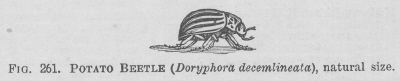
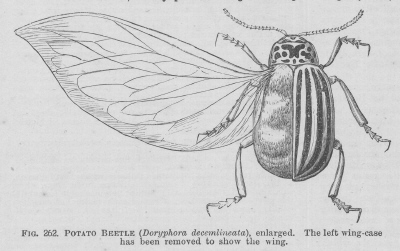
The insects most hurtful to Potato-plants in the United States of America, and in Canada, are beetles, most of them belonging to the group of Blister Beetles, of the genus Lytta. Five species of this genus have been observed to feed on the leaves and stems, but only as beetles. There seems little reason to fear injury from them on this side of the Atlantic, since their habits do not favour the chances of their being accidentally imported. The same holds good of the Three-lined Leaf Beetle (Lema trilineata), one of the Chrysomelidae, which lives, as larva and as beetle, on Potatoes; the larva shelters itself under a coating of its excrements. The famous Colorado Beetle (Doryphora decemlineata) requires a longer notice, and this will be found under the heading Potato Beetle. Still another American beetle that injures Potato crops is the Potato-stalk Weevil (Baridius trinotatus), which does harm only while in the larval state. The larva bores into the stems near the base, and eats downwards towards the root, killing the plants. It is white, and legless. The beetle is a dark, long-snouted Weevil, about 1/5in. long. It does not seem likely to be transported over seas to us; nor does there seem reason to fear the introduction of the other American insects that injure Potatoes.
SORTS. Varieties of Potatoes are exceedingly numerous, and new additions are annually made. It is requisite to have a selection of early, second early, and late ones, for maintaining the supply throughout the year. Some few sorts are grown in immense quantities because of their generally good flavour and cropping qualities under varied circumstances; others--a far larger proportion--are grown for private consumption, on a more limited scale, in gardens, and also by persons who exhibit collections at shows. Soil and locality have an important bearing on the quality and productiveness of different varieties of Potatoes, and the effect on each can only be properly learned by experience. A few good sorts known to succeed should always be depended upon, and new ones tried at first in small quantities, until their respective merits are ascertained. The extent to which any sort will withstand disease, especially in an unfavourable season, is now a material consideration when judging of its suitability for extended cultivation. Subjoined is a limited selection of sorts which are amongst those most approved. Kidney-Shaped. ASHLEAF, MYATT'S PROLIFIC, a well-known, prolific sort, which follows the old variety in season. ASHLEAF, OLD, a very old variety, but still one of the best for early supplies. ASHLEAF, VEITCH'S IMPROVED EARLY, a very heavy cropper, of handsome appearance, excellent quality, fine flavour, and a first-rate forcer; quite distinct. BEAUTY OF HEBRON, a heavy cropper, and early; tubers very handsome, smooth in texture, and slightly tinged with pink around the eye; fine for exhibition. COSMOPOLITAN, an excellent early white variety, of fine form, very productive, and of superior table quality. COVENT GARDEN PERFECTION, a second early white variety, of medium size and very handsome shape; a heavy cropper, and remarkably free from disease; fine for exhibition. EARLY DWARF-TOP, very small top, early, and fine for forcing. EARLY ROSE, a first early, American variety, of great productiveness. INTERNATIONAL KIDNEY, very handsome in shape; one of the finest exhibition Kidneys LAPSTONE, a well-known and good sort, of fine shape, and excellent quality. MAGNUM BONUM, a late, heavy cropper, of robust growth, and very free from disease. MISS FOWLER, a handsome late, white variety, seedling from WOODSTOCK KIDNEY, but much more prolific, and a thorough disease-resister; top growth strong and robust; a very heavy cropper; tubers of moderate size, very even, and of finest table quality. PRINCE ARTHUR, one of the best main crop Potatoes; a heavy cropper and excellent keeper; the flesh is white, and, when boiled, very floury, and of first-class quality. WELFORD PARK KIDNEY, tubers large, of first-rate table quality, very smooth, with clear, white skin; one of the finest varieties for exhibition or table use. WOODSTOCK KIDNEY, a very handsome variety, of beautiful shape, with very level eyes and rather rough skin; a good cropper, white and mealy when cooked; fine for exhibition. WORMLEIGHTON SLEDLING, excellent for table use; a great cropper and good keeper. YORKSHIRE HERO, a variety of unusual excellence; one of the finest of the LAPSTONE section; smooth, handsome tubers of highest quality, and a long keeper.
Round. BEAUTY OF KENT, a very handsome, second early variety; the tubers are flattish-oval in shape, and of a rich rosy-pink colour, and keep good till March; a fine variety for exhibition. BEDFONT PROLIFIC, a second early sort, very heavy cropper, of the finest quality, and a handsome exhibition variety. BLANCHARD, a fine, large variety, of handsome shape, with clear, white skin, beautifully streaked with purple; very desirable for exhibition purposes. DALMAHOY, a second early variety, of excellent quality; one of the best for general use. DUNBAR REGENT, a well-known, good late sort, very productive. EARLY COLDSTREAM, a remarkably early and prolific variety, of beautiful shape, and very white and floury; fine for forcing. EARLY REGENT, early, productive, and of good flavour. GRAMPIAN, a handsome and distinct, early variety; skin pinkish-white, flaked with rich rosy-pink round the eyes; an abundant cropper. M.P., a really excellent white variety, with rather deep eyes; seedling from PATERSON'S VICTORIA, of dwarf, stout growth, the crop remarkable for quantity and evenness, of most excellent size, and the quality all that can be desired; it is a second early, but requires time to ripen for the table. PATERSON'S VICTORIA, an excellent sort for general use, large, and very productive, PORTER'S EXCELSIOR, a remarkably handsome variety, superb for exhibition. RADSTOCK BEAUTY, tubers singularly handsome, and of fine quality; a robust grower and heavy cropper. READING HERO, a heavy cropper, of excellent quality, and very free from disease. READING RUSSET, a heavy cropping, second early variety, of good quality. RED EMPEROR, OR MAIN CROP, skin clear light red, very handsome tubers; fine for exhibition. SCHOOLMASTER, a very superior main crop variety; tubers large, round, of regular form, with small eyes; flesh white and floury when cooked; an abundant cropper, very handsome, fine for exhibition, and excellent for general use. SCOTCH CHAMPION, a good main crop variety, a heavy cropper, and very free from disease. VICAR OF LALEHAM, a very fine and distinct variety, seedling from VICTORIA; the tubers are purple, round, and of very handsome shape, with beautiful white flesh, of first-rate table quality, and fine for exhibition purposes.