Punica
(called by Pliny Malum Punicum, the Punic or Carthaginian Apple, probably with some allusion to puniceus, scarlet; referring to the colour of the flowers). Pomegranate. ORD. Lythrarieae. A monotypic genus; the species is a very handsome, hardy, deciduous tree. The fruit of this genus is remarkable in being composed of two whorls of carpels, one placed above the other, the lower consisting of three or four, and the upper of from five to ten, carpels; the seeds have a pellucid, pulpy covering. For culture, see Pomegranate.
P. Granatum.* Common Pomegranate. fl. red, from two to five together, almost sessile, rising near the tops of the branches. June to September. l. lanceolate or oblong, entire, dotless. Stem arboreous. h. 15ft. to 30ft. Orient and North-western Indian (largely cultivated throughout the tropics), 1548. (B. M. Pl. 113; B. M. 1832.) Of this well-known and handsome tree, there are several forms, including the following:
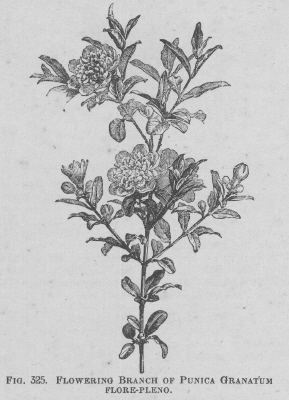
P. G. flore-pleno (double-flowered). fl. white, having the calyx yellowish, double. Garden variety.
P. G. nana (dwarf). fl. much smaller than those of the type. fr. about the size of a Nutmeg. l. narrower, linear. Stem shrubby. h. 5ft. to 6ft. 1723. (B. M. 634.)
In addition to these, there are a number of garden forms, varying more or less in the colour of the flowers.