Pupa
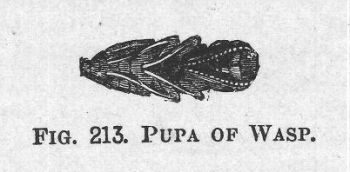
The third stage in the development of an insect. Let us take, as an example, the Large White Cabbage Butterfly. This butterfly is familiar to everyone in summer and autumn, flying in gardens, even in the heart of cities. The female lays eggs on the Cabbage leaves. From this first stage, after an interval, larvae (the second stage) emerge, very worm-like in form, with a number of similar body-rings, and a distinct head, with strong jaws for cutting the food. Each of the three segments immediately behind the head bears a pair of true, though short, jointed legs, which correspond to the three pairs possessed by the greater number of perfect insects. The sixth to ninth segments, and the last one, each bear a pair of fleshy claspers, or "prolegs," by means of which, usually, the larvae cling to any support, while the true legs are used for holding their food, as well as for walking. The claspers are not jointed, but belong to the skin in their origin, and are not present after the larval stage. When the larva is full-fed, it crawls away to search out a safe resting-place, and then spins round its middle a silken cord, which is fixed at both ends to the support. The tail, also, is fixed to the support by a pad of silk. The larva then sheds its skin, and the Pupa emerges, of the form shown. This figure shows the wing-cases protecting the future wings, and also the sheath for the left antenna. All the limbs of the perfect insect are indicated on the outer shell of the Pupa, though bound down immovably, and all useless to the insect in this stage. Throughout this stage of development no food can be eaten. The Pupa is often called chrysalis (from the Greek work chrysos, golden), because of the metallic-yellow spots that appear in the Pupae of certain common Butterflies, e.g., the Tortoiseshell. From the Pupa, usually after the winter has passed, the perfect insect emerges, bursting the skin on the front half of the back along the middle line, and crawling out. At first, the wings are only the size of the wing-sheaths of the Pupa, but, in an hour or so, they grow to their full size, and become stiff and firm, and fitted for flight This example has been selected for description as one in which the Pupa differs much in appearance, powers of movement, and many other points, from the larva on the one side, and from the perfect insect on the other. But, in several large groups of insects, the difference is less marked; e.g., the Pupa of a wasp has the limbs not bound down to the body, though it moves them little, and cannot eat any food. The Pupae of beetles resemble those of wasps in this respect. Among certain orders of insects, the metamorphosis in incomplete, and the Pupa in these orders usually resembles the perfect insect in all points, except that the wings are represented only by rudimentary organs, quite useless for flight, and the larva differs from the Pupa only in its smaller size, and in the entire absence of any trace of wings. In these, the Pupa is as active, and feeds as voraciously, as the larva. As common insects that exemplify this condition of Pupa, may be mentioned Aphides, Crickets, and Grasshoppers. The helpless Pupae, such as are met with among Coleoptera, Diptera, Hymenoptera, and Lepidoptera (see Insects) are usually protected in a cocoon, spun by the larva when it has reached a safe retreat, though a few resemble the Cabbage Butterflies in making no cocoon. Very often the retreat is underground, many of the larvae burrowing, and making the cocoons in the soil, chiefly of grains of earth, cemented by a silken network, or by a fluid emitted from the mouth.