Quince
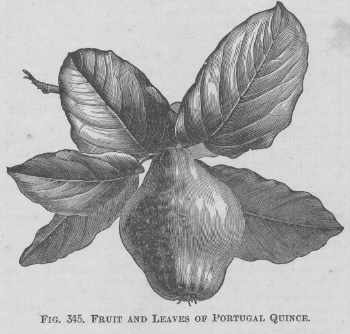
(Cydonia vulgaris). The Quince is a native of Northern Persia, but naturalised throughout the Mediterranean region, &c., whence it was long since introduced to this country. It forms a spreading, deciduous tree, the branches of which are usually much contorted. The fruits emit a powerful and rather peculiar perfume when ripe, and are exceedingly acid and astringent in a raw state. They are chiefly used for making a kind of marmalade, and other preserves, and for adding, in small quantities, to Apples when cooking, to give briskness and increased flavour. The chief use of the Quince-tree is, perhaps, that of providing stocks whereon to graft Pears. It is naturally inclined to root near the surface, and the roots are fibry, in comparison with those of the Pear itself, which is also used. The Quince stock possesses, in most instances, the valuable property of dwarfing the growth of Pear-trees, and causing them to become more productive than they would be on their own roots; hence, it is extensively and most successfully used for this purpose (see Pear). Most orchards--in all the southern parts of the country, at least--are furnished with one or more specimens of Quince. The trees seldom perfect their fruit northwards.
Propagation is most generally effected by cuttings and by layers; by seeds also, when any are obtainable. Cuttings of the current year's wood, with a heel of two-year-old wood attached, may be inserted in the open ground, early in autumn. They soon root, and will be ready for grafting or budding about the second, or sometimes the third, year afterwards. Layers may be obtained in quantity from an old stool that has been cut down. Young shoots proceed from the base, and when firm enough, the following autumn, these may be layered, or the stock itself covered with soil, into which the new growths will root. The following autumn, they may be detached and planted in nursery rows, and the next year other young ones will again proceed from the stock, which may, in turn, be similarly treated.
The Quince is not naturally inclined to grow straight and upright; to get standard trees, therefore, considerable attention and encouragement are necessary in training to get a vigorous and tolerably straight stem. As a stock, the Quince is not much required to from standards: the straight stem may be obtained, as a rule, more easily by adopting a system of double-grafting, as described under Pear.
Quince-trees succeed best in rather moist situations, where the soil is rich and somewhat light, not of a heavy, clayey nature. An open, sunny situation is necessary where the ripening and perfecting of fruit is of importance. The fruits may be allowed to hang on the tree until the approach of frost: they are seldom ripe before the end of October. When gathered, they should be laid on clean straw, or on a cool fruit-room shelf, away from other specimens of fruit, until becoming quite yellow, when they will be fit for use.
There are only three principal varieties of Quince cultivated for the use of their fruits. These are enumerated below.
Apple-shaped. Fruit roundish, somewhat similar to an apple, of a rich golden colour when ripe. Tree very productive.
Pear-shaped. Fruit pyriform, rather larger than the preceding, and later in ripening; skin also paler-coloured, and rather woolly. This is the variety most commonly grown.
Portugal. Fruit very large, sometimes 4in. long and 3in. in diameter at the thickest part, elongated, and often irregular in outline; skin deep yellow, thickly covered with a woolly substance. This variety is superior in flavour to either of the others, but the tree is not so productive. It grows very vigorously. See Fig. 345.