Quisqualis
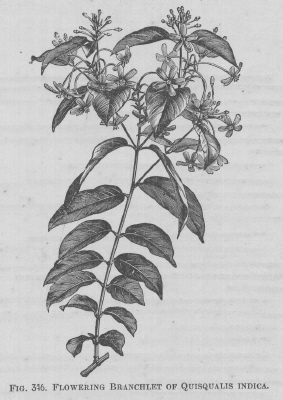
(from quis, who, and qualis, what kind; it was uncertain, when the name was given, to what class or order the genus belonged). ORD. Combretaceae. A genus consisting of two species of stove, climbing shrubs, with slender branchlets, native of tropical Asia and tropical and South Africa. Flowers white or red (colours variable), showy, disposed in short, axillary and terminal spikes, sometimes racemose; calyx tube produced a considerable length above the ovary; petals five, large or small, obtuse. Fruit rather large, dry, oblong, coriaceous, five-winged, one-seeded. Leaves opposite or nearly so, membranous, oblong or obovate, acuminate, entire. Q. indica thrives in a compost of peat and loam, the latter preponderating. Propagation may be effected by cuttings of the young shoots, taken off with a heel, and inserted in sand, under a bell glass, in bottom heat. The other species, Q. parviflora, a native of Natal, is not in cultivation.
Q. glabra (smooth). A synonym of Q. indica.
Q. indica (Indian).* Rangoon Creeper. fl. varying in colour from orange to red, beautiful, sweet-scented; petals oval-oblong, adpressedly pubescent. May to August. l. ovate, acuminate. Tropical Asia and Africa, 1815. Plant pubescent or glabrous.(B. M. 2033; B. R. 492.) SYNS. Q. glabra, Q. pubescens, Q. sinensis (B. R. xxx. 15).
Q. pubescens (downy). A synonym of Q. indica.
Q. sinensis (Chinese). A synonym of Q. indica.