Important: Safety Warning
This page recommends pest-control substances such as arsenic compounds, strychnine, or cyanide — in some cases applied to food crops. These substances are lethal to humans and animals, and their use is now banned or strictly controlled.
This information has been left in for historical purposes but should not be acted upon.
Raspberry
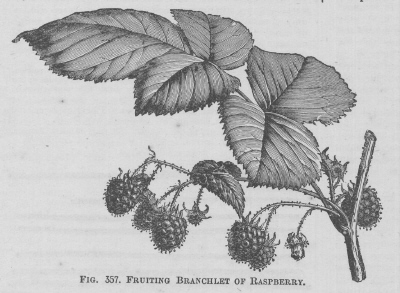
(Rubus Idaeus). The Raspberry is a native of most European countries, including Great Britain. It is a deciduous shrub, with a creeping, perennial rootstock, and a biennial stem. The fruit is extensively employed for cooking and preserving in various ways; it is also favoured for dessert, and largely used in the manufacture of Raspberry brandy, wine, vinegar, &c. When first ripened, it has a fine aroma, which is generally not retained longer than a day or two afterwards. Raspberry shoots, which are technically termed "canes," proceed annually from established plants, either from the rootstock or as suckers from the root. They grow through the summer, ripen and lose their leaves in autumn, and bear fruit the following season, on little branchlets, which are produced from the joints (see Fig. 357). In the following autumn, these canes die down, and their place, the next season, is occupied by others that will have been growing in succession. These remarks have reference to the summer-fruiting varieties; those which bear in autumn do so on the points of shoots made during the summer.
PROPAGATION. Raspberries are propagated from seeds, suckers, or offsets, and occasionally from cuttings. Seeds required for sowing should be saved from large, well-ripened fruits. They should be washed, to separate them from the pulp, and afterwards dried a little, yet not too much. If shown at once, in sandy soil, they will vegetate in the spring, be ready for transplanting the following autumn, and bear some fruit the second year. Propagation by suckers or offsets is the plan most generally adopted. These must be carefully detached from established plants, when they proceed from near the base; the root-suckers, which often spring up some distance away, may easily be transplanted. October and November are the best months for making new plantations, and for removing suckers; but the work may be performed, during fine weather, later on in winter. Cuttings are seldom inserted, unless for increasing any particular variety more rapidly than suckers alone admit.
CULTIVATION. Ground intended for a new Raspberry plantation should be well trenched, and have plenty of manure intermixed. A good depth of soil is essential, and a rather moist situation is preferable. When trenching, the subsoil need not be brought to the surface if it is of an inferior description, but it should be moved to a depth of from 2ft. to 2 1/2ft., and have some decomposed manure mixed with it. The usual method of planting is in rows, about 5ft. apart, a distance of not less than 3ft. being allowed between plants in the row. Canes may be arranged singly, in twos, or in threes; when more than one are planted, a space of 6in. should be allowed between them. Two or three canes form a full-sized bush on a stake in a much shorter time than one; but, of course, many more are required, in the first instance, to form plantation. After the canes are planted, they should be cut down to within 1ft. of the ground; this will encourage the production of stronger growths the next summer than could be expected if they were allowed to fruit the first year. The following autumn, the canes should be tied to stakes, and shortened to a height of about 6ft.; the plantation may then be considered established. In the second season, these canes will bear fruit from the side branchlets, and suckers will proceed from the base, to form others for fruiting the succeeding year; about six of the strongest will be sufficient to leave on each plant; the remainder should be removed early in the season as they appear. The pruning for this and successive seasons consists in cutting away the old canes any time after fruiting, and tying the new ones in the autumn to take their place. Raspberries are sometimes trained to a trellis formed horizontally with strained wire, or narrow strips of wood about 1in. thick, with upright stakes at intervals. The plants for training against these may be arranged about 2ft. asunder, and old and young canes should be trained alternately as far as convenient. Another method of training is that of arching, for which purpose plants may be inserted 4ft. apart, and the tops of one trained over to meet those of that adjoining.
A top-dressing of manure should be applied to Raspberry plantations in the autumn: it may be lightly forked in, but the soil should never be stirred to a great depth; otherwise, many of the surface-roots would be destroyed. When very large fruits are required, but few bearing shoots should be allowed, and these only of the strongest description. The young shoots from a few stools might be kept removed, in order to throw additional support into those fruiting; this, however, would prevent the development of canes for bearing the succeeding year.
FUNGI. Though a good many Fungi grow on dead Raspberry canes, this plant does not experience serious damage from parasitic Fungi. The most common one is a Brand, belonging to Phragmidium, a genus of Uredineae, characterised by having the more conspicuous spores (teleutospores) composed of a row of cells, end to end (see Phragmidium). The leaves of the Raspberry in autumn are often thickly sprinkled with small, black dots, made up of masses of spores of P. Rubi-Idaei, Pers. (P. gracilis, Grev.), or the Raspberry Brand. The spores are cylindrical, or nearly so, contain from six to ten cells, and end in a conical point. The dark masses are preceded by yellow spots, which are the aecidia, or the uredo form of this plant. These yellow spots are made up of spores, roundish or elliptical in form, yellow in colour, and prickly; but the aecidiospores are produced in rows, while the uredospores grow singly on the tips of short stalks, which are crowded together in separate spots.
The living leaves of Raspberries frequently have the upper side sprinkled thickly with black dots, smaller than those caused by Phragmidium. These are the perithecia of Coleroa chaetomium, Kunze (Stigmatea Choetomium, Fries.), one of the Pyrenomycetes. With the microscope, it is seen that they lie on the surface of the leaf, and are bristly, globular, and thin. Each contains a number of asci, each of which incloses eight two-celled spores.
Both kinds of Fungi are apt to cause the premature discoloration and the fall of the leaves, but it can scarcely be said that they seriously affect the welfare of the plants. The only remedy is to pick off the speckled leaves, or to cut down and burn those plants that are seriously attacked; but this is seldom, if ever, necessary.
INSECTS. The roots are, in common with those of other plants, liable to be cut and eaten by Mole Crickets, and by the usual subterranean larvae (e.g., Cockchafers, &c.). Damage from this cause is so seldom serious that it need not be dwelt on. The young canes, and the fruit, on the contrary, are sometimes very much injured by certain insects. Among these, the following have been recorded in Miss Ormerod's valuable "Reports on Injurious Insects," for 1879 and 1883, as peculiarly destructive. Certain Weevils (Otiorhynchus picipes, O. sulcatus, &c.) gnaw the young shoots, killing them, and greatly weakening the plants, many of which perish when the attack is severe. Besides this, the beetles gnaw through the bases of the flower shoots, either cutting them off entirely, or biting half through them, causing them to wither, and destroying the crops. For a description of these insects, see Otiorhynchus. They hide, during the day, under any shelter they can reach, and, as they are wingless, this must be near the plants. Hence, pieces of bark, or similar objects, placed in their haunts, prove good traps, and have been used with success for their capture, since they are easily cleared off the lower surface of such traps. Any sticky substance smeared round the stems would prevent the ascent of the insects to the flower-shoots; but this method is too laborious to be employed for any but choice plants. The most effectual means of destroying the beetles has been found to be shaking the plants after dark over shallow wooden trays, smeared with tar round the sides, to prevent the escape of the insects, which may then be killed by being thrown into boiling water. In certain districts in the south-west of England, and in France, the Raspberry crop has been injured to the value of hundreds of pounds in a season.
The larvae of a small moth (Lampronia rubiella), the Raspberry-bud Caterpillars, have been found feeding in such numbers in tips of the young shoots, eating their way down the centre, from near the tip towards the base, that the plants were severely injured. These larvae are bright red, with the head brown. They spin cocoons among dead leaves, in early summer; and, in two or three weeks, from them moths emerge about 1/2in. in spread of fore wings, which are brown, with gold spots. The larvae emerge from the eggs in autumn, and feed on the leaves; but in spring they bore into the shoots. They probably hybernate in the soil around the plants; hence, this should be turned over, to expose them to birds, damp, and cold. When the young shoots droop at the tips, the larvae should be looked for, and, if they are found, the diseased shoots ought to be removed and destroyed, with the larvae in them.
A second Weevil (Anthonomus Rubi) may be called the Raspberry Weevil, inasmuch as it lives in the flower-buds of Raspberries and of Brambles. It is about 1/8in. long by 1/24in. broad, black, with a fine, grey pubescence, and white scutellum; the wing-cases and the thorax are thickly pitted; the thighs are scarcely toothed. The colour varies so much as to have led to the forms being regarded as species, and named as such. The female bores a hole in each flower-bud, in early summer, and pushes in an egg. She usually gnaws half through the stalk of the bud, and the latter is apt to fall off. The larvae feed on the parts of the flower-bud, and the beetles appear from the buds in July, and hybernate during winter. When they prove troublesome, they may be shaken off the plants, as recommended for the species of Otiorhynchus, and the infested buds may be picked off and destroyed. See also the remedies under Apple-blossom Weevil.
Another beetle is recorded in the Report for 1883 as "causing fearful havoc, and entirely devouring the Raspberries" in Kent. This is the Raspberry Beetle (Byturus tomentosus). The beetle is about 1/6in. long by half as broad. It varies in colour from dull yellow or reddish to brown, and is densely covered with fine grey pubescence; the eyes are black, and the limbs are dull yellow or reddish-yellow. The female bores, like Anthonomus rubi, into the flower-buds; and the larvae live in the fruits, which may ripen. The larvae have six short legs, are rather flattened, and taper to each end. The head is pale brown; the body yellowish, darker on the back. The larvae, when mature, leave the fruits, and shelter themselves in crevices, e.g., in cracks of bark of the Raspberry canes, and there form their cocoons, and become pupae. The beetles emerge in spring. The same remedies may be used against these insects as have been recommended against the other beetles on Raspberries. A very similar insect (B. unicolor) is found in the United States of America on Raspberries. The leaves of Raspberries are frequently mined by larvae of various kinds, which produce in the leaves conspicuous pale winding tunnels. About the most hurtful of these leafmining larvae are those of Fenusa pumilio, a small Sawfly, about 1/7in. long, and black, with pale yellow legs, except at the joints, which are black. At times, the damage done by them materially affects the health of the plants. Almost the only remedy is to collect the diseased leaves and burn them, or to crush the larvae in the leaves between the finger and thumb.
The larvae of several larger species of Sawflies, and of Moths, feed exposed on the leaves. A Cynipid (Diastrophus Rubi) and a Midge (Lasioptera Rubi) cause woody galls on the stems, in the form of swellings, sometimes 2in. to 3in. long by 1/2in. to 1in. thick, tapering upwards and downwards. Three or four kinds of Aphides feed on the leaves and other green parts of the bushes, but none of these are very hurtful. The gall-makers are easily kept in check by cutting off the galls while still young. The larvae of the moths and Sawflies may be destroyed, if necessary, by applications of hellebore. The Aphides may be treated by any of the methods recommended under the heading Aphides.
SORTS. The following list comprises most of the best varieties in cultivation; it is unnecessary to grow all of them, but occasionally one succeeds better than another.
Baumforth's Seedling. Fruit large, dark crimson, of excellent flavour. Considered an improved form of NORTHUMBERLAND FILLBASKET. Good.
Belle de Fontenay. Fruit large, round, red. Leaves silvery underneath. An autumn-bearing variety, which ripens its fruit in October.
Carter's Prolific. Fruit large, deep red; flesh firm, and of good flavour. A very free-bearing summer variety.
Fastolf. Fruit very large, globular, bright red, of good flavour. A most abundant summer bearer; one of the best and most generally useful sorts.
Large-fruited Monthly. Fruit rather large, deep purplishred, of excellent flavour. A productive autumnal variety.
McLaren's Prolific. Fruit roundish, large, of a deep crimson colour, produced in summer, and again on the young shoots during autumn.
Northumberland Fillbasket. Fruit large, deep red, of good flavour. The variety is a very vigorous-growing one, and an abundant summer bearer.
October Red and October Yellow. Varieties with respectively red and yellow fruits, produced from September to November in fine seasons, principally from the young canes.
Prince of Wales. Fruit very large, globular, deep crimson, of excellent flavour. Summer. The canes are light-coloured, and of unusual strength, but are not produced very freely.
Red Antwerp. Fruit large, conical, dull red, of brisk flavour. A very old variety, several forms of which are in cultivation.
Yellow Antwerp. Fruit medium-sized, pale yellow, rich and sweet. An abundant bearer.