Rhododendron
(an old Greek name, from rhodos, a rose, and dendron, a tree; in allusion to the rose-red flowers of many of the species). Rose Bay. Azalea and Rhodora are merged, by the authors of the "Genera Plantarum," into this genus, but for garden purposes they have been kept distinct in this work. ORD. Ericaceae. A large and popular genus of highly ornamental, glabrous, pubescent, tomentose, or lepidoted, stove, greenhouse, or hardy shrubs, rarely trees. The species, which number upwards of 100, are natives of the mountains of Europe, Asia, the Malayan Archipelago, and North America, often gregarious, being copiously found on the Himalayan mountains. Flowers usually large, often disposed in terminal, many or few-flowered, sometimes subracemose corymbs, rarely axillary or solitary; calyx variable, five-sepaled, five-toothed, patelliform, cup-shaped, or obsolete, coriaceous or leaf-like, persistent; corolla variable, often funnel-shaped or bell-shaped, rarely tubular, salver-shaped, or sub-rotate; limb more or less oblique, five (rarely six to ten) lobed or rarely parted, very rarely sub-bilabiate, the lobes imbricated; stamens eight to ten, rarely five or twelve to eighteen, more or less unequal sometimes spreading; filaments subulate-filiform or short and thick, usually pilose or bearded at the base. Capsules short or elongated, woody, five to twenty-celled. Leaves alternate, often clustered at the tips of the branchlets, entire, coriaceous, rarely membranous, annual or biennial. Rhododendrons may justly be classed amongst the most beautiful and attractive of evergreen, flowering shrubs. Their foliage is at all times attractive, and the flower-trusses, which vary much in size with the species or variety, are usually borne in the greatest profusion whenever the plants succeed. Amongst outdoor shrubs, none are more showy when in flower than the gorgeous varieties and hybrids raised from R. ponticum. This species itself has now been so generally superseded by varieties or hybrids, that it need no longer be grown extensively, except for covert planting, and for the supply of stocks whereon to graft the superior forms. Some of the grandest indoor plants, where space can be allowed them to develop, are specimens of the Himalayan species, many of which have flowers highly perfumed, in addition to their other good qualities. Of late years, numerous hybrids have been raised, by using, for crossing and inter-crossing, several of the species and hybrids which have been from time to time obtained. These are all beautiful, and well adapted for culture in small pots, for greenhouse decoration. They have always been much valued, and seem deservedly to be fast increasing in popularity. Propagation. There are several methods by one or more of which the species, hybrids, and varieties of Rhododendron may be increased-namely, seeds, cuttings, and layers, and by grafting. Budding and inarching are also practicable. The seeds, which are very minute, require to be sown in thoroughly-drained pots, or shallow pans, of sandy peat. The top layer should have a little more sand intermixed than is necessary for the other portion, and should be passed through a fine sieve. After the surface has been rendered smooth and pressed firm, the pots, or pans, should be watered previous to sowing, and then allowed to drain. Scatter the seeds thinly over the top, press in, and cover very lightly with a little silver sand. To prevent the soil from drying too readily, the plan of placing a little moss over the soil is often practised; this must not be allowed to remain after the seeds begin to germinate. The pans may be placed in gentle heat, or in a cold frame; and shading from sunshine is necessary. February and March are the best seasons for sowing. When the plants come up, and are large enough to handle, they should be pricked off in pans of soil similar to that in which they have previously been growing, and be kept shaded and close until re-established. Afterwards, they may gradually have air and light admitted to harden them. Cuttings intended for propagating should be made of partially-ripened wood, inserted in sandy peat, and kept close and shaded. After they have callused, a slightly higher temperature may be allowed than at first, such as a gentle hotbed affords. Layering may be practised in autumn or spring, when the parent plant is sufficiently dwarf to allow of its being done. Roots proceed from almost any part of the firm wood near the base, but only very slowly indeed. Grafting is one of the principal methods adopted for increasing established varieties of Rhododendron, the stocks used being procured from seedlings or cuttings obtained from medium or strong-growing common varieties or species of good constitution. Grafting is most extensively practised towards the latter part of summer, when the scions have become ripened; with the tender indoor species, it is best done in winter. Grafted plants require to be kept for a time in close frames until a union has been effected. Culture of Indoor Greenhouse Rhododendrons. Many of these develop into very large bushes, where space can be afforded, and provision made for planting them out. Amongst the species may be specially mentioned the magnificent R. Nuttallii, also R. arboreum, R. Aucklandii, R. Edgeworthii, &c. An open, peaty soil suits best, and good drainage is essential, as large quantities of water are requisite in summer. Unless seeds are required, the whole of the seed-vessels should be carefully removed when flowering is over, and the plants should then, if possible, be kept rather close while making their annual growth. Specimens of the species above-named may also be grown successfully in large tubs or pots, as the root space required is not really so much as the size of head would suggest. All the beautiful hybrid greenhouse Rhododendrons are most desirable subjects for decorative purposes in cool houses. They are mostly free-growing, and exceptionally free-flowering, as, by affording what is known as a warm greenhouse temperature, some of the plants in a collection are nearly always to be seen in flower. Especially are these remarks applicable to the section raised from R. jasminiflorum, R. javanicum, &c., which require more heat in winter than R. ciliatum, R. Edgeworthii, and others mentioned above. The hybrids succeed in rather small pots; good turfy peat and some silver sand is the most suitable compost to use. The plants should be kept under glass, but subjected to plenty of air in summer after their annual growth has been made. Water must be very carefully administered, particularly after potting, or if signs of ill-health are apparent. Rain-water for these, as for all other hard-wooded plants, is much to be preferred to any other.
Culture of Hardy Outdoor Rhododendrons. Hardy Rhododendrons succeed under various conditions regarding situation and soil, but one thing is always fatal to the well-doing of most of them, namely, the presence of lime or chalk in the compost within reach of their roots. Naturally, they prefer a rather moist situation and partial shade, but these conditions are not absolutely necessary, as the plants are hardy enough to grow and flower splendidly where fully exposed to the sun. Peat and leaf soil are unquestionably best suited for Rhododendrons; but R. ponticum and its numerous beautiful varieties grow well where there is a good proportion of loam, provided the destructive ingredients already referred to are absent. It is generally necessary to have beds specially prepared for these plants, by taking out the ordinary soil and refilling with a prepared compost, If peat is procurable, it should form the bulk; leaf soil and sandy loam may be added more freely when they can be obtained more easily. Dried cow-manure is also a good addition. Prepared beds for Rhododendrons should, if possible, be from 2ft. to 2 1/2ft. deep; it is far better to make them properly at first, and large plants require that depth, although they always root near the surface. Transplanting may best be performed in spring; but there are few shrubs that withstand it so well at any season, provided the balls are not kept long out of the ground, and watering is well attended to afterwards. Large standard specimens of the numerous beautiful hybrids are exceedingly telling in pleasure-grounds, either isolated or planted amongst other smaller plants of Rhododendrons, or such subjects as are usually grown with them, hardy Ericas, Kalmias, Pieris, &c. The ponticum hybrids form valuable forcing subjects; they may be lifted from the open ground after the flower buds are set, and potted up. If introduced to heat in early spring, the flowers soon expand, and showy specimens are thereby obtained early for greenhouse decoration.
R. ferrugineum and R. hirsutum are dwarf, free-flowering species, well adapted for planting in small beds by themselves, or in prepared borders in different parts of rock-gardens, &c. They are always dwarf and some-what slow-growing, so that, if associated with the vigorous ponticum varieties, they are liable to become overgrown and smothered. All Rhododendrons have extremely small, fibre-like roots, which are disposed very close to, and even on, the surface of the soil. It is important that these be kept protected from the sun; if the foliage does not insure sufficient shade, a top-dressing of leaf soil, cocoanut-fibre refuse, or similar material, proves of great advantage through the summer time, when the roots require to be kept cool and moist.
The best-known species and varieties are described below. Except where otherwise indicated, all are shrubs, and require greenhouse treatment.
R. aeruginosum (verdigris-coloured). A synonym of R. campanulatum.
R. albiflorum (white-flowered). fl. drooping, on fascicled, rarely solitary peduncles; calyx large, deeply cut into five brownish-green segments; corolla pure cream-white, twice as long as the calyx, rotate-campanulate, five-lobed; stamens ten, included. July. l. deciduous, elliptic-lanceolate, shortly petiolate, entire, glabrous, penninerved, 1in. to 1 1/2in. long; stipules brown, early deciduous. Branches erect. h. 2ft. to 3ft. Rocky Mountains. Hardy. (B.M. 3670.)
R. album (white). fl. small, on pedicels 1in. to 1 1/2in. long; calyx minute; corolla pale yellowish-white or cream-colour, broad-campanulate, its five lobes nearly equal, rounded, retuse; stamens ten; corymbs umbellate, terminal, shorter than the leaves. November. l. rather copious, spreading, 3in. to 4in. long, oblong-lanceolate, acute, on short, lepidoted petioles, glabrous and dark green above, thickly clothed with minute, ferruginous scales beneath. Branches clothed with reddish-brown bark. h. 1ft. Java. (B.M. 4972.) R. Anthopogon (bearded-flowered).* fl. sulphur-coloured, glomerate: calyx with a short, five-lobed limb; corolla salver-shaped. with a woolly throat and a spreading limb of roundish, undulately-curled segments; stamens eight, inclosed. April and May. l. oval, rusty beneath from lepidoted tomentum, biennial, coriaceous, terminating in a reflexed mucrone. Branchlets downy. h. 1ft. to 1 1/2ft. Central and Northern Asia, 1820. Hardy. (B. M. 3947.)
R. arboreum (tree-like).* fl. white, rose, or blood-colour, disposed in dense heads; calyx absent; corolla campanulate; stamens ten. March to May. l. large, coriaceous, lanceolate, acute, cordate at base or attenuated into a thick petiole, of a beautiful green above, below impressed with netted veins, glabrous, silvery or ferruginous-pubescent. h. 20ft to 25ft. Himalayas, 1820. A magnificent, half-hardy tree, sometimes attaining a circumference of 150ft. See Fig. 366. (P. M. B. i. 101; R. S. H. vi., under name of R. Campbelliae.) This species has been largely used for hybridising purposes; many of its progeny, however, are early-flowering, and liable to be injured by spring frosts. Some of them are mentioned herewith: R. altaclerense (B. M. 3423), R. Russellianum (S. B. F. G. ser. ii. 91), R. Smithii (S. B. F. G. ser. ii. 50), R. undulatum (S. B. F. G. ser. ii. 341), R. venustum (S. B. F. G. ser. ii. 288). The following are varieties:
R. a. album (white). fl. white, with some purple dots above on the inside. l. ferruginous beneath. (B. M. 3290; B. R. 1684.)
R. a. cinnamomeum (cinnamon-leaved). fl. white, with purple and yellow spots. l. cinnamon-coloured beneath. (B. R. 1982.)
R. a. c. roseum (rosy). A splendid sub-variety, having rose-coloured flowers 2 1/2in. in diameter. (B. M. 3825.)
R. a. limbatum (bordered). fl., corolla limb rose-colour, gradually fading into an almost pure white throat, marked at the base with a deep blood-red blotch, broad. Half-hardy. (B. M. 5311.) R. a. puniceum (purple). fl. either purplish or of an intense red-scarlet colour; corolla segments sub-bilobed at apex, crenate, sub-undulated. l. covered below with velvety-silvery, adpressed pubescence. (B. R. 890 and H. E. F. 168, under name of R. arboreum.)
R. a. roseum (rosy). fl. rose-colour. l. ferruginous beneath. (B. R. 1240; S. B. F. G. ser. ii. 339.)
R. argenteum (silvery). A synonym of R. grande.
R. Aucklandii (Lord Auckland's).* fl. the largest of the genus; calyx platter-shaped, 1 1/2in. in diameter; corolla firm, rather fleshy, pure white, tinged with pink, veiny; tube short, yellowish and rose-coloured towards the base; limb spreading, 3in. to 5in. in diameter; peduncles longer than the petioles, red or green. May. l. variable in size and breadth, 4in. to 10in. long, coriaceous, oblong-elliptical, scarcely approaching to lanceolate, acute, cordate at base, full green above, paler below; petioles 2in. long. Branches sub-erect, copiously leafy. h. 4ft. to 8ft. Sikkim, 1850. (R. S. H. xi.) SYN. R. Griffithianum Aucklandii (B. M. 5065).
R. barbatum (bearded). fl. deep puce or blood-colour, moderate-sized, collected into a compact, globose head, 4in. to 5in. in diameter; calyx large, scarcely silky, deeply cut into five leaf-like lobes 1/2in. long. l., when young, sparingly hairy and ciliated; adults 5in. to 7in. long, 1 1/2in. to 2in. or more wide, elliptic-lanceolate, acute, rather broader above the middle; margins reflexed and rough with hard ciliae; petioles 1/2in. long, slightly tubercled, and beset with long, rigid, black setae or hairs, which often extend a little way up the midrib beneath. Main trunks few, clothed with reddish bark; branches numerous. h. 40ft. to 60ft. Sikkim, 1829. Half-hardy tree. (F. d. S. 469; R. S. H. 3.)
R. b. Smithii (Smith's). A variety differing from the type in having the under surface of the leaves furfuraceous sub-tomentose. SYN. R. Smithii (B. M. 5120).
R. blandfordiaeflorum (Blandfordia-flowered).* fl. often green before expansion, afterwards becoming more or less of a cinnabar or brick-red or orange-red on the upper part of the tube and limb, sometimes altogether green, at others red, even in the bud; corolla 1in. to 2 1/2in. long; stamens ten; heads five to ten-flowered. l. 2in. to 3in. long, coriaceous in luxuriant plants, lanceolate, acuminate, shortly petiolate, ferruginously lepidoted beneath. Branchlets slender, twiggy, lepidoted. h. 8ft. Himalayas, 1851. (B. M. 4930.)
R. Boothii (Booth's). fl. yellow, campanulate, disposed in many-flowered corymbs; calyx leaf-like, membranous, the segments oval, obtuse, glabrous. l. thickly coriaceous, rhomboid, ovate, acuminate, 4in. to 5in. long, 2in. to 2 1/2in. broad, scaly beneath, densely ciliated on the margins. h. 5ft. to 6ft. Bhotan. This is found growing as an epiphyte on Oak-trees in its native place. (I. H. 1858, 174.)
R. Brookeanum (Sir James Brooke's). fl. many, in a large, loose, terminal umbel, on rather short peduncles; calyx absent; corolla full orange or golden-tawny, between bell and funnel-shaped, large, thick, with an elongated tube and a limb of five crisped lobes; stamens ten, as long as the tube. April. l. 6in. to 9in. long, firm, oblong-lanceolate, acute, full green above, the same or a little paler beneath, and there sparingly dotted with minute scales; petioles dark purple, very short, broad, and thick. Branches dark purple, stout. Borneo, 1848. Stove epiphytal or terrestrial shrub. (B. M. 4935; F. d. S. v. 480; G. C. 1871, 236.)
R. B. gracilis (slender).* fl. pale yellow, freely produced on young plants in trusses of ten to twelve. l. light green, ellipticlanceolate. 1871. (J. H. S. iii. 85.) R. californicum (Californian). fl. many, in terminal umbels; calyx small, slightly pilose; corolla rose-purple, broadly campanulate, the lobes yellow-spotted within, and undulated; stamens ten, shorter than the corolla. June. l. somewhat obovate-elliptic, coriaceous, acute, glabrous, shortly petiolate, one-coloured, paler beneath. h. 3ft to 8ft. California. Hardy. (B. M. 4863.)
R. calophyllum (beautiful-leaved).* fl. in corymbs of four or five, on short, scaly peduncles; calyx very scaly, short, five-lobed; corolla pure white, slightly tinged with yellow-green, 3in. long and broad, tubular-campanulate, somewhat ringent, deeply five-lobed; stamens eighteen to twenty, included. May. l. 3in. to 5in. long, firm, rigid, coriaceous, ovate, oblong, or somewhat elliptical, dark glossy-green, obtuse at base, very acute at apex, glaucous beneath when young, ferruginous when old, with innumerable scales. Branches spreading, stout, terete. h. 3ft Bhotan. (B. M. 5002.)
R. camelliaeflorum (Camellia-flowered). fl. solitary or twin, on short, curved peduncles; calyx segments thick, obtuse; corolla pure white, with a faint rosy tinge, rather thick, lepidoted, 1 1/2in. across. April. l. at the tips of the branches, differing in little but size from those of R. Maddeni, 2 1/2 in. to 3in. long. Stems 2ft. to 6ft. long, seldom thicker than a goose-quill. Branches long, generally pendulous. Sikkim, 1851. (B. M. 4932; R. S. H. xxviii.)
R. campanulatum (bell-flowered).* fl. pale lilac, with a few purple spots, or rose-colour, corymbose; calyx lobes very short; corolla campanulate, about 2in. in diameter, with flat, entire lobes, rounded at the apex; pedicels glabrous. April. l. elliptic, mucronate, obtuse or sub-cordate at base, below greyish-powdery, above, as well as the petioles and branchlets, glabrous. h. 4ft. Sikkim, 1825. Half-hardy. (B. M. 3759; L. B. C. 1944; P. M. B. xvi. 193; S. B. F. G. ser. ii. 241.) SYN. R. aeruginosum (R. S. H. xxii.).
R. c. aeruginosum (verdigris-coloured). A form having the under surface of the leaves clothed with verdigris-coloured tomentum.
R. c. Batemani (Bateman's). A larger-flowered, more robust-habited form. (B. M. 5387.)
R. c. Wallichii (Wallich's). fl., corolla more brightly coloured than in the type. l. elliptic or oblong, loosely tomentose beneath, often caducous; petioles densely woolly. (R. S. H. v.)
R. campylocarpum (curved-fruited).* fl. honey-scented, horizontal and nodding, six to eight in a terminal head, on slender pedicels; calyx five-lobed, glandulose; corolla tinged of a sulphur hue, and always spotless, truly campanulate, nearly 2in. long, broader across the five spreading lobes, which are finely veined. June. Capsules curling upwards. l. coriaceous, but not thick, 2in. to 3 1/2in. long, 1 3/4in. to 2in. broad, cordate at base, rounded and mucronate at the apex, on slender petioles 3/4in. long. Ultimate branchlets, as well as the peduncles and pedicels, glandular-pilose. h. 6ft. Sikkim, 1851. A twiggy, branched bush. (B. M. 4968; R. S. H. xxx.)
R. catawbiense (Catawban). fl. lilac-purple; calyx lobes small; corolla broadly campanulate; pedicels (and capsule) rusty-pubescent. July. l. oval or oblong, rounded at both ends, smooth, 3in. to 5in. long, pale beneath. h. 3ft. to 6ft. Mountains of Southern United States, 1809. Hardy. (B. M. 1671.)
R. caucasicum (Caucasian).* fl. corymbose; corolla rose-coloured outside, white within, spotted with green at the throat, campanulate-infundibuliform. August. l. lanceolate, ovate, or nearly obovate, slenderly veined above, beneath clothed with much-adpressed, ferruginous tomentum, the margins revolute. Stems diffuse or decumbent. h. 1ft. Caucasus, 1803. Hardy. (B. M. 1145.) The following are handsome varieties of this species:
R. c. albiflorum (white-flowered). A hybrid with white flowers, not so desirable as the type. (B. M. 3811, under name of R. c. hybridum.)
R. c. flavidum (yellowish-flowered). fl. straw-colour, spotted with green. R. c. Nobleanum (Noble's). fl. of an intense rose-colour both outside and within. l. oblong.
R. c. pulcherrimum (very pretty). fl. rose-colour. l. oblong. A pretty hybrid between R. arboreum and R. caucasicum. (B. R. 1820, under name of R. pulcherrimum.)
R. c. stramineum (straw-coloured). fl. straw-colour, fulvous-spotted within. l. oblong. (B. M. 3422.)
R. Chamaecistus (Chamaecistus). A synonym of Rhodothamnus Chamaecistus.
R. Championi (Champion's). fl. white, tinged with delicate rose-colour, or white with the upper lip pale yellow towards the centre, and copiously dotted with ochre; calyx hispid, deeply cleft into four rather long segments; corolla 4in. across, the tube rather short, campanulate; stamens ten; umbels four to six-flowered; peduncles hispid. April. l. shortly petioled, lanceolate, shortly acuminate, reticulated, flat, dark green above, rusty beneath, where the margins, costa, and veins, are clothed with short, bristly hairs. H. 7ft. Hong Kong, 1881. (B. M. 4609.)
R. ciliatum (ciliated).* fl. pale reddish-purple, inclined, in three to many-flowered, terminal heads; sepals veined, ciliated; corolla 1 1/2in. long, and nearly as much across; tube rather contracted below; limb of five lobes, the upper one obscurely spotted. May. l. elliptic, acuminate, coriaceous, 2in., rarely 3in., long, sometimes obscurely cordate at the base; upper surface (except in age) pilose, even villous when young; beneath quite glabrous, covered with minute, ferruginous scales. h. 2ft. Sikkim. A small, more or less pilose or setose, hardy, rigid species. (R. S. H. xxiv.)
R. c. roseo-album (rose-and-white). fl. white, tinged with rose, larger than in the type. (B. M. 4648.) R. cinnabarinum (cinnabar-red).* fl. rather small, nodding, usually four to eight in a loose head; calyx segments of various sizes; corolla brownish-red, with a long tube; the lobes rounded, spreading, and slightly acuminated; stamens ten, included. April and May. l. ovate or oblong-lanceolate, acute at both ends, 2in. to 3in. long, 1in. wide, dull green above, ferruginous beneath. Branches slender. Sikkim, 1851. Half-hardy. (R. S. H. viii.)
R. Roylei (R. S. H. vii.) is nearly allied to this.
R. citrinum (citron-coloured). fl. drooping, fragrant, rather small, umbellate; calyx shortly five-lobed; corolla pale lemon-colour, more than 3/4in. long, campanulate; limb of five nearly erect, retuse lobes; stamens five, included; anthers deep orange. May. l. on short petioles, spreading, the largest not more than 2in. long, elliptic-oblong, obtuse, glabrous, coriaceous, dark green above; beneath, paler, and dotted with minute, pale-greenish scales. Java, 1854. A small, stove species. (B. M. 4797.)
R. Clivianum (Duchess of Northumberland's).* fl. white, slightly tinged with pale pink, especially on the margins; within, profusely dotted with light purplish-red. A hybrid, believed to have been produced between R. arboreum and R. catawbiense. It is a perfectly hardy, strong-growing plant, but is well worthy of protection while in flower. (B. M. 4478.)
R. dahuricum (Dahurian).* fl. rose-coloured, solitary or in twos or threes at the tips of the branches, on short pedicels; calyx very shortly or scarcely five-toothed; corolla rotate-campanulate, not lepidoted. March. l. oval-oblong, mucronulate, glabrous, lepidoted, paler beneath, deciduous. h. 3ft. Dahuria, 1780. An erect, hardy species. See Fig. 367. (A. B. R. 4; B. M. 636; l. B. C. 1605.)
R. d. sempervirens (evergreen). fl. of an intense purple. l. persistent, dark green. (B. M. 1888; B. R. 194, under name of R. d. atrovirens.) R. Dalhousiae (Lady Dalhousie's).* Epiphytal Rhododendron. fl. lemon-scented, three to seven in an umbellate head, the spread of which is greater than that of the leaves; calyx large, deeply divided into five foliaceous lobes; corolla white, with an occasional tinge of rose, 3 1/2in. to 4 1/2in. long, and as broad at the mouth, campanulate, much like that of Lilium candidum; lobes very broad, waved, spreading; stamens ten; peduncles stout, nearly 1/2in. long. April to July. l. few, patent or reflexed, petiolate, 4 1/2in. to 5in. long, elliptic-obovate, obtuse at base, attenuated below into a more or less downy footstalk about 1/2in. long, darkish-green, inclining to yellow above, beneath paler. Stems clothed with reddish, papery bark. Branches spreading, whorled. h. 6ft. to 8ft. Sikkim, 1850. A straggling, half-hardy epiphyte, especially found on Oaks and Magnolias. (B.M. 4718; F. d. S. 460; R. S. H. i. ii.)
R. D. hybridum (hybrid). A hybrid between R. Dalhousiae and R. formosum. The flowers are as large as those of the former, but have derived a tinge of pink from R. formosum; the ciliated calyx also resembles that of the latter species, while the leaves are intermediate in size, and quite glabrous. (B. M. 5322.)
R. Edgeworthii (Edgeworth's).* fl. showy, inclined; calyx large, of five deep, spreading, coloured lobes, very downy on the back, the edges finely ciliated; corolla white, often tinged with blush or pale yellow; tube rather short, widening much at the mouth; limb more than 4in. across, spreading, of five nearly equal lobes; stamens ten; peduncles terminal or axillary, usually two or three together. May and June. l. 2in. to 4in. long, ovate-lanceolate, acute or suddenly acuminate, obtuse at base, the margins recurved, the upper surface singularly wrinkled from impressed, reticulated veins; petioles about 3/4in. long. Sikkim, 1851. Shrub with straggling branches, often pendulous upon trees and rocks. The flowers are so fragrant that a few are sufficient to scent a large room. (B. M. 4936; F. d. S. 797-8; R. S. H. xxi.)
R. eximium (choice). A synonym of R. Falconeri.
R. Falconeri (Dr. Falconer's).* fl. white, numerous, rather small densely placed in small, globose heads; calyx very minute corolla of ten rounded lobes; peduncles erect, elongated after flowering. May. l. very coriaceous, 8in. to 12in. long, 5in. to 7in. wide; upper side glossy-green, fading to yellow on the margins, which are quite plane; beneath, except on the midrib and reticulated veins, clothed with short, dense, pale ferruginous down; young leaves velvety-downy. Trunks two or three from the same point, often 2ft. in diameter. h. 30ft. Sikkim, 1850. Half-hardy tree. (B. M. 4924; F. d. S. 477-80; R. S. H. x.) SYN. R. eximium.
R. Farrerae (Mrs. Farrer's). fl. of a pale lilac-rose colour, terminal; calyx very shortly five-lobed; corolla campanulate, the lobes spreading and undulated. March. l. coriaceous, ovate, obtuse, mucronulate, slightly attenuated at base, reticulate-veined, hairy on both sides, the margins slightly recurved and ciliated; petioles, as well as the branchlets, villous-pilose. h. 3ft. China, 1829. Hardy. (S. B. F. G. ser. ii. 95.)
R. ferrugineum (rusty-leaved).* Alpine Rose. fl. of a beautiful scarlet colour, marked with ash-coloured or yellow dots, disposed in umbels; calyx lobes five, short, obtuse; corolla funnel-shaped. May to July. l. oblong, attenuated at both ends, glabrous and shining above, thickly beset with ferruginous dots beneath, and much resembling those of the Box-tree; when young, ciliated, with a few hairs beneath. h. 1ft. Europe, 1752. Hardy. (J. F. A. 255; L. B. C. 65.)
R. f. albiflorum (white-flowered). A variety having white flowers. (S. B. F. G. ser. ii. 258, under name of R. f. album.)
R. formosum (beautiful).* fl. few, terminal; calyx small, scarcely lobed; corolla white, slightly tinged with purple and yellow, large, sub-campanulate, with an angular tube. April. l. lanceo-late, obtuse, shining above, beneath (as well as the outside of the corolla) lepidote. Branches smooth. h. 3ft. to 8ft. Eastern Himalaya, 1815. (B. M. 4457.) R. Fortunel (Fortune's).* fl. pendulous, fragrant, loosely clustered in heads of eight to ten, on peduncles 1/2in. to 1in. long; calyx discoid, small; corolla of a fine pale rose-colour, shortly campanulate, 3in. to 5 1/2in. in diameter, with seven rounded lobes; stamens fourteen. May. l. 5in. to 7in. long, oblong or linear-oblong, acute, bright green, but opaque above, glaucous below, acute, rounded or cordate at base; petioles red-brown, 1/2in. to 1in. long. Branches very stout, terete. h. 12ft. China, 1859. Hardy. (B. M. 5596.)
R. fulgens (brilliant). fl. on short pedicels, in dense heads; calyx obsolete or very short; corolla of a deep bright blood-red, somewhat fleshy, highly polished and shining, campanulate, with a slightly compressed tube, and a limb of five recurved lobes. June. l. broadly obovate or ovate-elliptic, rounded at apex, cordate at base, 4in. long, 3in. broad, tolerably constant, coriaceous, glossy above, densely woolly beneath, the margins recurved. h. 4ft. Eastern Himalaya, 1851. (B. M. 5317; F. d. S. 789; R. S. H. xxv.)
R. glaucum (glaucous).* fl. erect or inclined; calyx deeply five-parted, with leafy lobes; corolla pale pinkish-purple, above 1in. long, and about as broad, with a campanulate tube and a moderately spreading limb of five emarginate lobes; stamens ten, included. May. l. rather crowded at the tips of the branches, 1in. to 3in. long, usually 1in. to 1 1/2in. broad, shortly petioled, oblong or broadly lanceolate, obtuse, with a mucro, when old naked above; below glaucous, almost white, and dotted with copious little scales, which abound on young leaves, bracts, buds, peduncles, and calyx segments. h. 2ft. Sikkim, 1850. Half-hardy. (B. M. 4721; F. d. S. 672; R. S. H. xvii.)
R. grande (large).* fl. white, 2in. to 3in. long 2in. to 2 1/2in. in diameter; calyx very short, obscurely lobed; corolla limb of rather short segments; stamens ten; stigma swollen. March. l. obovate-oblong, acute, attenuated into the thick petioles, 6in. to 12in. long, 3in. to 5in. broad, nearly flat, glabrous, full green above, silvery-white beneath; when in bud, very beautiful, erect and silky, at first enveloped in large scales. Trunks solitary or two or three together, spreading, branched above. h. 30ft. Sikkim, 1850. Tree. SYN. R. argenteum (B. M. 5054; F. d. S. 473-6; R. S. H. ix.). R. Griffithianum Aucklandii (Griffith's, Lord Auckland's var.). A synonym of R. Aucklandii.
R. hirsutum (hairy).* Alpine Rose. fl. pale red or scarlet, disposed in umbellate corymbs; calyx lobes oblong, obtuse; corolla funnel-shaped, the outside, as well as the calyx, having resinous dots; pedicels bristly. May to July. l. sub-elliptic, rigid-ciliated, ferruginous-dotted beneath, glabrous on both sides. h. 1ft. to 2ft. South Europe, 1656. Hardy. (B. M. 1853; J. F. A. 98; L. B. C. 479.)
R. Hodgsoni (Hodgson's). fl. delicate pale purple or rose-colour, in heads 4in. to 6in. diameter; calyx obsolete; corolla tube 1 1/2in. long, broadly campanulate; limb spreading, 2in. to 2 1/2in. across, eight-lobed; stamens sixteen to eighteen; anthers dark purple-brown. May and June. l. terminal on the ultimate branches, spreading, 1ft. to 1 1/2ft. long, oblong-elliptic, obovate or ovate-lanceolate, obtuse, nearly cordate at base, thickly coriaceous, glabrous and glossy-green above, the margins recurved; beneath, except the midrib, clothed with pale silvery-white, rarely ferruginous tomentum; petioles very stout, 1in. to 2in. or more long. Bark pale flesh-colour. h. 12ft. to 20ft. Eastern Himalaya, 1851. A small tree, branching from the base. (B. M. 5552; R. S. H. xv.)
R. Hookeri (Hooker's).* fl. red, in many-flowered corymbs; calyx ample, campanulate, obsoletely lobed; corolla campanulate, with five deeply bilobed lobes; stamens ten. April. l. coriaceous, highly glabrous, rigid, oblong-oval, obtuse, long-stalked, rounded at base, glaucescent beneath, 3in. to 5 1/2in. long, 1in. to 1 1/2in. broad; nerves furfuraceous-pubescent; petioles thick, 1in. long. h. 12ft. to 14ft. Bhotan. An erect species. (B. M. 4926.) R. jasminiflorum (Jasmine-flowered).* fl. many, in terminal umbels; calyx obscurely five-lobed; corolla white, slightly tinged with rose below the limb; tube 2in. long, straight, scarcely gibbous at the base; limb spreading, of five obovate wavy lobes; stamens ten; anthers red. May. l. crowded towards the tips of the branches; lowermost ones sub-verticillate on short petioles, obovate-oblong, rather acute, glabrous, nearly coriaceous. h. 2ft. Malacca, 1849. (B. M. 4524; L. & P. F. G. i. 70.)
R. javanicum (Javan).* fl. fascicled, eight to twelve or more, large and handsome; calyx very small, five-lobed; corolla orange-coloured, with scattered red spots, between funnel and bellshaped; tube gradually widening upwards into a limb of five nearly equal lobes; stamens ten, slightly ascendent; anthers dark purple. All seasons. l. scattered, oblong-oval, or approaching obovate, acute, tapering into a short petiole, naked above, beneath minutely dotted with very small, brown, peltate scales. Branches spreading. h. 4ft. Java, 1847. (B. M. 4336; P. M. B. xv. 217.)
R. Jenkinsii (Jenkins'). fl. white, four to six in a corymb; calyx segments short; corolla lobes sub-equal, rounded, obtuse; style very long. l. shortly petioled, oblong-lanceolate, acute, cuneate at base, 4in. to 5 1/2in. long, 1in. to 1 1/2in. broad, glaucous and densely scaly beneath. h. 6ft. to 7ft. Bhotan. (R. G. ix. 277.)
R. kamtschaticum (Kamtschatka). fl., calyx lobes oblong, leaf-like; corolla purplish-red, striped inside with dark purple, nearly 1 1/2in. in diameter, the lobes obtuse and not callous at the apex. July. l. oval, slightly acute, reticulated, five-nerved, naked, ciliated. Kamtschatka, North America, &c., 1802. A procumbent, hardy sub-shrub. (L. & P. F. G. i. 22, under name of Rhodothamnus kamptschaticus.) R. Kendrickii latifolium (Kendrick's broad-leaved). fl. ten to fifteen in a rather loose, globose head; calyx of five small teeth; corolla bright scarlet, broadly campanulate, equally five-lobed; stamens ten. Spring. l. 4in. to 6in. long, about 1in. wide, generally undulated on the margins, more or less whorled, green on both surfaces; young ones (and other parts of the plant) clothed with reddish, glutinous hairs that disappear in age. Trunk 7in. to 8in. in girth. Bhotan, 1859. Hardy. (B. M. 5129.)
R. Keysii (Keys'). fl. red, yellow, small, five or six in a corymb; calyx five-toothed; corolla tubular or urceolate, the lobes ovate, obtuse; stamens ten; filaments exserted. July. l. 2 1/2in. to 3in. long, about 1in. broad, ovate-lanceolate, acute, glabrous, glaucous and scaly beneath. h. 2ft. to 6ft. Bhotan, 1851. (B. M. 4875; F. d. S. 1110.)
R. lanatum (woolly).* fl. rather large, inclined, in terminal corymbs of six to ten; calyx minute, five-toothed; corolla yellowish-white or pale sulphur-colour; tube broad-campanulate, within, above, and three of the upper lobes in part, red-dotted; limb 2in. to 2 1/2in. across, of five very spreading, entire lobes. June. l. at the tips of the branches, 3 1/2in. to 5in. long, about 2in. broad, obovate or elliptical, obtuse, shortly mucronate, rather acute, or at most obtuse, at the base; under surface, as well as ultimate branchlets, peduncles, and petioles, covered with adpressed, white or tawny, cottony tomentum. Trunk 6in. in diameter. Sikkim, 1851. A large shrub or small tree. (F. d. S. 684; R. S. H. xvi.)
R. lapponicum (Lapland). fl. violet-purple, few in an umbel; corolla open bell-shaped, dotted, with a short tube and a rotate limb; stamens five to ten. July. l. elliptic, obtuse, 1/2in. long, rigid, persistent, and, as well as the branches, dotted with rusty scales. h. 6in. Arctic regions, 1825. Hardy, tufted shrub. (B. M. 3106.) R. lepidotum (scaly).* fl. on slender pedicels, 1 1/2in. to 2in. long; calyx lobes obtuse, somewhat leaf-like; corolla yellow or purple, 1in. across, lepidoted, especially on the outside of the tube; upper lobes spotted with green; anthers large, rich redbrown. May and June. l. obovate, lanceolate, or oblong, shortly apiculate, petiolate, pale green. h. 2ft. to 4ft. Sikkim, 1829. Half-hardy. (B. M. 4657; R. S. H. xxiii., under names of R. eloeagnoides and R. salignum.)
R. l. chloranthum (yellow-flowered). fl. of a yellowish-green colour, with green spots. (B. M. 4802.)
R. l. obovatum (obovate-leaved). fl. few, terminal; corolla maroon-purple, 1in. in diameter, salver-shaped; stamens usually eight, rarely ten. May. l. pale glaucous-green, 1/2in. to 1 1/2in. long, emitting a resinous odour, obovate. A stout or slender, twiggy shrub, forming extended clumps 1ft. to 4ft. high, branching from a woody, tortuous rootstock. (B. M. 6450.)
R. Maddeni (Madden's).* fl., calyx always small, five-lobed; corolla pure white, with a faint blush, chiefly on the upper lobe, 3 1/2in. to 4in. long, and as much across; tube sparingly lepidoted, funnel-shaped; limb very large, spreading, of five rounded, entire lobes; stamens eighteen to twenty, as long as the tube; peduncles about three, short and stout. June to August. l. abundant, elliptic-lanceolate, acute or acuminate, 4in. to 7in. long, gradually tapering to rather short, ferruginous petioles, frequently pendulous; young ones entirely, perfect ones usually beneath only, clothed with dense, white squamules, which become ferruginous with age. h. 6ft. to 8ft. Sikkim, 1850. Half-hardy. (B. M. 4805; F. d. S. 912; R. S. H. xviii.) R. malayanum (Malayan). fl. nodding, 3/4in. long, in terminal, few-flowered umbels, on short, curved peduncles; calyx minute, five-toothed; corolla dull scarlet; tube 3/4in. long, gibbous at base; limb flat, horizontal, 1/3in. to 1/2in. across; stamens ten. Summer. l. 3in. to 4in. long, elliptic or elliptic-lanceolate, acute at both ends, coriaceous, narrowed into a petiole 1/3in. to 2/3in. long, dark green above, red-brown beneath. Branches red-brown. Branchlets, leaves beneath, petioles, pedicels, calyx, ovary, and corolla (sparingly), clothed, with red-brown, lepidote scales. Malayan Archipelago, 1854. A large, stove shrub or small tree. (B. M. 6045.)
R. maximum (greatest). American Great Laurel. fl. on viscid pedicels; corolla pale rose-colour or nearly white, greenish in the throat on the upper side, and spotted with yellow or reddish, 1in. broad, campanulate. July. l. elliptic-oblong or lanceolate-oblong, 4in. to 10in. long, very thick acute, narrowed towards the base, very smooth, with somewhat revolute margins. h. 6ft. to 20ft. North America, 1756. Hardy shrub or tree. (B. M. 951.)
R. m. hybridum (hybrid). fl. fragrant, often as large as those of R. ponticum; corolla pale purplish, with acute lobes. l. attenuated at base, scarcely glabrescent beneath. Garden hybrid. (B. M. 3454.) R. m. bigener (B. R. 195) is almost identical with this.
R. Metternichii (Metternich's).* fl. rose-coloured, sub-campanulate, disposed in corymbose heads. Spring. l. oblong or obovate-oblong, coriaceous, ferruginous-tomentose beneath. Japan, 1870. Hardy shrub. (S. Z. F. J. 9.)
R. nilagericum (Neilgherries). fl. pink, in a large, terminal, capitate raceme; calyx small, very shortly five-lobed; corolla campanulate, the segments undulated, rounded, and bilobed. May. l. elliptic or oblong, sub-obtuse, acute, reticulately veined, the margins revolute, above opaque, beneath densely clothed with loose, ferruginous tomentum. h. 25ft. Neilgherries, 1840. Tree. A variety of R. arboreum. (B. M. 4381; F. d. S. 1030-1.) R. niveum (snowy-leaved). fl. rather numerous, moderately large, on short, tomentose peduncles; calyx very small; corolla externally yellowish-lilac, internally pale lilac, blotched with deeper lilac, and at the inner base having five deep blood-purple spots, broadly campanulate, narrow at base; limb five-lobed, retuse and slightly waved; stamens ten, included. May. l. moderately large, spreading, opaque on both sides, obovate-lanceolate, tapering below into a short footstalk; young leaves white-tomentose all over, afterwards glabrous above, clothed beneath with white, appressed, flocculent tomentum. Sikkim, 1850. Shrub. (B. M. 4730.)
R. n. fulvum (tawny). fl. of a deeper purple colour, and with larger trusses, than in the type. l., under-surface buff-coloured. Sikkim, 1885. A handsome plant. (B. M. 6827.)
R. Nuttallii (Nuttall's).* fl. white, scarcely rosy, fragrant, in corymbs of four to six; calyx lobes large, rather thick, oblongoval, obtuse; corolla sub-campanulate, 4 1/2in. to 5in. long, five-lobed; stamens ten. May. l. large, coriaceous, oval, obtuse at both ends, apiculate, below closely reticulated with dark scales. h. 12ft. to 30ft. Bhotan, 1859. Shrub or tree. In a wild state, this frequently occurs as an epiphyte on the branches of large trees. (B. M. 5146.)
R. parvifolium (small-leaved). fl. pale rose, in small, compact, terminal umbels; calyx small, five-toothed; tube half as long as the five-lobed, sub-campanulate limb. Spring. l. 1/2in. to 3/4in. long, oblong, acute, attenuated at base, scaly on both sides, green above, rusty beneath. Baiacul, 1877. An erect, flexuously-branched, hardy species. (R. G. 902.) R. pendum (pendulous). fl. small; calyx large in proportion, deeply cut into five lobes; corolla pure white, about 1in. in diameter, externally lepidote; tube very short, gradually expanding into a five-lobed limb; stamens ten. Spring. l. chiefly at the tips of the ultimate branches, on short petioles, spreading, between elliptic and oblong, acute, mucronate, 1 1/2in. to 2in. long, about 3/4in. broad, the margins recurved, beneath densely ferruginous-tomentose. Stems 3ft. to 4ft. long. Sikkim. An epiphyte on trees. (F. d. S. 662; G. C. n. s., xvii. 429; R. S. H. xiii.)
R. ponticum (Pontic). fl. purple, often spotted on the upper lobe, about 2in. in diameter, disposed in short, terminal corymbs; calyx lobes sub-acute, very short; corolla campanulate-rotate, the lobes sometimes lanceolate and acute, sometimes obtuse. May. l. oblong-lanceolate, attenuated at both ends, glabrous, pale or slightly ferruginous beneath. h. 6ft. to 12ft. Asia Minor, 1763. Hardy. See Fig. 368. (B. M. 650.) Of this species, there are several varieties; the following call for mention:
R. p. azaleoides (Azalea-like). fl., corolla lobes much undulated, unspotted. l. lanceolate, sub-deciduous. Hybrid. (A. B. R. 379, under name of R. p. deciduum.)
R. p. myrtifolium (Myrtle-leaved). fl. purplish, unspotted; corolla scarcely 1in. in diameter. l. smaller than in the type, being about 2in. long. (L. B. C. 908, under name of R. myrtifolium.)
R. punctatum (dotted). fl. in dense corymbs; calyx lobes small, rounded, sometimes minute; corolla rose-colour, spotted within, somewhat funnel-shaped, longer than the pedicels. May and June. l. elliptic, 2in. to 3in. long, acute at each end (sometimes 1in. to 1 1/2in. long, oval or obovate and obtuse), glabrous; under surface, as well as the corymbs, thickly dotted with resinous globules. h. 4ft. to 6ft. North America, 1786. (A. B. R. 36; W. D. B. 162A, under name of R. p. minus.)
R. p. majus (larger). fl., corolla unspotted, larger than in the type. l. also larger. (B. R. 37.) R. retusum (blunt-leaved). fl. somewhat drooping, six to nine in an umbel, on red, hairy peduncles about 2/3in. long; calyx minute, yellow-green, five-toothed; corolla bright scarlet without, yellowish inside the tube, 1 1/4in. to 1 1/2in. long, tubular-infundibuliform, the base ventricose, the limb moderately spreading; stamens ten, a little exserted. May. l. 2in. to 2 1/2in. long, almost sessile, oblong or elliptic-obovate, evergreen, coriaceous, spreading, glabrous, the margins recurved, the apex very obtuse, or often retuse; old ones slightly ferruginous beneath. Branches woody, brown in age. h. 1ft. to 2ft. Java, 1853. Stove. (B. M. 4859; F. d. S. 1044; I. H. 70.)
R. Rollisoni (Rollison's). fl. in a round and compact head like that of R. arboreum, but the colour is much richer, being a deep blood-red, with a few dark spots at the bottom of the tube; calyx obsolete; corolla campanulate; peduncles tomentose. Spring. l. short, oblong, acute, obtuse or even cordate at base, wavy, very rugose and convex, revolute on the edges, covered beneath with close, pale brown wool. Ceylon. A small, hardy tree, with rugged, corky bark. In its native place, it attains a height of 30ft. and a girth of 4ft. (L. & P. F. G. i. 7.)
R. Shepherdii (Shepherd's). fl. of a deep scarlet, disposed in large, terminal heads like those of R. barbatum; calyx small, but distinct, four-lobed; corolla broadly campanulate, equally five-lobed; stamens ten. Spring. l. towards the ends of the branchlets, oblong or elliptic-oblong, acute, 3in. to 4in. long, about lin wide, deep green above, pale below, very thick and opaque; young ones deep purplish-red beneath. h. 6ft. Bhotan, 1859. (B. M. 5125.)
R. Smithii (Smith's). A synonym of R. barbatum Smithii. R. Thomsoni (Thomson's).* fl. in a corymb of six to eight, on peduncles 1in. or more long; calyx red in the upper half, green below, 3/4in. long and wide; corolla deep blood-red and glossy; tube elongated, 2in. long, often vertically compressed; limb large, much spreading, five-lobed, the upper one spotted; stamens ten, slightly exceeding the tube. June. l. 2in. to 3in. long, very broad, generally orbicular-ovate, but sometimes nearly orbicular, blunt and shortly mucronate at apex, quite glabrous, sub-glaucous below. h. 6ft. to 10ft., or sometimes 15ft. Sikkim, 1851. (B. M. 4997; F. d. S. 688-90; R. S. H. xii.)
R. triflorum (three-flowered). fl., calyx very short, five-toothed or lobed; corolla greenish-yellow, resembling that of the common Azalea; limb nearly 2in. across, of five spreading segments; stamens eight, much exserted, the style much longer; peduncles usually in threes, 1/2in. to 3/4in. long. May and June. l. often pendulous, on rather short, slender petioles, ovate-lanceolate, approaching oblong or elliptical, 2in. (rarely 3in.) long, acute at both ends, or cordate at base and sometimes blunt, beset with ferruginous squamules below. Branches twiggy. h. 4ft. to 6ft. Sikkim, 1850. Half-hardy. (G. C. n. s., xviii. 45; R. S. H. xix.)
R. Veitchianum (Veitch's).* fl. pure white, three or four together from the apex of a branch; corolla very large, between campanulate and funnel-shaped, the margins of the limb singularly waved and crisped. May. l. 3in. to 4in. long, obovate, acute, mucronate, very shortly petiolate, glaucous and clothed with red or ferruginous scales beneath. h. 6ft. Moulmein, 1850. Halfhardy. (B. M. 4992.)
R. virgatum (twiggy). fl. very delicate rose-colour, axillary from the upper and more crowded leaves, nearly sessile, when fully expanded forming a leafy head. April. l. scattered, petiolate, short or oblong-lanceolate, acute and slightly mucronate. Branches twiggy, slender, the new shoots covered with copious, peltate scales. h. 1 1/2ft. Sikkim-Himalaya, 1850. Halfhardy. (B. M. 5060.)
R. Wallichii (Wallich's). A form of R. campanulatum. R. Wightii (Wight's). fl. on slender pedicels, 1in. to 1 1/2in. long, faintly honey-scented, twelve to twenty in heads larger than those of R. arboreum; calyx obsolete; corolla pale straw-colour, stained and spotted with blood-colour on the inside of the tube and upper lobes, large and very beautiful, truly bell-shaped, five-lobed at the insertion of the pedicel; stamens ten. June. l. 6in. to 8in. (rarely 10in.) long, 2 1/2in. to 3in broad, very coriaceons, rather flat, deep green above, covered with rusty-cinnamon tomentum beneath, rarely pale and nearly white in the young foliage; petioles 1/2in. long, stout. h. 6ft. to 14ft. Sikkim, 1851. A small, shrubby tree. (R. S. H. xxvii.)
R. Wilsoni (Wilson's). A hybrid between R. ciliatum and R. glaucum, It has the foliage of the former without the hairs, and is destitute of the glaucous hue of the latter. The corolla is longer than in R. glaucum, but with a prevalence of the same rose-colour, not verging to white, as in R. ciliatum. (B. M. 5116.)
R. Windsori (Windsor's). fl. many in a crowded head; calyx lobes elongated, tapering; corolla deep crimson-scarlet, the lobes all emarginate; stamens ten. Spring. l. coriaceous, obovate-lanceolate, acute, 4in. to 5in. long, 1in. to 1 1/2in. broad, strongly reticulated and pinnately nerved, shining, white and silvery beneath, at length pale brown. Bhotan. A small, half-hardy tree. (B. M. 5008.)
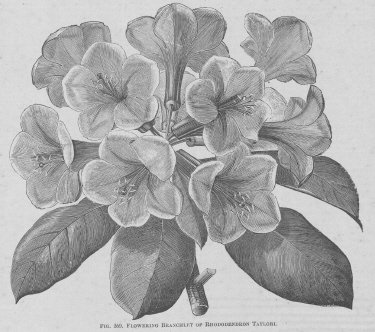
Varieties. There are almost endless varieties of R. ponticum in cultivation, and the hybrids which require greenhouse treatment are now becoming somewhat numerous, as many of the species and their progeny have been, from time to time, used for seed-raising. The following list includes a selection of good kinds, but very many others have, of necessity, to be omitted: Hybrid Greenhouse Rhododendrons. COUNTESS OF HANDDINGTON, pink, changing to blush-white. COUNTESS OF SEFTON, white, tinged rose. DUCHESS OF CONNAUGHT, vermilion-red; of good substance. DUCHESS OF EDINBURGH, rich, glowing crimson. DUCHESS OF SUTHERLAND, white. DUCHESS OF TECK, buff. FAVOURITE, delicate satiny-rose; large, compact trusses; new, 1866. LADY SKELMERSDALE, pure white. LORD WOLSELEY, pale buff-yellow; flowers large, new, 1866. MAIDEN'S BLUSH, blush-white. PRINCESS ALEXANDERA, pure white; flowers waxy; very beautiful. PRINCESS ALICE, white, tinged pink. PRINCESS FREDERICA, pale buff. PRINCESS ROYAL, pink or rose-coloured; one of the oldest and best-known hybrids. TAYLORI (see Fig. 369, for which we are indebted to Messrs. James Veitch and Sons), pink, tube of corolla white.
Hardy Rhododendrons. Hybrids of R. ponticum. ACHIEVEMENT, clear rosy-scarlet, white centre. ALBUM GRANDIFLORUM, blush; fine truss and foliage. ALEXANDER DANCER, bright rose, lighter centre; one of the finest. ATROSANGUINEUM, intense blood-red; one of the hardiest. AUGUSTUS, purplish-crimson or plum-colour. BARCLAYANUM, deep rosy-crimson; late. BLANDYANUM, rosy-crimson; extra fine. CANDIDISSIMUM, blush, changing to white. CARACTACUS, rich purplish-crimson; fine truss; one of the best. CHANCELLOR, purplish-lilac, spotted. CHARLES DICKENS, dark scarlet; fine habit and foliage. DELICATUM, blush, changing to white, with a distinct brown spot; fine habit. DUCHESS OF BEDFORD, deep rose, light centre. EVERESTIANUM, rosy-lilac, spotted and fringed; free-flowering. FAIR HELEN, pure white, marked with rich yellow spot. FREDERICK WATERER, crimson; very showy. GEORGE PAUL, crimson, finely spotted; free-flowering. HELEN WATERER, centre white, edged with crimson. H. W. SARGENT, crimson; very large trusses. LAGO, pale rose, spotted. JAMES MACINTOSH, rosy-scarlet; splendid habit and foliage. JAMES NASMYTH, rosy-lilac, blotched maroon; large truss. J. MARSHALL BROOKS, rich scarlet, bronze spot; distinct. LADY ARMSTRONG, pale rose, much spotted; beautiful. LADY ELEANOR CATHCART, pale rose, spotted chocolate. LUCIDUM, purplish lilac, brown spots; free-flowering. MARCHIONESS OF LANSDOWNE, pale rose, intense black spot; distinct and telling. MICHAEL WATERER, crimson-spotted; fine. MINNIE, blush-white, spotted with chocolate; distinct. MONT BLANC, white, dwarf, and free-flowering. MRS. JOHN CLUTTON, white; one of the best in cultivation. MRS. WILLIAM BOVILL, rich rosy-scarlet; one of the most attractive. MURILLO, rich crimson. NERO, dark rosy-purple, richly spotted. PURITY, white, faint yellow eye; very showy. REEDIANUM, bright cherry; very pretty. ROSABEL, pale rose; fine foliage and habit. SIR ISAAC NEWTON, plum-colour, shaded and spotted. SIR THOMAS SEBRIGHT, rich purple, distinct bronze blotch. SNOWFLAKE, pure white; conical truss; distinct and beautiful. STANDARD OF FLANDERS, blush, distinctly spotted; very showy. STELLA, pale rose, intense chocolate blotch; free-flowering. SYLPH, bright rosy-pink; fine truss. THE QUEEN, blush, changing to white; fine shape. TITAN, clear rosy-scarlet; one of the best. VANDYCK, rosy-crimson; good. VERSCHAFFELTII, blush, much spotted. VESTAL, pale rose, much spotted; fine truss. WILLIAM DOWNING, rich dark puce, finely blotched.