Trientalis
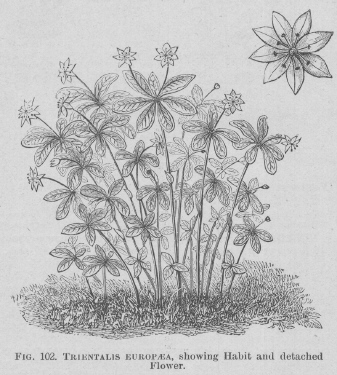
(a Latin term, signifying one-third of a foot in height; in reference to the stature of the plants). Chickweed Wintergreen. ORD. Primulaceae. A small genus (two species) of highly glabrous, hardy herbs, with creeping, perennial rhizomes; one is found in Europe, North Asia, and North-west America. Flowers white; calyx five to nine-parted, persistent; corolla hypogynous, rotate, five to nine-parted, the tube very short, the segments elliptic-lanceolate; stamens five to nine; peduncles one to three, one-flowered, filiform, ebracteate. Leaves usually as many as the petals, somewhat whorled, obovate-elliptic or lanceolate, entire. Stems solitary, slender, erect. These pretty little plants require a light, rich soil and a shady situation. Propagated, in spring, by seeds, covered with a handlight; or by divisions.
T. americana (American). Star Flower. fl., divisions of the corolla finely acuminate. May. l. lanceolate, acuminate at both ends. Stem very naked below, unequally five to nine-leaved at the summit, 9in. high. North-west America, 1816.
T. europaea (European). fl. few, erect; corolla 1/2in. to 3/4in. in diameter, the lobes ovate, acute. June and July. l. obovate or obovate-lanceolate, 1 1/2in. to 2 1/2in. long, shining, rigid, obtuse or acute, narrowed into short petioles. Stem wiry, slender, leafy at top, 4in. to 8in. high. Europe (Britain), &c. See Fig. 102. (L. B. C. 105; Sy. En. B. 1139.)