Sedum
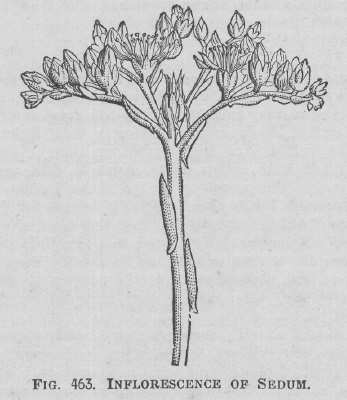
(from sedeo, to sit; alluding to the manner in which the plants fix themselves on rocks and walls). Orpine; Stonecrop. Including Rhodiola. ORD. Crassulaceae. A genus comprising about 120 species of mostly hardy, glabrous or glandular-pubescent, fleshy, erect or decumbent, sometimes tufted or Musk-like herbs, rarely sub-shrubs, nearly all natives of the temperate and frigid regions of the Northern hemisphere; they are rare in America; one is found in Peru. Flowers white or yellow, rarely pink or blue, cymose in a few cases axillary and solitary; calyx four or five-lobed; petals four or five (rarely six or seven), free; stamens eight to ten (rarely twelve to fourteen); filaments filiform or subulate. Leaves very variable, opposite, alternate, and whorled, entire or serrate, rarely laciniate. Sedums are amongst the easiest of plants to grow; like Saxifrages and Sempervivums, they succeed in almost any position, on rockwork, old walls, or ruins, or in the mixed border. Some are specially adapted for use in carpet bedding, S. lydium being an example. S. acre, and its variety aureum, though common, are plants much favoured by almost everybody, and allowed to spread extensively. S. spectabile is a fine, herbaceous border plant, also equally well adapted for pot culture. All Sedums are readily propagated by seeds, by cuttings, or by division of the tufts in spring. They prefer an open, loamy soil, and to grow amongst stones, but, as before noted, they thrive in almost any position.
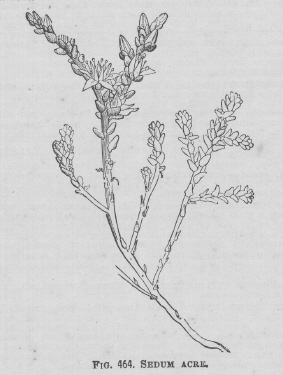
A selection of the best-known species is given below; they are hardy, herbaceous perennials, except where otherwise indicated. S. acre (bitter). Wall Pepper. fl. yellow, numerous, 1/2in. across; sepals like the leaves, half the length of the lanceolate, spreading petals; cymes one-sided, two to five-forked; flower-stems erect, 2in. to 3in. high. Summer. l. minute, 1/8in. to 1/4 in. long, crowded, thick, conical, obtuse, gibbous at base, having an acrid taste; those on the flower-stems scattered. Barren stems creeping, branched, about 2in. long, slender-cylindrical, rooting near the base. Europe (Britain). Plant glabrous, evergreen. (Sy. En. B. 532.) The commonest British species, of which the following varieties are worth notice:
S. a aureum (golden).* l. and tips of the shoots bright golden-yellow in spring. This charming variety is admirably suited for spring bedding, or for giving colour at a dull time of the year.
S. a. elegans (elegant). l., young ones and tips of the shoots of a pale silvery colour. This is not so effective as aureum, and is more delicate.
S. a. majus (large). fl. 3/4in. across; sepals linear-oblong, slightly gibbous at base; petals twice the length of the sepals; cyme two parted, with a central sessile flower, the branches recurved, one sided. l. in seven rows, closely crowded, thick, deltoid-ovoid, scarcely auricled at base. Plant larger and more robust than the type. A distinct plant, regarded by Dr. Masters as "perhaps even deserving of specific rank."
S. Aizoon (Aizoon).* fl. yellow, numerous, 1/2in. in diameter, in a loose, panicled cyme, 1in. to 3in. in diameter; lower peduncles axillary, distant; upper ones umbellate, flat-topped. Late summer. l. distant, sessile, alternate, 2 1/2in. by 3/4in., oblong-lanceolate, coarsely and irregularly toothed for the greater part of their length; midrib prominent. Stems glabrous, 1ft. or more high, sub-angular, several from the same crown, erect, unbranched. Siberia, &c., 1757. An old inhabitant of our gardens.
S. albicans (whitish). A garden form of S. Telephium. S. album (white).* fl. white, nearly 1/2in. across; petals lanceolate, spreading, twice the length of the calyx; cymes 2in. to 3in. in diameter, corymbose, much-branched, many-flowered; flower stems pinkish, erect, 4in. to 6in. high. Summer. l. alternate, spreading, 1/2in. long, linear-oblong, obtuse, contracted at base. Barren shoots erect or creeping, rooting, terete, olive-brown, sometimes slightly tubercled. Europe (Britain). Plant glabrous, tufted, evergreen, handsome when in flower. (Sy. En. B. 529.) SYNS. S. farinosum and S. neglectum (of gardens). The following are varieties:
S. a. brevifolium (short-leaved). l. shorter and thicker than in the type.
S. a. micranthum (small-flowered). fl. smaller than in the species. l. on the barren shoots ascending, not spreading, flattened on both surfaces.
S. a. teretifolium (terete-leaved). fl., sepals and petals obtuse. l. much flattened above. (Sy. En. B. 529.)
S. amplexicaule (stem-clasping). fl. golden-yellow, numerous, secund; sepals furrowed outside; petals 1/4in. long, keeled, twice the length of the sepals; cymes two-forked, leafy, with a solitary flower in the fork; flower-stems decumbent, ascending, 6in. to 9in. long. Summer. l. dilated and membranous at base, tapering to a long, awl-shaped point; those of the flower-stems alternate, ascending, sessile, 1/2in. long. Branches 2in. to 4in. long, wiry, ascending, clothed with imbricating leaves. Mediterranean region. A curious, glabrous, evergreen species. The ends of the shoots swell out into small, scaly tubers.
S. Anacampseros (Anacampseros). fl. violet, numerous, but rarely produced, about 1/4in. in diameter; cymes dense, terminal, globose, with a few small leaves intermixed; flower-stems erect, terete, reddish. July. l. orbicular or obovate, obtuse, apiculate, cordate, auricled at base, with reddish margins. Branches erect, rooting at the nodes. Central Europe, 1596. Plant glaucous, evergreen. (B. M. 118.) S. anglicum (English).* fl. pure white or rosy-tinted, 3/8in. across; sepals less than half the length of the lanceolate petals; cymes dichotomous, few-flowered; flower-stems 2in. long. July. l. crowded, alternate, sub-opposite, less crowded on the flower stems, erect or spreading, 1/8in. to 1/4in. long. Barren shoots trailing or erect, 1in. to 2in. long, forming dense, cushion-like masses. Western Europe (Britain). A neat and pretty, glabrous, evergreen species, suitable for rockeries. It is rather difficult to cultivate. (Sy. En. B. 531.)
S. anopetalum (erect-petaled). fl. pale greenish-yellow, 1/2in. across; sepals five to seven, deltoid, grooved; petals erecto-patent, somewhat folded and keeled; cymes dense, flat or concave, umbellate, about 1in. in diameter. July and August. l. in eight ranks, approximate, sessile, spreading (or on the flowering shoots ascending), 3/8in. long, terete, awl-shaped, spine-tipped, greyish-green, red at the tips. Branches prostrate or ascending, 4in. to 6in. long. South Europe, 1818. Plant more or less glaucous, evergreen.
S. arboreum (tree-like). fl. white, 1/2in. across, five-parted; petals lanceolate, keeled, twice or more longer than the linear-oblong sepals; cymes terminal, many-flowered. July. l. on older shoots deltoid, subulate, terete, or somewhat four-sided, 1/8in. long, horizontally spreading; those on the young shoots more or less crowded, linear, terete, pimpled. h. 4in. to 6in. Native place unknown. Plant glabrous, suffrutescent, evergreen, with no separate barren shoots, branching from near the base, the branches spreading.
S. asiaticum (Asiatic). fl. greenish-yellow, in compact, terminal, globose cymes, numerous, five-parted; petals twice the length of the sepals; anthers orange-brown. Summer. l. opposite, decussate, spreading, sessile, 3/4in. to 1in. by 1/8in. or more, linear oblong, coarsely and irregularly toothed. Stems annual, 6in. to 12in. high, erect, unbranched, slender, glabrous. Himalayas. Half-hardy or greenhouse.
S. Beyrichianum (Beyrich's). fl. white, 1/8in. across; sepals as long as the petals; cyme forked; fertile stems erect, 2 1/2in. high, with numerous crowded, ascending leaves. l. in rosettes, 1/2in. by 1/8in., spathulate, obtuse, tapering to stalks, red-dotted. Native place unknown. Evergreen.
S. brevifolium (short-leaved).* fl. 1/4 in. across; sepals whitish, with a pink midrib, oblong-lanceolate; petals also having a pink midrib, oblong, acute; cyme umbellate, two or three-forked, with a pedicellate flower in the center of each fork. July. l. crowded, in four rows, 1/10in. long, ovoid, pinkish, densely mealy-pubescent. France, &c. A beautiful little, densely tufted, glaucous, pruinose, evergreen species, with much the habit of S. dasyphyllum.
S. carneum variegatum (flesh-coloured, variegated). A form of S. sarmentosum.
S. coeruleum (blue).* fl. pale blue, five to seven-parted, 1/4in. in diameter; sepals half the length of the petals, both oblong, obtuse; cyme loose, many-flowered, 1in. in diameter, with recurved branches. July. l. tufted, 1/4in. long, oblong, obtuse, pale green, spotted with red. Stems 2in. to 3in. high, branched from the base. Mediterranean region, 1822. Plant glabrous or the inflorescence pilose. A charming little annual.
S. collinum (hill-loving). A garden synonym S. reflexum.
S. corsicanum (Corsican). A corruption of corsicum, a name which has been applied to forms of S. dasyphyllum and S. maximum.
S. corsicum (Corsican), of Duby. A synonym of S. dasyphyllum glanduliferum. S. dasyphyllum (thick-leaved). fl. pinkish, 3/4in. across; petals lanceolate, three or four times the length of the fleshy sepals; cymes corymbose, loose, few-flowered. July. l. crowded, sessile, spreading, thick, 1/8in. to 1/6in. long, oblong, acute, or sub-orbicular, pimpled. Stems tufted, slender, 2in. to 3in. long, branching. Europe (Britain). Plant glaucous, glabrous, or glandular, evergreen. (Sy. En. B. 530.) The form glanduliferum (B. M. 6027), often met with in cultivation, is densely glandular-pubescent (SYN. S. corsicum, of Duby); while oblongifolium has oblong leaves.
S. dentatum (toothed). A garden synonym of S. S. stoloniferum.
S. denticulatum (slightly-toothed). A garden synonym of S. stoloniferum.
S. elegans (elegant). A synonym of S. pruinatum.
S. crythrostictum (blush-tinted).* fl. greenish, nearly 1/2in. across; petals spreading, lanceolate, flushed with pink, twice the length of the sepals; cymes terminal, corymbose. September. l. opposite or alternate, ascending, 2 1/2in. by 1in., concave, oblong, sinuate, obscurely toothed, entire and sub-cuneate or rounded at base, tapering into short petioles or quite sessile. Stem erect, greenish, 1ft. to 1 1/2ft. high. Japan. A handsome species. (Ref. B. 33 and R. G. 709, under name of S. albo-roseum.) The form variegatum has leaves blotched with yellow.
S. Ewersii (Ewers').* fl. pink or pale violet, numerous; petals twice the length of the sepals, dark-spotted; cymes dense, globose. August and September. l. opposite, sessile, about 1/2in. in diameter, sub-orbicular, cordate-amplexicaul, entire or slightly sinuate. Stock thick, giving off many trailing or ascending, slender branches. Siberia, &c., 1829. A rather tender evergreen, well worth pot culture.
S. farinosum (mealy). fl. white, crowded, five to seven-parted; sepals pink-tipped, linear-oblong, obtuse; petals lanceolate, acute, keeled; cyme two or three-parted. July. l. crowded in four to six rows, deciduous, 1/2in. by 1/4in., scarcely forming a rosette, oblong, obtuse. Stems tufted, cylindrical, much-branched. Madeira. Plant glabrous, glaucous, pruinose or mealy, rather tender, evergreen. Probably an outlying insular form of S. album.
S. farinosum (mealy), of gardens. A synonym of S. album.
S. glandulosum (glandular).* fl. pale reddish-purple, 1/3in. in diameter, usually alternate on short, recurved, simple or forked, terminal cymes; petals twice or thrice as long as the calyx. June. l. scattered, sessile, 1/3in. to 2/3in. long, linear-oblong, obtuse, cylindric. Stems simple or forked, 2in. to 6in. long, sub-erect, decumbent or ascending. Spain, 1871. Whole plant glandularhairy. Annual. (B. M. 5924.)
S. glaucum (glaucous).* fl. pinkish-white, 1/2in. across, six-parted; sepals deltoid, acute; petals oblong, sharp-pointed at apex; stamens twelve; cymes three to seven-branched, umbellate, the branches spreading, slightly pilose; flower-stems 3in. to 4in. long, reddish. July. l. densely crowded, about 1/4in. long, linear, greenish-grey, becoming reddish, studded with fine hyaline pimples at the tips. Barren shoots 2in. long, branched. Central and Southern Europe. A very pretty, glaucous, evergreen species, much used for carpet bedding and other purposes. The form polypetalum has seven to nine petals.
S. Hildebrandi (Hildebrand's). fl. bright yellow, 3/8in. across; sepals lanceolate; petals lanceolate, acute; cyme branches 1/2in. long. July. l. 1/6in. long, densely packed, linear, turgid, subulate, erecto-patent, longer and narrower than in S. acre. Hungary. Plant glaucous, evergreen. S. hybridum (hybrid). fl. yellow, numerous; sepals linear, obtuse, half as long as the apiculate petals; cymes terminal, much-branched, inversely pyramidal, 2in. to 3in. in diameter; peduncles horizontal or deflexed, with large, spreading bracts. Summer. l. alternate, stalked, about 1in. by 1 1/2in., spathulate, coarsely toothed in the upper half, entire and tapering in the lower part, the teeth red-tipped. Stems creeping, glabrous or glandular hairy. Siberia, 1776. Evergreen.
S. ibericum (Iberian). A garden form of S. stoloniferum.
S. japonicum (Japanese).* fl. yellow, 1/2in. in diameter; sepals oblong; petals lanceolate, acute, twice the length of the sepals; cymes loose, terminal and lateral, panicled, many-flowered. Summer. l. scattered or opposite, sub-reflexed, spreading, spathulate, oblong, acute, entire, convex below, channelled above, bright green. Stems diffuse. Japan, 1866. Evergreen. (R. g. 513, f. 3, 4.)
S. kamtschaticum (Kamtschatkan).* fl. yellow, numerous, 3/4in. across; sepals deltoid, less than half as long as the spreading, apiculate, keeled petals; cymes terminal, umbellate, inversely pyramidal, 1in. to 3in. in diameter; peduncles radiating, with large bracts at base; flower-stems erect, 4in. to 6in. high. Late autumn. l. alternate or opposite, 1 3/4in. by 1/2in., oblong-obovate, deep green, toothed above the middle, gradually tapering to the petioles; edges minutely papillose. Branches 6in. to 8in. long, greenish or purplish. Stems prostrate. Kamtschatka, 1829. Evergreen SYN. S. Selskyanum (of gardens).
S. Liebmannianum (Liebmann's). fl. whitish-pink, small, sessile; cymes terminal, three to five-flowered. Summer. l. sessile, clustered, fleshy, shining, spreading, conical, one to two lines long, scarcely acute. Branches red, ascending. h. 3in. to 4in. Mexico, 1880. Greenhouse perennial.
S. lividum (livid). A garden synonym of S. lydium.
S. lydium (Lydian).* fl. pinkish, 1/10in. across; petals twice as long as the sepals; cyme corymbose, many-flowered; flowering shoots 4in. to 5in. long. Late summer. l. crowded, 1/4in. long, linear, sub-terete, greenish or red-tipped, auricled at base, tipped with numerous very minute pimples. Barren shoots 2in. to 3in. high, erect, purplish. Asia Minor, 1867. A charming little, glabrous evergreen for rockwork edgings or carpet bedding. SYN. S. lividum (of gardens).
S. Maximowiczii (Maximowicz's). fl., yellow, numerous, in a dense, flat, spreading cyme; sepals unequal, protracted into a long, slender point; petals half as long again as the sepals. Late summer. l. sub-opposite or alternate, sub-sessile, 1in. to 1 1/2in. long, oblong-ovate or oblong-lanceolate, sometimes obtuse, regularly toothed, the midrib channelled; upper ones longer and narrower. Stems erect, about 1ft. high, terete or somewhat four sided, greenish. Japan, Amur.
S. maximum (largest).* fl., sepals deltoid-lanceolate, half the length of the lanceolate, whitish petals, whose tips are spotted with red; cymes terminal and lateral, on long stalks, forming a loose panicle, sub-globose, many-flowered, the lowest stalks usually longest. August and September. l. opposite, sessile, spreading, stem-clasping, 2 3/4in. long, ovate, acute, more or less cordate, crenate-toothed. Stems 1ft. to 2ft. high, erect, green or purple. Europe and Asia. The following varieties are enumerated by Dr. Masters:
S. m. assurgens (increasing). fl. pinkish; cymes corymbose; inflorescence loose. l. ascending, opposite, green, oblong, obtuse, sinuate. Stem weak, ascending, green.
S. m. cordifolium (cordate-leaved). fl. whitish, with red spots, 1/3in. across; petals concave; inflorescence corymbose. l. alternate and opposite, spreading horizontally, oblong-ovate, sinuate-toothed. Stems purplish. (Ref. B. 34, under name of S. cordifolium.) S. m. corsicum (Corsican). fl. pale yellow, with a pleasant, apple-like fragrance; inflorescence corymbose. l. alternate and opposite, spreading, oblong-ovate, toothed, green. Stems purplish.
S. m. haematodes (bloody).* fl. whitish, the petals tipped with red; cymes numerous, long-stalked, forming a large, loose, inversely pyramidal panicle, with a few scattered leaves. September. l. opposite, 5in. by 3in., oblong-ovate, obtuse, subcordate, coarsely-toothed, purplish. Stems deep purple, erect, 2ft. to 2 1/2ft. high, glabrous. Portugal. A really noble plant, of robust habit.
S. m. pachyphyllum (thick-leaved). fl. greenish-yellow; cymes globose, long-stalked, forming a loose, terminal panicle. l. opposite, spreading, cordate-ovate, serrulated. Stems reddish.
S. m. praeruptorum (overhanging). fl. greenish; cymes globose, on long stalks. l. recurved, finely toothed. Stems green.
S. m. recurvum (recurved). fl. greenish-yellow; cymes in a loose, terminal panicle. l. opposite, oblong-ovate, irregularly toothed, recurved. Stems green.
S. m. rigidum (rigid). fl. greenish; inflorescence loosely corymbose. l., cauline ones opposite, sessile, ovate-oblong, obtuse, slightly and irregularly sinuate-toothed. Stems deep red, 2ft. to 3ft. high.
S. m. Rodigasi (Rodigas'). A form having purplish leaves, variegated with yellow. In cultivation, it is more tender than most of the varieties of S. maximum. (F. d. S. 1669.)
S. m. serotinum (late). fl. greenish-yellow; inflorescence loosely panicled. l. opposite, the upper ones ternate, spreading, ovate-oblong, sinuate-toothed, green. Stems green, weak.
S. m. ternatum (ternate). fl. yellowish; inflorescence corymbose. l. reddish above, dark green below, in whorls of three. Stems red.
S. m. triphyllum (three-leaved). fl. in terminal corymbs. l. ternately whorled, oblong, serrated.
S. Middendorffianum (Middendorff's). fl. yellow, numerous, in a flat-topped, umbellate cyme; petals spreading, 3/8in. longer than the sepals; primary branches four, with a central flower in the forks. Summer. l. alternate, rather fleshy, sessile, 1in. to 2in. long, erecto-patent, oblanceolate, toothed towards the apex, somewhat concave below. Amur, 1880. The variety minor is dwarfer in all its parts.
S. monregalense (Monregalensis). fl. white, 1/4in. across, five parted; sepals pink-spotted, one-third the length of the petals; petals pinkish-brown and pubescent beneath; cyme loose, terminal, many-flowered, panicled, glandular-pubescent. Summer. l. on barren shoots crowded, spreading, thick, 1/8in. to 1/4in. long; those on fertile shoots scattered, narrower, often spotted with pink. Barren shoots spreading, erect, or creeping, 1in. to 4in. long, rooting at the nodes. North Italy. A pretty, dwarf, glabrous (except the inflorescence) evergreen.
S. montanum (mountain-loving). A mere catalogue name, under which no plant has been botanically described.
S. multiceps (many-stemmed). fl. pale yellow, 1/2in. across, five parted; sepals linear-oblong, obtuse, half the length of the oblong-lanceolate, spreading petals; cymes sub-scorpioid, many branched, two to six-flowered; flower-stems erect, twice the length of the barren ones. Summer. l. 1/6in. to 1/4in. long, glaucous or pruinose, pinkish and papillose, linear and oblanceolate, sub-terete, gibbous at base, spreading on the barren, appressed on the fertile, stems. Branches 2in. to 6in. long, flexuous or erect, giving off adventitious roots, and bearing at the ends dense rosettes of leaves. Algeria. Plant sub-shrubby, much-branched, glaucous, evergreen. (G. C. n. s., x. p. 120.) S. neglectum (neglected), of gardens. A synonym of S. album.
S. Nevii (Dr. Nevius'). fl. white, numerous, 1/2in. across; sepals half the length of the lanceolate petals; cymes forked, the branches 1 1/2in. long, recurved, with a few leafy bracts; flowering stems erect, 2in. to 3in. high. July. l. on barren shoots crowded in terminal rosettes, each 3/4in. by 3/8in., obovate-spathulate, tapering into a short stalk, auricled at base, pink-dotted; those on the fertile stems appressed, scattered, smaller than the others. Stems prostrate. North America. Evergreen.
S. nicaeense (Nice). fl. greenish-yellow, 1/2in. in diameter, five or six-parted; petals boat-shaped, twice the length of the sepals; cymes many-flowered, terminal, umbellate; flowering stems erect, 10in. to 12in. high. Late summer and autumn. l. of the barren shoots 1/2in. to 3/4in. long, less than 1/2in. wide, ascending or spreading; those of the flowering shoots appressed, lanceolate, distinctly auricled. Stems 6in. to 8in. long, at first prostrate, afterwards ascending; rootstock thick, woody. Mediterranean region. Evergreen. (A. F. P. iii. 90.)
S. obtusatum (obtuse). fl. yellow, 1/4in. across, shortly pedicellate; petals lanceolate, more than double the length of the oblong, acute sepals; cymes terminal, spreading, umbellate, 1 1/2in. to 2in. in diameter; flower-stems erect, terete, reddish, ultimately leafless, but scarred. June and July. l. rosulate, 1in. by 3/8in., spathulate, entire, glaucous, becoming reddish-green. Stems prostrate, glaucous, pruinose. California. Evergreen.
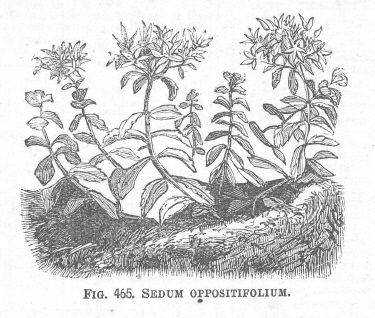
S. oppositifolium (opposite-leaved). fl. whitish, resembling those of S. stoloniferum; fertile stems 6in. high, erect. August. l. opposite, decussate, 1 1/2in. by 1 1/4in., sub-orbicular or rhomboid, tapering to short-channelled stalks, bright green, crenate-ciliate at the edges; younger ones crowded at the ends of the branches. Stems rough with minute asperities. Caucasus. Trailing evergreen. (B. M. 1807.) S. populifolium (Poplar-leaved). fl. whitish or pinkish, numerous, nearly 1/2in. across, with the fragrance of Hawthorn; petals three times longer than the sepals; cymes terminal, much-branched, corymbose. August, l. alternate, 1 1/2in. by 1in., stalked, ovate, acute, sub-cordate, coarsely and irregularly toothed. Stems erect, 6in. to 10in. high, greenish or purplish, slender, branched. Siberia, 1780. Plant glabrous, suffrutescent, evergreen. Though quite hardy, it forms a charming greenhouse subject.
S. pruinatum (pruinose). fl. bright yellow, 1/2in. in diameter, four to eight-parted; sepals acute, half as long as the obtuse, concave petals; cyme at first recurved, umbellate, many-branched, flat-topped; flower-stems erect, 1ft. high. Late summer. l. in many rows, sessile, crowded, spreading, slightly incurved at the ends of the sterile shoots, glaucous-blue, often tipped with rose-pink, about 3/4in. long, linear-oblanceolate, aristate; those of the flowering shoots larger and less crowded. Branches 6in. to 8in. long, trailing, ascending. Europe (Britain). Plant glaucous, pruinose, evergreen. SYN. S. elegans (Sy. En. B. 806).
S. p. Forsterianum (Forster's). l. on the barren shoots many ranked, forming terminal rosettes, spreading, pale green, oblanceolate, mucronulate, gibbous at base. Plant glabrous or slightly glaucous. SYN. S. rupestre Forsterianum.
S. p. minus (lesser). l. oblanceolate, mucronate, in rosettes. Plant glaucous, smaller in all its parts than the type. SYN. S. rupestre minus.
S. pulchellum (pretty).* fl. rosy-purple, 1/2in. across; petals lanceolate, acuminate, half as long again as the linear-oblong sepals; cyme three or four-branched, with erect flowers crowded in two rows along the upper surface, and each provided with a leafy bract. Branches slender, trailing, or ascending, 3in. to 6in. long. United States, 1874. A very handsome, but little-known, evergreen species. (B. M. 6223; G. C. 1878, 114.) S. quadrifidum (four-cleft). fl. red, in terminal cymes; sepals oblong; petals linear-oblong, twice as long as the sepals. July. l. glabrous or puberulous, approximate, sub-terete, 1/4in. long. Stem thick, giving off numerous erect, slender stems, 2in. to 5in. high. Arctic Russia, &c., 1809.
S. reflexum (reflexed).* Stone Orpine. fl. yellow, 3/4in. across, four to eight-parted; sepals half as long as the linear petals; cymes umbellate, leafy, many-flowered, many-branched, with a flower in each fork; flower-stems erect, 8in. to 10in. high. Summer. l. in six or seven rows, crowded on the barren stems into a conical mass, 1/2in. to 3/4in. long, linear-subulate, terete, gibbous at base, spreading or abruptly decurved. Stems trailing. Europe (Britain). Plant glabrous, scarcely glaucous, evergreen. SYNS. S. collinum and S. virens (of gardens). The following varieties are enumerated by Dr. Masters:
S. r. albescens (whitish). fl. yellowish-white, 1/2in. across, often six-parted; sepals acute. l. rarely in rosettes. Plant glaucous.
S. r. cristatum (crested). This resembles the type; but the stems are fasciated so as to form a crest, as that of the Cockscomb.
S. r. minus (lesser). The smallest variety of all.
S. r. septangulare (seven-angled). l. scarcely glaucous, usually somewhat thicker than in albescens, and arranged in seven distinct rows, often spirally wound round the stem.
S. r. virescens (greenish). This only differs from albescens in having pale sulphur-yellow flowers.
S. retusum (retuse-leaved). fl. white, with a rosy centre, 1/2in. to 3/4in. in diameter, arranged in small, dense, terminal clusters. June. l. green, shining, obovate-oblong, retuse, 1/2in. to 3/4in. long. Branches grey, mealy when young, leafy only at the tips. Mexico, 1880. Greenhouse. S. rhodanthum (rose-flowered). fl. rose-coloured, numerous, in a dense, terminal cyme 4in. to 5in. long, mostly four-parted; sepals linear; petals lanceolate, acuminate, twice as long as the sepals. End of June. l. alternate, lanceolate, entire, channelled, 1in to 2in. long. Stems tufted, 1ft. to 1 1/2ft. high, erect. Rocky Mountains of Utah and Colorado.
S. Rhodiola (Rhodiola).* fl. greenish or reddish-purple, in a terminal, flat-topped, sub-globose cyme, about 1in. in diameter; petals four; pedicels short. Summer. l. scattered, glaucous, spreading or erect, 1in. by 1/4in., sessile, oblong, obtuse, rounded at base, obscurely one-nerved, slightly toothed at apex. Stems annual, several from the same stock, 6in. to 8in. high, erect, unbranched. Europe (Britain), &c. The roots exhale a perfume of rose-water. (Sy. En. B. 525.) SYN. Rhodiola rosea. linifolia (R. G. 1080) is a Turkestan form, with narrow leaves and brightly-coloured flowers. minor is a small form.
S. rupestre (rock-loving). fl. clear yellow, numerous, barely 1/2in. in diameter, five to seven-parted; sepals ovate-oblong, obtuse; petals similar, concave, not keeled; cymes umbellate, three to five-forked, ultimately hollow-topped; stalks 8in. to 12in. long. July. l. 1/2in. long in very numerous rows, linear-subulate, incurved, convex below, flattish above, forming dense, obconical rosettes 3/4in. to 1in. in diameter, at the ends of the sterile branches. Western Europe (Britain). Plant glaucous, evergreen, but reddening with age and drought.
S. r. Forsterianum (Forster's). A synonym of S. pruinatum Forsterianum.
S. r. minus (lesser). A synonym of S. pruinatum minus. S. sarmentosum (sarmentose).* fl. bright yellow, numerous, 1/4in. in diameter; sepals fleshy, half the length of the lanceolate petals; inflorescence a flat-topped, umbellate, three to five-forked cyme, with a solitary flower in the forks. l. crowded, opposite, or whorled, 1/2in. to 3/4in. long, linear, terete or slightly flattened, apiculate, slightly gibbous at base; those of the flower-stem scattered, ascending. China. Greenhouse evergreen. There is a variety of this with pink stems, and having leaves marked with a marginal stripe of white or cream-colour; it is grown in greenhouses and for carpet beds under the name of S. carneum variegatum.
S. Selskyanum (Selsky's). fl. yellow, numerous in a many-branched, hollow-topped, leafy cyme, the rachis flexuous; corolla nearly 1in. across, half as long again as the calyx. Late summer. l. sessile, ascending; upper ones 1 1/2in. long, less than 1/2in. broad, lanceolate from a broad base, ciliated; midrib very prominent on the under surface; margin serrated in its distal third. Stems 1ft. to 1 1/2ft. high, erect, pilose. Amur and Manchuria.
S. Selskyanum (Selsky's), of gardens. A synonym of S. kamtschaticum.
S. Semenovii (Semenow's). fl. whitish, 1/4in. or more in diameter, in compact, terminal, globose cymes; sepals reddish, longer than the tube; petals tipped with pink. June. l. in six rows, erectopatent, sessile, about 1in. long, linear, acute, entire, one-nerved, channelled above. Stems annual, from a many-headed rhizome, erect, cylindrical, glabrous, about 1ft. high. Turkestan.
S. sempervivoides (Sempervivum-like).* fl. bright red; sepals deltoid, acute, pilose; petals 1/4in. long, lanceolate, acute; cyme many-flowered, panicled, 2in. to 4in. in diameter; peduncle pilose. July. l. of the rosette forty to fifty, obovate-cuneate, 1in. by 3/4in.; those of the flower-stem clasping, greenish-red, oblong, acute. h. 4in. to 8in. Asia Minor. A remarkably handsome, pubescent, annual or biennial species.
S. sexangulare (six-angled). fl. yellow, 1/2in. across; petals lanceolate, double the length of the linear-oblong sepals; cyme three to five-branched, umbellate, 1in. to 3in. across, with scorpioid, one-sided branches; flower-stems erect, 2in. to 3in. high, very slender. July. l. densely crowded in six or seven rows, spreading or ascending, about 1/6in. long, linear-cylindric. Barren shoots ascending, 2in. to 3in. long, branched. Europe (Britain). (Sy. En. B. 533.) Plant glabrous, evergreen. A neat-habited species.
S. Sieboldi (Siebold's).* fl. pinkish, numerous, 1/2in. across; petals having a green spot on the back near the top, three times as long as the sepals; cymes much-branched, umbellate; pedicels longer than the flowers. August. l. in whorls of three, sessile or nearly so, spreading, sub-orbicular, sinuate, cuneate at base, bluish-green, pinkish on the margins. Branches terete, slender, purplish, erect, afterwards recurved. h. 9in. Japan, 1836. Greenhouse or half-hardy evergreen. (B. M. 5358.)
S. S. medio-variegatus (variegated-centred). This differs from the type in having a central blotch of creamy-white on each leaf. (I. H. 373.)
S. spathulifolium (spathulate-leaved). fl. yellow, numerous, 1/2in. across; sepals half the length of the acuminate, keeled petals; cymes terminal, forked, the branches 3in. long. May and June. l., upper ones on the barren shoots about fifteen in a terminal rosette, 1 1/2in. in diameter; lower ones and those of the flower-stem scattered, spreading, 1/2in. by 3/8in.; those of the flower-stem club-shaped. Branches creeping or ascending, 3in. to 4in. long. North-west America, 1873. Evergreen. (G. C. n. s., v. 146; R. G. 741.) S. spectabile (remarkable).* fl. pink, numerous, 1/2in. across; sepals whitish; petals twice the length of the sepals, slightly concave; cymes large, flat-topped, inversely pyramidal, leafy, umbellate. September. l. opposite, decussate, or in horizontally-spreading whorls of three, 3in. by 2in., flat, scarcely petiolate or the upper ones quite sessile, ovate, obtuse, or spathulate, entire or obscurely toothed, slightly cuneate at base. Stem 1 1/2ft. to 2ft. high. Probably Japan. A robust and noble species. (Ref. B. 32; R. G. 709; I. H. viii. 271, under name of S. Fabaria.)
S. spurium (spurious). A synonym of S. stoloniferum.
S. stenopetalum (narrow-petaled). fl. bright yellow, five-parted; petals linear-lanceolate, acuminate, twice longer than the awlshaped sepals; cymes much-branched, scorpioid. l. numerous, crowded on the barren shoots, sessile, fleshy, lanceolate, 1/2in. long. Stems 3in. to 6in. long, erect from a decumbent base, simple or somewhat branched. Rocky Mountains, 1877. Plant glabrous, evergreen.
S. stoloniferum (stolon-bearing). fl. pink or white, numerous, 3/4in. in diameter; petals nearly twice the length of the sepals; cymes terminal, umbellate, 2in. in diameter; ultimate pedicels shorter than the flowers; flower-stems 6in. long, ascending, reddish. July and August. l. opposite, 3/4in. to 1 1/4in. long, cuneate-spathulate, coarsely toothed above the middle, tapering into short stalks, the margins studded with hyaline papillae. Barren stems trailing, sometimes brown-dotted, rooting at the nodes. Caucaus. Evergreen. SYNS. S. dentatum and S. denticulatum (of gardens), S. spurium (B. M. 2370). S. ibericum (of gardens) is a small, slender form, with white flowers and ciliolate leaves.
S. telephioides (Telephium-like). fl. small, numerous; petals falcate, hooded at the tip; cymes small, dense, 1in. to 1 1/2in. in diameter. June. l. scattered, 2in. by 1in., oblong-obovate, obtuse, nearly entire or sparingly toothed, cuneate at base. Stem 6in. to 12in. high. North America, 1810. Plant glabrous.
S. Telephium (Telephium). fl. pink, white-spotted, or sometimes pure white, numerous, in dense, terminal or lateral, sub-globose, stalked cymes; calyx tube very short, the sepals lanceolate; petals spreading, somewhat recurved; peduncles short and nearly equal. August and September. l. scattered, rarely opposite, ascending or spreading, 2in. to 3in. long, 1in. to 1 1/4in. broad, oblong-ovate, obtuse, toothed; lower ones cuneate at base; upper ones somewhat rounded. Stem erect, 1ft. to 1 1/2ft. high. Europe (Britain). S. T. Fabaria is a sub-species, having flowers smaller, appearing earlier; petals less recurved; peduncles short, arranged in a terminal cyme. Leaves narrower than in the type, the lower ones slightly stalked. To S. Telephium and its sub-species may be referred a large number of more or less constant forms, of which the following are described by Dr. Masters:
S. T. affine (related). fl. pink, 3/8in. across; sepals one-third the length of the spreading petals; cymes terminal, loosely fastigiate. August. l. alternate, sessile, 2in. by 1in., ovate-oblong, acute, irregularly toothed above. Stem 1ft. to 1 1/2ft. high, greenish or red-spotted.
S. T. arduennense (Ardennes). fl. whitish, 3/8in. across; sepals deltoid, one-third the length of the erecto-patent petals; cymes numerous, forming a loose, terminal panicle. August. l., cauline ones alternate, appressed, nearly 4 1/2in. by 2 1/2in., ovate-oblong, obtuse. Stems purplish, 8in. to 12in. high.
S. T. Borderi (Border's). fl. pink; cymes corymbose, flattopped. l. distinctly stalked, oblong, obtuse, tapering to the base, irregularly and coarsely toothed. Stems reddish.
S. T. Brunfelsii (Brunfels'). fl. pink, 3/8in. across; sepals one-third the length of the spreading, oblong-lanceolate petals; cymes terminal, rounded. August. l. glaucous, appressed, sessile, oblong-obovate, 3in. by 1/4in., irregularly toothed, reddish along the midrib. Stem 6in. to 18in. high. S. T. Jullianum. fl. greenish, ultimately pinkish, 1/3in. across; sepals one-third the length of the lanceolate petals; cymes terminal and lateral, compact, forming a large, terminal panicle. August. l. alternate, appressed, 3in. by 1 1/2in., obovate, irregularly toothed in the upper half. Stems 1ft. to 1 1/2ft. high, finely spotted.
S. T. lugdunensis (Lyons). fl. rose-pink; cymes numerous, loosely corymbose, on long stalks. l. in whorls of three, spreading or ascending, rounded at base, coarsely toothed. Stems stout.
S. T. occidentale (Western). fl. pinkish, 3/8in. across; sepals deltoid-linear; petals spreading, lanceolate; cymes numerous, many-flowered, leafy. August and September. l. alternate, ascending, 3in. by 1 1/4in., obovate-oblong, obtuse, tapering to the base, toothed in the upper two-thirds; upper ones sub-cordate. Stems reddish, robust.
S. T. pycnantha (dense-flowered). fl. greenish; cymes globose, the lower ones on long stalks; inflorescence compact, many-cymed. l. alternate, ascending, tapering at both ends. Stem green.
S. T. rhodanensis (Rhone). fl. pink; cymes corymbose, globose, long-stalked. l. alternate, spreading, tapering to the base and apex, coarsely toothed.
S. T. rubella (reddish). fl. pink; cymes globose, the lower ones on long, horizontal stalks, forming an elongated, oblong panicle. l. red, tapering to the base, narrow-oblong, coarsely toothed. Stems red.
S. T. thyrsoideum (thyrsoid). fl. greenish or yellowish, 1/8in. in diameter; cymes numerous, globose, many-flowered, on long, ascending stalks, forming a large, compact panicle. August and September. l. opposite or whorled; lower ones ascending, 3in. by 1in., oblong, acute, toothed in the upper two-thirds; upper ones smaller, sub-cordate. Stems about 2ft. high, reddish. The following other forms of S. Telephium have been mentioned: albicans, Bulliardi, Carioni, controversum, corymbiferum, grandidentatum, intermedium, and Lobellii.
S. ternatum (ternate). fl. white, 1/2in. across, four-parted: sepals oblong, obtuse; petals oblong, acute, twice the length of the sepals; flower-stems erect. July and August. l. 1/2in. long, in whorls of three, sub-orbicular-spathulate, crowded into rosettes at the ends of the barren stems; those of the fertile stems scattered, ascending or spreading, oblong, acute. Barren stems 6in. to 8in. long, prostrate. North America, 1789. A glabrous or glaucous evergreen. (B. M. 1977; B. R. 142.)
S. trifidum (trifid). fl. at first reddish, in small, dense, terminal cymes; petals linear-lanceolate, twice the length of the lanceolate sepals. Summer. l. glabrous, aggregated towards the top of the stem, sessile, spreading, oblong, cuneate at base, coarsely toothed or pinnatifid. Stems erect, slender, 3in. to 7in. high, unbranched. Temperate Himalayas.
S. umbilicoides (Umbilicus-like). fl. white, seven-parted; inflorescence long-stalked, cymose. l. rosulate, convex, oblong-lanceolate. Alatan, Turkestan. Evergreen. (R. G. 917.)