Rhopalostylis
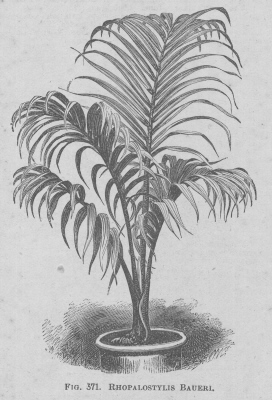
(from rhopalon, a club, and stulos, a pillar; alluding to the club-shaped spadix). ORD. Palmae. A small genus (two species) of greenhouse, unarmed palms, with mediocre, annulate trunks, natives of New Zealand and Norfolk Island. Flowers mediocre, spirally disposed; spathes two complete, oblong, complanate, the lower one two-winged; spadices short, spreading, on very short and thick peduncles, the branches somewhat flabellate, rather thick, and dense-flowered; bracts subulate at apex; bracteoles scale-like. Fruit small or rather large, ellipsoid, smooth. Leaves terminal, equally pinnatisect; segments equidistant, numerous, narrow-ensiform, acuminate, recurved, but not thickened at the margin and base; petioles very short; sheath elongated. For culture, see Areca.
R. Baueri (Bauer's).* fl., spathes white, 8in. to 10in. long, 3in. to 4in. across, narrow-oblong, acuminate; spadix axillary, "but, owing to the falling away of the leaf as soon as the spathe is ready to open and the flowers are fully formed, only flowering when infraaxillary, horizontally spreading from the caudex, 1ft. to 2ft. long, sparingly branched" (Hooker). l. 6ft. to 9ft. long, pinnate, furfuraceous-scaly on the rachis, costa, and nerves; pinnules closely set, 2ft. long, 1 1/2in. broad, stiff, acuminate, ribbed and plaited. Trunk 20ft. high and 4in. in diameter. Norfolk Island. (B. M. 5735, under name of Areca Baueri.) R. sapida (savoury).* fl. pale pink, very numerous; spadix much-branched, dense-flowered, 1 1/2ft. to 2ft. long, inclosed in a double, boat-shaped spathe. l. pinnate, 4ft. to 6ft. long; pinnules very narrow, linear-lanceolate, with replicate margins; nerves and costa, and especially the petioles, covered with minute, lepidote scales. Trunk 20ft. high, 6in. to 8in. in diameter. SYNS. Areca sapida (B. M. 5139), and Kentia sapida (of gardens).