Rhus
(from Rhous, the old Greek name of the genus used by Theophrastus). Sumach. Including Lithraea. ORD. Anacardiaceae. A genus comprising about 120 species of stove, greenhouse, or hardy trees or shrubs, mostly possessing poisonous properties in a greater or lesser degree; they are found in the temperate regions of both hemispheres, being especially abundant at the Cape of Good Hope, but rarely occur within the tropics. Flowers small, polygamous, in axillary and terminal, bracteate panicles; calyx four to six-parted, persistent, the segments imbricated; petals four to six, equal, much spreading, imbricated; stamens four, five, six, or ten. Drupes small, dry, compressed. Leaves alternate, simple, one to three-foliolate, or impari-pinnate; leaflets entire or serrate. "Some American species, such as R. venenata and R. Toxicodendron, produce effects almost rivalling those once fabulously imputed to the Upas-tree of Java (Antiaris), the hands and arms, and sometimes even the whole body, becoming greatly swollen from simply touching or carrying a branch of one of these plants, and the swelling being accompanied with intolerable pain and inflammation, and ending in ulceration. These effects, however, are not felt by everyone, some people being able to handle the plants with impunity" (Lindley and Moore). R. Coriaria affords the sumach or shumac of commerce. From R. Cotinus the yellow dyewood called Young Fustic is obtained. A selection of introduced species (which are hardy, deciduous shrubs, except where stated otherwise) is given below. The greenhouse kinds will grow in any soil, and may be increased by ripened cuttings, inserted in sand, under a hand glass. The hardy species are very suitable for shrubberies. Some of them propagate freely by cuttings of the roots, and others by cuttings and layers.
R. aromatica (aromatic). fl. pale yellow, in clustered, scaly-bracted, catkin-like spikes, preceding the leaves. April and May. l. pubescent when young, thickish when old, sweet-scented when crushed; leaflets three, rhombic-ovate, unequally cut-toothed, the middle one wedge-shaped at base. h. 8ft. North America, 1773. SYN. R. suaveolens.
R. atomaria (undivided). A synonym of R. villosa.
R. caroliniana (Carolina). A synonym of R. glabra.
R. coccinea (red). A synonym of R. glabra.
R. copallina (gum-copal). fl. greenish-yellow, in a terminal, thyrsoid panicle. July. l., petioles wing-margined between the nine to twenty-one oblong or ovate-lanceolate, often entire leaflets, which are oblique or unequal at the base, smooth and shining above. Branches and stalks downy. h. 1ft. to 7ft. North America, 1688. Shrub with running roots.
R. Coriaria (hide-tanning). fl. whitish-green, in large, loose panicles. July and August. l. villous; leaflets eleven to fifteen, elliptic, with large, blunt teeth, becoming purplish-red in decay. h. 15ft. to 20ft. Portugal to Tauria, 1629. Shrub or low tree. (W. D. B. 136.)
R. Cotinus (Cotinus).* Smoke Plant. fl. pale purplish or flesh-colour, in loose panicles; pedicels becoming lengthened and hairy after flowering. June and July. l. obovate, undiviled. h. 6ft. to 8ft. Spain to Caucasus, 1656. Shrub rambling. (J. F. A. 210.)
R. C. pendula (weeping). A form with pendulous branches.
R. diversiloba (variously-lobed). l. smaller than in R. Toxicodendron; leaflets ovate, very obtuse, obtusely lobed on the anterior margins. Branchlets short. h. 15ft. California. Erect tree. (B. R. 1845, 38.)
R. elegans (elegant). A synonym of R. glabra.
R. glabra (glabrous).* fl., males greenish-yellow, females greenish-red, paniculate. June. l. glabrous; leaflets seventeen to twenty-one, lanceolate-oblong, serrate, whitish beneath. Branches glabrous. h. 5ft. to 18ft. North America, 1726. Shrub or low tree. (W. D. B. 15; T. S. M. 572.) SYNS. R. caroliniana, R. coccinea, R. elegans (W. D. B. 16), R. sanguinea.
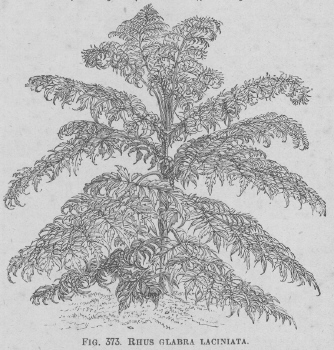
R. g. laciniata (torn).* Fern-leaved Sumach. A very elegant variety, having leaves cut in a laciniate manner.(R. H. 1863, 7.) R. javanica (Javan). A synonym of R. semialata Osbeckii.
R. lucida (clear). fl. white; panicles axillary and terminal, shorter, or a little longer, than the leaves. July. l. shortly petiolate; leaflets sessile, obovate, quite entire, very blunt, somewhat emerginate, quite smooth, glossy. h. 4ft. to 6ft. Cape of Good Hope, 1697. Greenhouse.
R. sanguinea (bloody). A synonym of R. glabra.
R. semialata Osbeckii (half-winged, Osbeck's).* l. large; leaflets fifteen to twenty-three, oval, toothed, whitish-woolly beneath. Bark smooth. h. 20ft. Japan, 1867. Greenhouse. (R. H. 1867, 111, under name of R. Osbeckii.)
R. suaveolens (sweet-smelling). A synonym of R. aromatica.
R. succedanea (substituting).* Red Lac Sumach. fl. greenish-yellow. June and July. fr. white, the size of a cherry, containing a smooth nut. l. smooth, permanent, on wingless petioles; leaflets eleven to fifteen, ovate-lanceolate, taper-pointed, shining, netted with veins, and glaucous beneath. h. 10ft. to 15ft. Japan, 1768. Greenhouse evergreen.
R. Toxicodendron (poison-tree).* Poison Ivy; Poison Oak. fl. greenish-yellow, in loose, slender, axillary panicles. June. l., leaflets three, rhombic-ovate, mostly pointed, and rather downy beneath, variously notched, sinuated, or cut-lobed. North America, 1640. Shrub climbing by rootlets over rocks, &c., or ascending trees, poisonous to the touch. (A. F. B. ii. 556; T. S. M. 577.)
R. T. radicans (rooting). l. mostly entire or nearly so. Stems rooting, but not climbing. (B. M. 1806, under name of R. T. vulgare.) R. typhina (fever).* Stag's-horn Sumach; Vinegar-tree. fl. greenish-yellow, in a terminal, thyrsoid panicle. June. l., leaflets eleven to thirty-one, pale beneath, oblong-lanceolate, pointed, serrate, rarely laciniate. Branches and stalks densely-velvety hairy. h. 10ft. to 30ft. North America, 1629. Shrub or tree. (T. S. M. 571.) R. viridiflora (green-flowered) is a male-flowered form of this species.
R. t. arborescens (arborescent). l. slightly downy beneath. h. 10ft. to 25ft. Tree.
R. t. frutescens (shrubby). l. downy and whitish beneath. h. 2ft. to 10ft. Shrub.
R. venenata (poisonous). Poison Elder, Sumach, or Dogwood. fl. green, in loose and slender axillary panicles. July. l. rather glabrous than pubescent; leaflets seven to thirteen, obovate-oblong, entire. h. 6ft. to 18ft. North America, 1713. The most poisonous species of the genus. (T. S. M. 575; W. D. B. 19.) SYN. R. vernix.
R. vernicifera (varnish-bearing). Japan Lacquer or Varnish-tree. fl. greenish-yellow. June. l. long, resembling those of a Walnut; leaflets eleven or thirteen, elliptic, acute, quite entire, smoothish above, but velvety beneath from pubescence. Branchlets and stalks clothed with soft down. h. 30ft. Japan, 1823. Tree.
R. vernix (varnish). A synonym of R. venenata.
R. villosa (villous). fl. greenish-yellow; racemes axillary, much shorter than the leaves, the terminal ones paniculate, somewhat longer. July. l. petiolate; leaflets sessile, obovate, obtuse, mucronulate, entire, 1in. to 1 1/2in. long, 1/2in. to 1in. wide, with revolute margins, hairy or villous on both surfaces, as well as the petioles and branchlets. Cape of Good Hope, 1714. Greenhouse evergreen shrub or tree. SYN. R. atomaria.