Ribes
(an Arabic name, properly belonging to a species of Rheum; Grossularia was, according to Dr. Asa Gray, the proper name to have been adopted for the genus). Currant; Gooseberry. Including Calobotrya, Chrysobotrya, and Grossularia. ORD. Saxifrageae. A genus comprising about fifty-six species of hardy, deciduous shrubs, often resinous-glandular, unarmed, or with spines beneath the axils or scattered; they are natives of Europe, temperate Asia and America, and the Andes of South America. Flowers white, yellow, red, or green, rarely purple, often unisexual by abortion, racemose or sub-solitary; calyx tube ovoid or spherical, adnate to the ovary; limb tubular or campanulate, four or five-fid, often coloured, the lobes erect or incurved, imbricated or sub-valvate; petals four or five, inserted at the throat of the calyx, small, scale-like, usually included; stamens four or five, inserted with the petals; pedicels bracteate at base and bibracteolate in the middle. Berries oblong or globose, pulpy, crowned by the calyx, one-celled, many-seeded. Leaves scattered, often fascicled, petiolate, simple, entire or often lobed, crenate, or cut, plicate or convolute in vernation; stipules adnate to the petioles or wanting. A great many of the plants have been introduced; those best known in garden are described below. Four species are included in the British Flora. Spring is the flowering period. There is but little difficulty in propagating and growing any of the species. They root readily from cuttings or layers, and succeed in almost any ordinary garden soil. See also Currant and Gooseberry. FUNGI. These are not, on the whole, very destructive to the shrubs of this genus. The dead roots and stems provide suitable food for Nectria Ribis, and for other Pyrenomycetes; but these need not be discussed here. The living leaves of Gooseberries frequently, and of Currants occasionally, show orange or reddish, swollen spots, on which are numerous little pits or cups, filled with the small spores of AEcidium Grossulariae. This Fungus also attacks the fruits, and may do a good deal of harm, but is not usually very injurious. The diseased leaves and fruits should be picked off as soon as the orange spots are observed. Less often, the leaves bear small, dark brown masses, which, on examination with the microscope, are found to be made up of brown spores, each consisting of two cells, and borne on a pale stalk attached to one end of the spore. This Fungus is named Puccinia Ribis. Another Fungus is common and destructive to the leaves of species of Ribes on the Continent of Europe. It appears in the form of yellow, raised spots on the lower surface of the leaves, often so numerous as almost to overspread them, and, in time, to destroy them. These spots are covered with the round, one-celled spores of Caeoma Ribesii.
The leaves of Gooseberries and of Currants are often marked with discoloured spots, which become dry and withered. In these are generally to be seen minute, black spots, which, under the microscope, are found to be pycnidia with minute sporidia. Those on Currants belong to forms known by the names of Gloeosporium Ribis and Septoria Ribis, and those on Gooseberries have received the name of Septoria Grossulariae. They are all, probably, young stages of true Pyrenomycetes, of which one, Sphaerella Ribis, has been recorded from similar spots. These Fungi seldom do serious injury. The most successful treatment is to pick off and burn the leaves that show the spots, and the same holds good of the Puccinia and the Caeoma mentioned above. The leaves of Gooseberries are frequently covered with a thin, white coating, which, after a time, becomes studded with small, black grains, like gunpowder. This is due to the growth of a Mildew (which see), known as Microsphaera Grossulariae. The white coast is composed of the mycelium and conidia (see Oidium). The black specks are perithecia, which bear ten to fifteen transparent outgrowths, bifurcated about three times. Each perithecium incloses from four to eight asci, which contain four or five spores. Flowers of sulphur and solution of potassium sulphide, employed as advised under Oidium, are the best remedies, should any be needed.
INSECTS, &c. The animals most injurious to plants of this genus have been briefly treated of under the headings Currant and Gooseberry; and several of them have received somewhat fuller notice under the headings mentioned below. The young twigs of Currants are often bored into and killed by the larvae of the Currant Clearwing Moth (which see). The infested branches may be detected by the drooping of the leaves, and should be cut off, with the larvae in them, and burned.
The buds of Black Currants (R. nigrum) are, in some localities, tenanted by Mites (Phytoptus Ribis), which cause them to enlarge, but destroy the shoots; and the bushes are thus rendered useless, and may be killed. The swollen buds should be removed, and destroyed; and, if the attack is severe, the bushes should be uprooted, and burned, and others should not be planted in the same soil for two or three years (see Mites).
The leaves of Gooseberries, and of Currants of several kinds, suffer very seriously from the attacks of the larvae of the Gooseberry or Magpie Moth (which see); and, to a less degree, from those of the V-Moth (Halia or Phalaena Wavaria). The appearance of the former, and the remedies against the larvae, are specified under the heading quoted above. The V-Moth also belongs to the Geometers, and resembles the Magpie Moth in form; but the spread of wings does not exceed 1 1/4in., and the colour is grey, with a purplish gloss, and brownish hind margins to the wings. Along the front margin, each fore wing bears numerous short streaks, and four spots of dark brown. The second spot joins with a dark spot in the centre of the wing, so as to form a V (hence the popular name of the moth), with its tip directed from the body. The moth appears in July; the larvae are most conspicuous about May. They are cylindrical, with slight dilatations along the sides. The head is lead-coloured, with dark markings; and the body varies from dull green to lead-colour, but always shows wavy, smoke-coloured lines lengthwise, and a row of pale yellow spots along each side; in each spot are three black warts, each bearing a black bristle. The pupa is suspended in a slight web among the leaves on the bushes. The same remedies may be used against these insects as against the Magpie Moth.
Sawflies are frequently most hurtful to Gooseberries, and to Red and White Currants. (See Gooseberry and Currant Sawfly for a short account of Nematus Ribesii, the most hurtful species. But the account there given is so incomplete, that we supplement it here, in view of the very great damage often done by the larvae to Gooseberry and Currant-bushes, which, at times, they completely strip of their leaves.) The insects (see Fig. 374) are clay-yellow, with three large, black marks on the back of the thorax, one on the breast, and others on the sides. The legs are pale, except dark tips to the last pair; the antennae are dark. The wings are hyaline, with a black stigma. The body is 1/4in. or 1/3in. long. The insects vary in the amount of black upon them, occasionally having even the abdomen almost black. The eggs are laid on the veins of the lower surface of the leaf, in which the young larvae eat little holes at first; but, after a time, they devour the whole leaf, except the chief veins. The larvae, till their last moult, are mostly green, studded with numerous black, shining tubercles, bearing hairs (see Fig. 375). The first and second, and the eleventh to thirteenth, segments are orange. The true legs are mostly black, and the claspers are pale green. In the last moult, the tubercles are thrown off, and the larvae become uniform bluish-green, with an orange spot behind the head, and another on the tail. When full-fed, the larvae drop to the ground, and an inch or two below the surface spin brown cocoons. Inside these may be found the pupae, green or yellowish-green, with orange markings on the thorax and tip of the abdomen. There are usually two generations in the year.
Nematus appendiculatus is less often markedly injurious to Gooseberry and Currant-bushes; for, though widely diffused throughout Britain, it is not very common. This Sawfly is readily distinguished from N. Ribesii by its black abdomen, as well as by its more truncate front wings, rather smaller size, and other minor peculiarities. The larva is green, with a yellowish tint on the second and eleventh and anal segments, and on the posterior legs. The larvae go below ground to pupate.
Nematus consobrinus also feeds, in the larval state, on the leaves of Gooseberries, and is not rare in Britain. It much resembles N. Ribesii, but is slightly smaller and duller-coloured, though it varies a good deal in the latter respect. The larva is green, beset with black tubercles, each bearing a hair; the second segment, the sides over the legs, and part of the last segment, are yellow. At the last moult, the body becomes uniform bright green, except that behind the head and on the last segment yellow is visible. There is only one generation annually in Britain.
Remedies are specified under the heading already quoted, and need not be repeated here. They are applicable to all three species of Sawflies, and are, indeed, useful against all the insects that feed exposed on the leaves.
Several species of Greenflies, or Aphides (which see), live on the lower surface of the leaves of Gooseberries and Currants, and frequently distort the young leaves at the tips of the branches, causing these, on the Currants especially, to become swollen and reddened. Besides the injury thus done to the plants, the fruit suffers from being covered with the sticky excretions of the insects, and with the dust and soot that adhere to these, and the Fungi that find suitable food in them. In Buckton's "British Aphides," the following are recorded as especially injurious, viz., Myzus Ribis (see Fig. 376) with cylindrical honey-tubes, and Rhopalosiphum Ribis with the honey-tubes widened in the middle. Both species are green, with dark markings. For remedies against these insects, see Aphides. The tips of the twigs bearing distorted leaves should be cut off and destroyed by fire, if practicable. Syringing the bushes with water afterwards is beneficial, by cleaning the leaves and fruits.
On the Continent of Europe, of late years, a good deal of injury has been done by a Gall-midge, the larvae of which feed in the flower buds, and destroy them. The insects have not yet been reared. This foe has not been recorded in Britain.
The fruits are sometimes injured by the larvae of Halia Wavaria (see above); but the worst foes to them are birds, e.g., blackbirds and thrushes. The loss from this cause is easily prevented by netting bushes of any choice varieties; but probably the plants benefit as much as they lose when left unnetted, inasmuch as it has been observed that bushes under nets are more liable than others to be injured by insects. It must be remembered, also, that the birds most apt to carry off the fruits of Gooseberries and Currants well repay such plundering by their services in destroying noxious insects, snails, and other marauders during the year, besides the pleasure derived from their song.
R. alpinum (alpine). Tasteless Mountain Currant. fl. yellowish; racemes erect, glandular-pubescent; males 2in. to 2 1/2in. long, twenty to thirty-flowered; females shorter, eight to ten-flowered. fr. scarlet, 1/4in. in diameter, insipid. l. 1 1/2in to 2in. in diameter, broadly ovate, three to five-lobed; lobes usually three, acute, cut, and serrate, hairy. h. 3ft. Europe (Britain), &c. Unarmed shrub. (Sy. En. B. 519.)
R. a. japonicum (Japanese). fl. greenish, small, glomerulate fr. cherry-red. l. persistent, three-lobed, denticulate-crenate, strongly nerved. Branches divaricate. h. 3ft. Japan, 1877.
R. a. aureum (golden-leaved). A very dwarf, garden strain, with yellow flowers, well adapted for rockeries, &c. 1881.
R. aureum (golden-flowered).* Buffalo Currant. fl. golden-yellow; petals much shorter than the calyx segments; racemes many-flowered. April and May. fr. yellow, seldom black, glabrous, of exquisite flavour. l. three-lobed; lobes divaricate, with a few deep teeth, shorter than the petioles, which are ciliated at the base. h. 6ft. to 8ft. North-west America, 1812. Glabrous, unarmed shrub. (B. R. 125.)
R. a. praecox (early-flowering). fl., racemes bracteate. fr. smaller, copious, turbinate. l. cuneate at base, pubescent beneath. The flowers and fruit appear earlier than in the type. (L. B. C. 1533, under name of R. fragrans.) R. a. serotinum (late-flowering). fl., racemes naked, produced later than in the type. fr., berries few, round. l. variable; lobes deeply serrate.
R. a. tenuiflorum (slender-flowered). fl. yellow. fr. purple or yellow, glabrous. l. roundish, three-lobed, covered, when young, with a mealy bloom; lobes bluntly toothed at the apex. h. 6ft. to 8ft. North America, 1812. (B.R. 1274.) In the form fructunigro, the berries change from yellow to red, and finally become deep blackish-purple; in fructu-luteo, they are always yellow.
R. Beatonii (Beaton's). A synonym of R. Gordonianum.
R. cereum (waxy). fl. white, three to five in a pendulous, pubescent raceme as long as the leaves; calyx segments reflexed. fr. red, glabrous. l. nearly round, obtusely trilobed, crenate, viscid. h. 3ft. North America, 1827. Unarmed shrub. (B. M. 3008; B. R. 1263; B. R. 1471, under name of R. inebrians.)
R. Cynosbati (Dog-Bramble). fl. green, two or three to a slender peduncle. fr. large, armed with long prickles like a burr, or rarely smooth. l. on slender petioles, slightly cordate, roundish, three to five-lobed, pubescent, 1in. to 2in. in diameter. h. 4ft. Stems spiny and commonly bristly. North America, 1759.
R. divaricatum (spreading-branched). fl. white, three on a drooping peduncle; calyx funnel-shaped. fr. black, smooth, spherical, of an agreeable flavour. l. roundish, three-lobed, deeply toothed, nerved, glabrous. Branches divaricate, bristly, at length naked; spines one to three together, axillary. h. 5ft. to 7ft. North America, 1826. (B. R. 1369.) R. floridum (flowery).* American Wild Black Currant. fl. whitish, large; calyx tubular-campanulate, smooth; racemes drooping, downy. fr. black, smooth, round-ovoid, resembling the common Black Currant in smell and flavour. l. sprinkled with resinous dots, slightly heart-shaped, sharply three to five-lobed, doubly serrate. h. 4ft. North America, 1729. Unarmed shrub. SYNS. R. missouriense (of gardens), R. pennsylvanicum. The decaying foliage assumes a bright purplish-bronze colour in autumn, and the plant is then highly ornamental.
R. Gordonianum (Gordon's). A hybrid between R. aureum and R. sanguineum, intermediate between the two in all its characters. (F. d. S. 165.) SYNS. R. Beatonii, R. Loudonii.
R. gracile (slender).* fl. white, pendulous, about two together on peduncles; sepals reflexed; stamens very prominent. fr. deep rich purple, about 2/3in. in diameter, having a rich sub-acid, vinous, rather perfumed flavour. l. glabrous, roundish, entire at base, having in the outward part three crenately cut, blunt lobes. Branches prickly; prickles one, two, or three together. h. 4ft. to 5ft. North America, 1826. SYN. R. niveum (B. R. 1692).
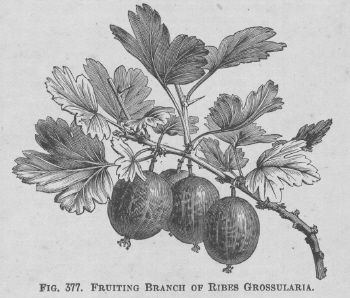
R. Grossularia (Grossularia).* Cat Berry; Wild Gooseberry. fl. greenish, drooping, 1/4 in. in diameter; calyx lobes purplish, reflexed; peduncles one to three-flowered, short-pubescent one to three-bracteate about the middle. fr. 1/2in. to 1in. to 1in. in diameter. l. orbicular, glandular-hairy, three to five-lobed, 1in. to 2in. in diameter, fascicled on short, lateral branches, shining above; lobes irregularly crenate. Europe (Britain), &c. A small, spreading shrub, with one to three spines under the leaf-buds. See Fig. 377. (Sy. En. B. 518.) In the form Uva crispa (formerly regarded as a species), the ripe fruit is glabrous, and the leaves are smaller. There are many other varieties. For culture, &c., see Gooseberry.
R. hirtellum (slightly hairy). A synonym of R. oxyacanthoides. R. lacustre (lake-loving).* fl. greenish-yellow; calyx broad and flat; racemes four to nine-flowered, slender, nodding. fr. bristly, small, unpleasant to the taste. l. heart-shaped, three to five-parted, with the lobes deeply cut. Young stems clothed with bristly prickles and weak thorns. h. 4ft. North America (in cold woods and swamps), 1812. (B. M. 6492.)
R. Lobbii (Lobb's). fl. drooping, two or three to a peduncle, large; calyx dark purple; limb of five segments, marked with lines of hairs; petals erect, almost white. April and May. l. small, cordate, three to five-lobed, glabrous above, downy beneath, sometimes glandular; petioles hairy. Branches harsh, rigid, beset with stipulary, spreading spines in threes or fours. h. 6ft. California. (B. M. 4931, under name of R. subvestitum.)
R. Loudonii (Loudon's). A synonym of R. Gordonianum.
R. missouriense (Missouri). A garden synonym of R. floridum.
R. multiflorum (many-flowered). fl. greenish-yellow, in very long, pendulous, drooping racemes. fr. red, small, and seldom produced. l. five-lobed, large, cordate, tomentose beneath. Branches vigorous, spreading, unarmed. h. 4ft. to 6ft. Eastern Europe, 1822. (B. M. 2368.)
R. nigrum (black).* Black Currant; Quinsy Berry. fl. green, 1/4in. to 1/3in. in diameter; calyx campanulate, glandular; pedicels long; racemes drooping, loose-flowered, tomentose, eglandular. fr. black, 2/3in. in diameter, globose. l. 2in. to 3in. in diameter, five-to seven-lobed, similar to those of R. rubrum, but rather deeply lobed; petioles slender, pubescent. h. 5ft. Europe (Britain, but probably a garden escape). Unarmed shrub, emitting a strong odour when bruised. For culture, &c., see Currant.
R. niveum (snowy). A synonym of R. gracile.
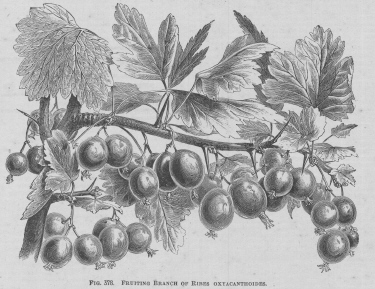
R. oxyacanthoides (Hawthorn-like).* fl. greenish, one or more on a short peduncle. fr. red and green, or purplish-blue, small, of an agreeable flavour. l. glabrous, plaited; lobes toothed; petioles villous and a little hispid. Infra-axillary prickles larger and mostly solitary; smaller prickles scattered here and there. h. 2ft. to 3ft. North America, 1705. See Fig. 378. SYN. R. hirtellum.
R. pennsylvanicum (Pennsylvanian). A synonym of R. floridum.
R. punctatum (dotted). fl. yellowish-green; racemes pedunculate, pendulous, at first ovate, becoming oblong and looser. fr. small, glabrous. l. trilobed, serrated, shining yellowish-green, dotted beneath; petioles pubescent and ciliated. h. 3ft. Chili, 1826. A compact, shining, resinous shrub. (B. R. 1658.)
R. Roezlii (Roezl's). fl. solitary or in pairs, pendulous; calyx lobes red, lanceolate, revolute; petals white, linear-truncate, not spreading. l. roundish, sub-cordate, lobed. Branches armed at the nodes with trifld spines. h. 3ft. North-west America, 1879. (R. G. 982, Figs. 1-3.)
R. rubrum (red).* Wild Currant; Garnet Berry. fl. green, 1/4in. in diameter; racemes 1in. to 3in. long, many-flowered, pubescent or glabrous, never glandular; bracts ovate. fr. red, acid, 1/4in. in diameter. l. 2in. to 4in. in diameter, three to five-angled and lobed, cordate at base, glabrous or pubescent above, usually tomentose beneath; lobes triangular, crenate; petioles pubescent or bristly. h. 4ft. Europe (Britain), &c. Unarmed shrub. For culture, &c., see Currant.
R. r. album (white). A form with white berries.
R. r. hortense (garden). fr. sweeter and larger than in R. r. sylvestre. l. large, sometimes variegated.
R. r. sativum (cultivated). fl. in glabrous, always drooping racemes. fr. globose. l. glabrous on both surfaces when mature. An escape from cultivation. (Sy. En. B. 520.)
R. r. spicatum (spiked). fr. contracted at the top. l. hairy above when young, and tomentose beneath. (Sy. En. B. 522.)
R. r. sylvestre (wood). fl. purplish; racemes pubescent, usually sub-erect when in flower, and drooping when fruiting. fr. contracted at the top. l. hairy above, tomentose beneath.
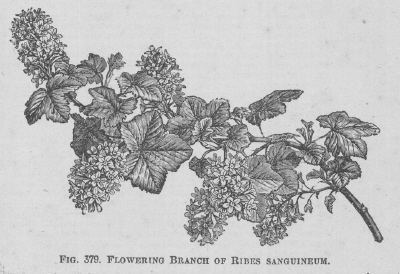
R. sanguineum (bloody-flowered).* Flowering Currant. fl. deep rose-colour; racemes drooping, pubescent, twice the length of the leaves. fr. purplish, with a glaucous bloom. l. cordate, somewhat five-lobed, serrated, veiny, smoothish above, clothed with villous tomentum beneath. h. 4ft. to 8ft. North-west America, 1826. Unarmed shrub. See Fig. 379. (B. M. 3335; B. R. 1349; L. B. C. 1487; S. B. F. G. ser. ii. 109; T. H. S. vii., p. 508.)
R. s. atro-rubens (dark-reddish). fl. much deeper and darker red, smaller, and in smaller racemes, than in the type.
R. s. glutinosum (glutinous). fl. very pale rose-colour; racemes rather larger than in the species. l. destitute of down, slightly viscous.
R. s. malvaceum (Mallow-like). fl. rather darker than in R. s. glutinosum, and having more of a lilac tinge, almost sessile; racemes short and close. l. rough and hispid on the upper side, clothed beneath with whitish, cottony down. (S. B. F. G. ser. ii. 340, under name of R. malvaceum.)
R. setosum (bristly). fl. white, tubular, in pairs. May. fr., berries black, spherical, hispid, with a pleasant, sub-acid, somewhat musky flavour. l. nearly round, cordate at base, pubescent, three to five-lobed. Branches densely bristly; prickles unequal, subulate. 1810. (B. R. 1237.) R. speciosum (showy).* Fuchsia-flowered Gooseberry. fl. deep red, four-parted; calyx cylindrical; pedicels glandular-hairy; stamens twice as long as the calyx; peduncles longer than the leaves, one to three-flowered. fr. red. l. wedge-shaped at base, rounded at the outer end, indistinctly three-lobed, incisely crenate, glabrous and nerved; petioles short. Branches hispid. Prickles infra-axillary, triple. h., in a wild state, 3ft. to 4ft.; twice as much in cultivation. California, 1829. (B. 38; B. M. 3530; B. R. 1557; S. B. F. G. ser. ii. 149.)