Richardia
(named in honour of L. C. Richard, 1754-1821, an eminent French botanist). SYN. Zantedeschia (in part). ORD. Aroideae (Araceae). A genus comprising five species of greenhouse or nearly hardy, marsh-loving, South African, perennial herbs, with thick rhizomes, four of which have been introduced to this country. Flowers monoecious, all perfect; spathe white or yellowish, erect; tube short, convolute, funnel-shaped, accrescent, persistent; throat opening; blade obliquely explanate, marcescent, with a cuspidate, recurved apex; spadix shorter than the spathe, sub-stipitate, erect, cylindrical; inflorescence dense-flowered; peduncles usually several, elongated. Leaves sagittate, sometimes with white, trans-lucid, fenestrate dots; petioles elongated, thick, sheathed at base. Richardias are very distinct and attractive subjects, both on account of their handsome foliage and tall-growing, elegant flower spathes. They are easily cultivated, and the spathes, particularly those of the well-known R. africana, are greatly favoured for cutting purposes. In a greenhouse, few things are more attractive than a group of these plants in flower. Propagation is easily effected from suckers, which are produced in quantity. They may be taken at any time, when the old plants are being repotted; spring is, perhaps, the best season, as young suckers will then have time to establish themselves, so as to flower early the following season. Richardias require a very rich soil; a compost of good loam and cow-manure in nearly equal parts will suit them when established. The suckers should be inserted singly in pots proportionate to their size, and subjected to a little heat to start them. When under glass through the summer, they should be placed in a situation fully exposed to light, and about the end of July it is well to transfer them to the open air, in order to get the growth matured and well ripened--an essential towards free-flowering. Before the appearance of frost, the plants must be again housed; exposure to anything below freezing point proves very destructive to the foliage. An excellent plan of treating Richardias, when established, is that of planting them out each year in the open garden; a piece of ground should be prepared by adding a heavy dressing of manure, and the plants should then be turned out of their pots, and divided, or kept intact, according to their size and the quantity required. If planted about 15in. apart, but little attention will be necessary through summer, beyond supplying an abundance of water, which Richardias require at all times. About the middle of September, the plants may be lifted and potted carefully without much injury being caused. In this way, good, strong specimens may soon be obtained; they may be grown singly in 5in. or 6in. pots, or two or three together in a pot of larger size. Aphides are usually troublesome in spring, but an occasional fumigation will destroy them.
R. aethiopica (African). A synonym of R. africana.
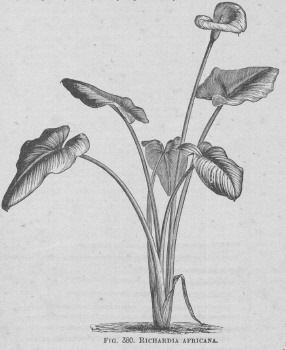
R. africana (African).* Lily of the Nile; White Arum or Trumpet Lily. fl., spathe usually dead-white, large, rolled round below, but flattened and bent backwards above; spadix bright yellow, completely covered with flowers. Spring and summer. l. sagittate, about half as broad as they are long, deep green, unspotted, cuspidate-apiculate at apex, borne on long petioles. h. 2ft. 1731. A very elegant and popular plant. See Fig. 380. SYNS. R. aethiopica, Calla aethiopica (B. M. 832).
R. albo-maculata (white-spotted).* fl., spathe greenish-white, smaller and less expanded than in R. africana. Summer. l. elongate-hastate, borne on rather short petioles, cuspidate-apiculate at apex, marked with oblong, white, translucent blotches parallel with the nervation. h. 2ft. 1859. (B. M. 5140; F. d. S. 2258; I. H. 255; R. G. 462.)
R. hastata (halbert-leaved). fl., spathe greenish-yellow, with a campanulate tube, and a long-cuspidate blade. Summer. l. sub-flaccid, hastate-ovate, about half as broad as they are long, cuspidate-apiculate at apex, unspotted, very similar to those of R. africana. h. 2ft. 1859. (B. M. 5176.)
R. melanoleuca (black and white).* fl., spathe pale yellow, with a black-purple spot at the base, oblong, widely expanded, terminating the tall, hispid stems; spadix white, one-third shorter than the spathe; peduncle slender, dark bristly below. Summer. l. oblong or ovate, sagittate-hastate, marked with oblong, translucent, white spots. h. 1 1/2ft. 1869. (B. M. 5765.)