Scolopendrium
(the ancient Greek name of the genus, used by Theophrastus; it was said to be so-called because the numerous parallel lines of fruit resemble the feet of the Centipede, or Scolopendra). Hartstongue. Including Antigramme, Camptosorus, and Schaffneria. ORD. Filices. A genus comprising about nine species of interesting, stove, greenhouse, or hardy ferns, inhabiting temperate and tropical regions. Sori attached to the veins, oblique with regard to the midrib, or occasionally almost parallel with it, linear or oblong; involucres arranged in pairs, and open towards each other. The species thrive on rockwork; they will also succeed in shady situations, where scarcely any other plant would live. Of S. vulgare, the common British Hartstongue, a multitude of varieties are grown in gardens, and present a wonderful series of interesting variations from the normal state of the plant. The best known species and varieties are described below; except where otherwise indicated, all are hardy. For general culture, see Ferns.
S. Hemionitis (Hemionitis-like). Mule's Fern. sti. 4in to 6in. long, slender, slightly fibrillose. fronds 4in. to 6in. long, oblong. lanceolate, hastate-cordate at base, with short and rounded, or prominent and almost acute, lobes. South Europe, 1779.
S. Krebsii (Krebs'). A form of Lomaria punctulata.
S. officinarum (officinal). A synonym of S. vulgare.
S. pinnatum (pinnate). sti. compressed, greyish. fronds 2ft. to 4ft. long, with an entire terminal pinna, 4in. to 6in. long, and 1 1/2in. to 2in. broad, proliferous at the point, and one to six pairs of similar lateral ones; veins usually once forked. sori oblique, 1/2in. to 3/4in. long, one line broad. Philippines. Greenhouse.
S. rhizophyllum (rooting-fronded). sti. 1in. to 4in. long, naked, compressed, chestnut-brown below. fronds 4in. to 9in. long, lanceolate, from an auricled cordate base, the point tapering out, and frequently rooting. sori short, irregular, linear-oblong. North America.
S. vulgare (common). Burnt Weed; Christ's Hair; Common Hartstongue. rhiz. very stout, often scaly (as well as the stipes and midrib). sti. very stout, 4in. to 8in. long. fronds 6in. to 18in. long, broadest in the middle, flaccid, bright green; basal lobes usually auricled, converging; margins undulated; midrib stout. sori parallel, at right angles to the midrib, very variable in length and number. Europe (Britain). SYN. S. officinarum.
The following are some of the best marked varieties of this species:
S. v. acrocladon (branch-tipped). fronds very distinct, narrow-linear, crested and branched at the apex.
S. v. claphamii (Clapham). fronds forked and crested at the apex, laciniate and lobed on the margins.
S. v. columnare (columnar). fronds having the rachis fringed with a narrow, wing-like membran, leaving only a dense, multifid head. h. 6in.
S. v. coolingii (Cooling's). A form about 4in. broad and high, much branched. The plant is almost spherical in shape.
S. v. crispum (curled). fronds 1ft. to 1 1/2ft. long, always barren under cultivation; margins crenated and undulated, imparting a handsome, frilled appearance. There are many forms of this variety, the most important of which are: fertile, latum, and minus.
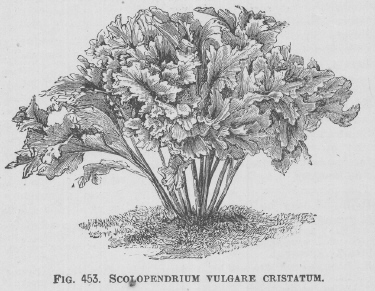
S. v. cristatum (crested). fronds branched at the apex, the branches again forked, thus forming a large crest.
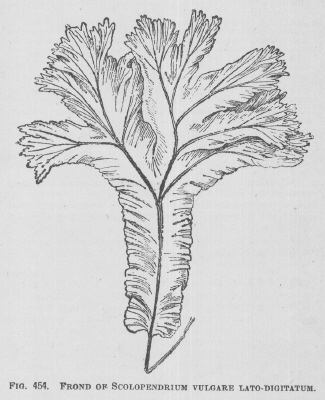
The form lato-digitatum has digitately-branched fronds, and irregularly-laciniate and wavy divisions. See Fig. 454.
S. v. densum (dense). A remarkable form, about 3in. high, having the fronds very much branched, so that the plant resembles a green ball, studded over with innumerable points, something like curled parsley. 1882. S. v. laceratum (torn). fronds beautifully crested and curled at the tips, forming large, crisp heads.
S. v. marginatum (margined). fronds about 1ft. long, having on the under side, near the margin, a continuous, raised line, which often produces thorn-like processes. A very elegant and distinct variety.
S. v. multfidum (much-cut). fronds much-branched and forked at the apex, forming a very handsome, crested head.
S. v. Stansfieldii (Stansfield's). This mainly differs from crispum in that the fronds are peculiarly fringed on the edges and crested at the apex. It is a very striking variety.