Selaginella
(diminutive of Selago, the old name for another Lycopod). ORD. Lycopodiaceae. A vast genus (upwards of 300 species) of stove, greenhouse, or hardy, evergreen plants, much resembling Mosses. "The genus is concentrated in the tropical zone, and has its head-quarters in tropical America. Only two species extend their range into Europe; and the Selaginellas of the Cape, temperate Australia, and South temperate America, are neither numerous nor remarkable. . . . . Habit entirely of Lycopodium, from which it differs by its dimorphic spores and sporangia, some of the species, small and fugacious, resembling Hepaticoe, with not more than two vascular bundles on the main stems. Stems copiously branched, the ultimate branching usually flabellate-dichotomous, trailing, sub-erect, sarmentose, or scandent, with the root-fibres confined to the base, or in the trailing species extended to the upper nodes; in shape more or less distinctly quadrangular, the faces angled (stems goniotropous, Spring) or the faces flat (stems pleuro-tropous, Spring); nodes sometimes distinctly articulated. Leaves small, furnished only with a single central vein, usually tetrastichous and dimorphous, and more or less oblique, the two rows of the lower plane larger and more spreading, the two rows of the upper ascending, adpressed to the stem and imbricated; in the sub-genus Euselaginella multifarious, or, if tetrastichous, all alike. Spikes usually tetrastichous and often sharply square, but in two sub-genera dimorphic on the same plan as the leaves, but mostly resupinate (i.e., the small bracts on the same plane as the large leaves, and vice versa)" (J. G. Baker, to whose admirable monograph of Selaginella, in the "Journal of Botany," 1883-5, we are indebted for the appended descriptions of the species best known to cultivation in this country). Selaginellas grow freely in any light soil, which should be kept open by intermixing charcoal, or small potsherds, through it. They require to be kept quite moist at all times, and prefer shade. Propagated readily from cuttings, made from the creeping stems, which emit roots at nearly every joint. S. Kraussiana is the well-known Lycopod so useful for edgings to greenhouse beds, and for decorative purposes in pots. This may be propagated in quantity at any season. Cuttings for preserving a collection of the species should be inserted, about February or March, in the pots or pans in which they are to remain for the season. Both stove and greenhouse Selaginellas succeed under somewhat similar conditions respectively to stove and greenhouse Ferns.
S. affinis (related). stems 1ft. or more long, trailing, flat on the back, bisulcate on the face, jointed at the nodes, forked low down and copiously pinnate, with erecto-patent, copiously compound branches. l. of the lower plane obtuse on the branchlets, ascending, oblong-lanceolate, acute, 1/8in. to 1/6in. long, bright green; leaves of the upper plane one-third as long, oblique-oblong, cuspidate, imbricated. spikes 1/4in. to 1/2in. long; bracts ovate, cuspidate, strongly keeled. Guiana. A rare, stove species. SYN. S. rigida (of gardens).
S. africana (African). A synonym of S. Vogelii.
S. albo-nitens (shining-white).* stems slender, trailing, copiously pinnate, the upper branchess imple, the lower slightly compound. l. of the lower plane spaced on the main stem, spreading, oblong-lanceolate, one line long, bright green, rather unequal-sided, rounded on the upper side at the base, shortly ciliated; leaves of the upper plane one-third as long, oblique-ovate, distinctly cuspidate. spikes 1/4in. to 1/2in. long; bracts acute, very crowded, strongly keeled. West Indies. Greenhouse.
S. amaena (pleasing). A variety of S. caulescens.
S. apoda (footless). A garden name for S. apus.
S. apus (footless).* stems slender, trailing, densely matted, 1in. to 4in. long, the short, distant, erecto-patent branches simple or forked. l. of the lower plane spaced below the tips of the branches, the upper spreading, the lower reflexed, ovate, acute, half a line long, unequal-sided; leaves of the upper plane half as long, shortly cuspidate. spikes 1/4in. to 1/2in. long; bracts ovate, acute, about one line long, strongly serrulated. Canada, &c. Greenhouse. SYNS. S. apoda and S. densa (of gardens).
S. argentea (silvery), of Spring. A variety of S. caulescens. The name argentea is also used in trade catalogues for S. erythropus.
S. ascendens (ascending). A form of S. Martensii.
S. atroviridis (dark green).* stems sub-erect, 6in. to 12in. long, flat on the back, the root-fibres confined to the lower part, decompound, the branching between pinnatifid and pinnate. l. of the lower plane close, both on the stem and branches, spreading or rather ascending, oblong-rhomboid, sub-obtuse, 1/5in. to 1/4in. long, bright green, unequal-sided, obscurely or distinctly ciliated; leaves of the upper plane half as long, oblong, long-cuspidate, much imbricated. spikes square, 1/2in. to 1in. long; bracts ovate, acute, strongly keeled. Madras, &c. Stove.
S. azorica (Azores). stems trailing, rooting nearly to the tip, 2in. to 3in. long, with several short, compound branches. l. of the lower plane contiguous on the branches, oblique-oblong, nearly equilateral, acute, 1/8in. long, rounded at the base, serrulated from base to apex along both branches, bright green; leaves of the upper plane much imbricated, more than half as long as the others, oblique, oblong-lanceolate. Azores. Greenhouse.
S. bellula (rather pretty), of Moore. A synonym of S. inaequalifolia perelegans.
S. brasiliensis (Brazilian). stems trailing, 2in. to 4in. long, copiously pinnate, the branches erecto-patent, the upper simple, the lower slightly decompound. l. of the lower plane spaced and spreading, except towards the tips of the branches, nearly or quite one line long, bright green, cordate at base on the upper side, distinctly ciliated and imbricated over the stem; leaves of the upper plane half as long, distinctly cuspidate. spikes 1/4in. to 1/2in. long; bracts ovate-lanceolate, strongly keeled. Brazil. Greenhouse. A near ally of S. apus.
S. Braunii (Braun's). stems 1ft. to 1 1/2ft. long, erect, pale straw-colour, simple in the lower half, decompound, deltoid, and flexuous in the upper half; pinnae erecto-patent, deltoid; pinnules regular, short, deltoid, spaced; ultimate branchlets 1/8in. to 1/4in. long. l. of the lower plane contiguous only on the final branchlets, nearly spreading, ovate-rhomboid, half a line long; leaves of the upper plane one-third to half as long, shortly cuspidate. spikes short, square; bracts little longer than the sporangia. West China. A distinctly-marked and well-known, greenhouse species.
S. Brownii (Brown's). A form of S. Kraussiana.
S. caesia (grey). A garden synonym of S. uncinata.
S. c. arborea (tree-like). A synonym of S. Willdenovii.
S. canaliculata (channelled).* stems sub-erect, sarmentose, 3ft. to 4ft. long; pinnae deltoid, usually 4in. to 6in. long, sometimes flexuous and more elongated; lower branchlets copiously compound, the tertiary divisions more erecto-patent, and not so close as in S. inaequalifolia. l. of the lower plane crowded, oblongrhomboid, 1/12in. to 1/8in. long on the branchlets, bright green, cuneate-truncate on the upper, nearly square on the lower, side at the base; leaves of the upper plane half as long, ovate-lanceolate. spikes square, 1/4in. to 1in. long; bracts cuspidate, strongly keeled. Eastern Himalayas, &c. Stove. Rare in cultivation. SYNS. S. caudata, S. chinensis, S. sinensis (of gardens).
S. c. robusta (robust). A very tall, strong-growing garden form SYN. S. robusta (of gardens).
S. caudata (tailed). A synonym of S. canaliculata.
S. caulescens (stemmed).* stems generally 6in. to 12in. long, stiffly erect, unbranched in the lower half, with spaced, adpressed leaves, deltoid and decompound in the upper half; pinnae close, deltoid, with copiously sub-flabellately compound lower pinnules, the final branchlets ascending. l. of the lower plane crowded, ovate, falcate, acute, half a line to one line long, bright green, slightly ciliated on the upper side at base; leaves of the upper plane a quarter to one-third as long, much imbricated. spikes square, 1/4in. to 1/2in. long; bracts ovate, cuspidate. Japan, China, &c. Stove.
S. c. amaena (pleasing). stems erect, about 1ft. high; upper part triangular, pinnately branched, with spreading, distant, acuminate leaves; branches horizontal, bipinnate. Mexico. Whole plant of a bright and cheerful green.
S. c. argentea (silvery). This only differs from the type in the silvery sheen of its under surface. SYN. S. argentea (of gardens).
S. c. japonica (Japanese). stems, pinnae less crowded, and not so decompound as in the type. l. of the lower plane broadly ovate; those of the main stem and pinnae nearly as broad as long; those of the unbranched part of the stem rather spreading. Japan.
S. chinensis (Chinese). A garden name for S. canaliculata.
S. cognata (related). A synonym of S. Lobbii.
S. conferta (clustered). stems very slender, trailing, intermatted, 1in. to 2in. long, copiously pinnate, the lower branches slightly compound. l. of the lower plane close, erecto-patent, linear-oblong, obtuse, half a line long, equal-sided, strongly ciliated, a little imbricated; leaves of the upper plane one-third or one-fourth as long, acute. spikes very short; bracts ovate, crowded, strongly keeled. Cuba. Stove.
S. convoluta (convolute). stems densely tufted, 3in. to 6in. long, compound nearly to the base, the primary branching pinnate, the short, broad, erecto-patent pinnae between pinnate and flabellate. l. of the lower plane much imbricated, ascending, ovate, acute, half a line long, serrulated, bright green; leaves of the upper plane half as long, acute. spikes square, 1/4in. to 1/2in. long; bracts cuspidate, strongly keeled. Tropical America. Stove.
S. cuspidata (cuspidate).* stems densely tufted, about 6in. long, branched nearly or quite from the base, the primary branching pinnate; pinnae short, rhomboid, copiously compound, with contiguous branchlets. l. of the lower plane crowded, ascending, oblique-ovate, cuspidate, dilated and ciliated on the upper side at base, pale green, white-edged, half a line to one line long; leaves of the upper plane nearly as long, cuspidate. spikes square, 1/4in. to 1/2in. long; bracts cuspidate, strongly keeled. Mexico, &c. A common, stove species.
S. c. elongata (elongated). stems 1ft. or more long, simple in the lower part, the primary branches more elongated and more pinnate. SYN. Lycopodium cordifolium (of gardens).
S. delicatissima (very delicate). stems densely matted, very slender, stramineous, trailing to a length of 6in. to 12in., forked and copiously pinnately branched, the branches copiously compound. l. of the lower plane spaced, except at the tips of the branches, spreading, oblong, obtuse, broadly rounded and densely ciliated on the upper side at base; leaves of the upper plane half as long, acute, strongly auricled on the outside at base. spikes unknown. Probably Andine. Greenhouse. The leaves and branches curl up readily in drought.
S. densa (dense). A garden name for S. apus.
S. denticulata (small-toothed).* stems densely matted, pale, trailing, 6in. long, copiously pinnately branched, the lower branches copiously fiabellately compound. l. of the lower plane close or slightly spaced, broadly ovate, oblique, sub-acute, three-quarters of a line to one line long, spreading or erecto-patent, flat, denticulate, cordate on the upper side at base, much imbricated over the stem; leaves of the upper plane half as long, cuspidate, rather diverging. spikes sessile, square, about 1/2in. long; bracts acute, much imbricated, strongly keeled. Mediterranean region. Greenhouse. In exposed places, the whole plant sometimes turns bright red when old.
S. dichrous (two-coloured). A garden form of S. Vogelii.
S. distorta (distorted). stems slender, trailing or sub-erect, intermatted, 3in. to 6in. long, obscurely jointed at the nodes, copiously pinnate, the short, ascending branches sub-flabellately compound. l. of the lower plane crowded on the branchlets, deflexed, oblong-lanceolate, acute, about half a line long; leaves of the upper plane more than half as long, imbricated, oblong, acute. spikes short, square; bracts acute, strongly keeled. Brazil. Greenhouse.
S. d. major (larger). More luxuriant, with stouter stems, 1ft. or more in length, and often excurrent at the end; leaves of the lower plane often one line long, spreading, or rather ascending.
S. divaricata (divaricate). A form of S. Martensii.
S. erythropus (red-footed).* stems about 9in. long, bright crimson, simple in the lower half or third, deltoid and decompound upwards; lower pinnae deltoid, tripinnate; final branchlets ascending, contiguous. l. of the lower plane contiguous, ascending, oblong or ovate-lanceolate, acute, 1/12in. to 1/8in. long, bright green, unequal-sided, strongly ciliated and imbricated over the stem on the upper side at the base; leaves of the upper plane half as long, oblique-ovate, cuspidate. spikes square; bracts cuspidate, strongly keeled. Tropical America. Stove. The form major is more compound, the unbranched part of the stem longer, and all its leaves adpressed. S. setosa (of gardens) is a starved, small form of this species.
S. filicina (Fern-like). A synonym of S. haematodes.
S. flabellata (fan-shaped). stems 1ft. to 2ft. long, erect, simple in the lower half, deltoid and decompound in the upper half; pinnae deltoid, the lower three or four-pinnate; final branchlets contiguous, 1/4in. to 1in. long. l. of the lower plane contiguous, oblique-ovate, acute, ascending, bright green, obliquely inserted, much dilated, ciliated, much imbricated over the stem on the upper side at base; leaves of the upper plane a quarter to one-third as long, cuspidate. spikes square, 1/2in. to 1in. long; bracts cuspidate, strongly keeled. Tropics of Asia, America, and Polynesia. Stove.
S. flagellata (whip-like). stems trailing, 6in. long; branches erecto-patent, the lower ones copiously compound; branches excurrent and whip-like at the end. l. of the lower plane ovate-lanceolate, very acute, above one line long, pellucid, bright green, more produced on the upper side of the midrib, rounded at the base, shortly ciliated, imbricated over the stem; leaves of the upper plane one-third as long, ovate, acuminate, falcate, converging. spikes 1/3in. to 1/2in. long; bracts very acuminate, strongly keeled. French Guiana. Stove.
S. flagellifera (whip-bearing). A garden form of S. plumosa.
S. flagelliformis (whip-like). A synonym of S. plumosa flagellifera. S. flexuosa (flexuous). stems about 1ft. long, flat on the back, copiously branched, the lower branches elongated and copiously compound, the upper part assurgent; root-fibres often only developed from the lower half. l. of the lower plane close, spreading, bright green, oblong-rhomboidal, sub-acute, 1/8in. to 1/6in. long, more produced on the upper side of the distinct midrib, serrulated on the upper side near the base; leaves of the upper plane one-third as long, long-cuspidate. spikes 1/2in. to 1in. long, square; bracts half a line long, crowded, sharply keeled. South Brazil. Stove.
S. formosa (beautiful). A form of S. Martensii.
S. fulcrata (fulcrate). stems 1 1/2ft. to 2ft. long, stiffly erect, simple in the lower half, with a few distant, small, adpressed leaves, deltoid and decompound in the upper half; pinnae deltoid. the lower ones three or four-pinnate, the rachises pubescent; final branchlets contiguous, 1/4in. to 1/2in. long. l. of the lower plane rather spaced even on the branchlets, ascending, lanceolate, acute, 1/12in. to 1/8in. long, truncate; leaves of the upper plane half as long, incurved, not cuspidate. spikes square, 1/4in. to 1/2in. long; bracts little longer than the sporangia. Eastern Himalayas. A well-marked, greenhouse species.
S. Galeottei (Galeotte's). stems 1ft. to 2ft. long, sub-erect, with root-fibres from the lower half, sometimes excurrent and whip-like at the tip, copiously pinnate, the branches pyramidal and decompound. l. of the lower plane close on the branchlets, spaced on the branches and stem, ascending, lanceolate or oblong-lanceolate, acute, 1/8in. to 1/6in. long, more produced on the upper side of the midrib, broadly rounded and shortly ciliated on the upper side at the base, truncate and auricled on the lower; leaves of the upper plane one-third to one-half as long, much imbricated. spikes 1/4in. to 1/2in. long; bracts cuspidate, strongly keeled. Mexico. Stove. S. grandis (great).* stems erect, 1 1/2ft. to 2ft. long, simple in the lower half, deltoid and decompound in the upper half, the branching midway between flabellate and pinnate, the contiguous final branchlets 2/3in. broad. l. of the lower plane crowded, lanceolate, very acute, 1/4in. to 1/3in. long, bright green, equilateral except at the base, slightly ciliated; leaves of the upper plane one-third as long, ovate-lanceolate, very acute, much imbricated. spikes copious, square, tetragonal, 1in. to 1 1/2in. long; bracts strongly ciliated. Borneo, 1882. A very fine, stove plant. (G. C. n. s., xviii. p. 40.) SYN. S. platyphylla (of gardens).
S. haematodes (bloody).* stems 1ft. to 2ft. long, bright crimson, unbranched in the lower half, with leaves much spaced and adpressed, deltoid and decompound in the upper half; pinnae deltoid, three or four-pinnate, the contiguous, erecto-patent ultimate divisions 1/4in. to 1in. long. l. of the lower plane contiguous, ascending, ovate or oblong-rhomboidal, acute, 1/6in. to 1/3in. long, bright green, dilated on the upper side at the base, broadly rounded; leaves of the upper plane minute, with a large cusp. spikes square, 1in. to 1 1/2in. long; bracts ovate-lanceolate. Andes. Stove. One of the handsomest species. SYN. S. filicina.
S. helvetica (Swiss). stems densely matted, slender, pale, trailing, 2in. to 3in. long, forked at base, distantly pinnately branched, with short, erecto-patent, slightly compound branches. l. of the lower plane spreading, close or slightly spaced, half a line or more long, oblique, produced on the upper side; leaves of the upper plane acute, half as long, rather divergent. spikes distinctly pedunculate, 1/2in. to 1in. long, terete; bracts imbricated. Central Europe to Japan. Hardy. (J. F. A. 196, under name of Lycopodium helveticum.) S. inaequalifolia (unequal-leaved). stems sub-erect, sarmentose, 3ft. to 4ft. long; pinnae oblong-lanceolate, 6in. long, the erectopatent branchlets considerably compound, with ascending tertiary divisions. l. of the lower plane contiguous, oblong-rhomboid, 1/12in. to 1/8in. long, bright green; leaves of the upper plane half as long, shortly cuspidate, spikes square, 1/4in. to 1/2in. long; bracts ovate, cuspidate, strongly keeled. Eastern Himalayas. A well-known, stove species.
S. i. perelegans (very elegant). stems not more than 1ft. long; pinnae shorter, more deltoid, with more compound lower branches. spikes copious, often 1in. long. SYN. S. bellula (of Moore) (G. C. n. s., xi. p. 173).
S. involvens (rolled up). stems very densely tufted, 2in. to 6in. long, deltoid, twice or thrice pinnate, branched nearly or quite from the base, the branching of all grades between flabellate and pinnate. l. of the lower plane very crowded, ascending, ovate, with a distinct cusp, about one line long, bright green, very thick, serrulated, nearly equal-sided; leaves of the upper plane nearly as long, oblique, distinctly cuspidate. spikes square; bracts acutely keeled. Japan, China, &c. Greenhouse. (G. C. n. s., xix. p. 404.)
S. i. texta (woven). A peculiar garden form, in which the branches are almost simple. SYN. S. texta (of Belgian gardens).
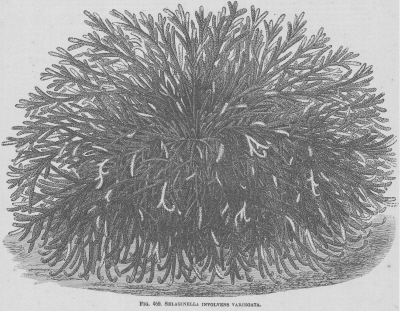
S. i. variegata (variegated). This only differs from the type in having the tips of some of the branches creamy-white. See Fig. 469, for which we are indebted to Mr. Wm. Bull.
S. japonica (Japanese). A variety of S. caulescens.
S. Karsteniana (Karsten's). stems about 1ft. long, erect from a decumbent base, bisulcate down the face, copiously pinnate; branches short, erecto-patent, sparingly compound. l. of the lower plane ovate, acute, dark green, sub-diaphanous, very unequal-sided, denticulate on the upper margin, much produced on the upper side at base and imbricated over the stem; leaves of the upper plane one-third as long, ovate-oblong, cuspidate. spikes short, often twin, but little flattened; bracts not very obviously dimorphous. New Grenada. Greenhouse.
S. Kraussiana (Krauss').* stems trailing, 6in. to 12in. long, jointed at the nodes, copiously pinnate, with copiously compound, erecto-patent branches. l. of the lower plane contiguous on the branchlets, spaced on the branches and main stems, oblong-lanceolate, acute, 1/8in. to 1/6in. long, bright green, ciliated and broadly rounded at base; leaves of the upper plane one-third as long, not cuspidate. spikes short, square; bracts cuspidate, strongly keeled. South Africa, 1878. Greenhouse. S. Brownii is a dwarf form from the Azores. The form aurea has yellow leaves; variegata is a variegated form.
S. laevigata (smooth).* stems erect, 1ft. to 1 1/2ft. long, simple in the lower half, the leaves small, distant and soon deciduous, deltoid in the upper half, with petiolate, deltoid, once or twice pinnate pinnae; final divisions erecto-patent, 2in. to 3in. long. l. of the lower plane crowded, oblong-lanceolate, sub-patent, very falcate, acute, 1/8in. to 1/6in. long, bright green, adnate by a broad base, decurrent on the lower side; leaves of the upper plane minute, recurved. spikes square, 1/2in. to 1in. long; bracts acute, strongly keeled. Madagascar. Stove.
S. l. Lyalli (Lyall's). stems, lower pinnae bipinnate, with final divisions 1/2in. to 1in. long. A more compound variety.
S. lepidophylla (scaly-leaved).* The Resurrection Club-moss, which is frequently exposed for sale as a vegetable curiosity, owing to the manner in which its curled-up stems unroll and resume a fresh appearance when placed in water. stems densely tufted, 2in. to 4in. long, branched to the base, the primary branching closely pinnate, the broad, cuneate, ascending pinnae copiously sub-flabellately compound. l. of the lower plane much imbricated, ascending, oblique, ovate, obtuse, half a line long, minutely ciliated, when old tinted red-brown; leaves of the upper plane nearly as long, obtuse. spikes square, 1/4in. to 1/2in. long; bracts deltoid, acutely keeled. Texas to Peru. Greenhouse. (G. C. 1872, p. 69.)
S. Lobbii (Lobb's). stems sub-erect, sarmentose, 3ft. to 4ft. long; pinnae regular, lanceolate-deltoid, about 6in. long, cuneate at base; pinnules contiguous, erecto-patent, the upper ones simple, the lower forked. l. of the lower plane contiguous, oblong-lanceolate, falcate, acute, 1/8in. long on the pinnules, 1/6in. to 1/5in. on the pinnae, bright green, truncate and rather dilated on both sides at base; leaves of the upper plane one-third as long, cuspidate. spikes square, oblique-ovate, terminal on the branchlets, 1/4in. to 3/4in. long; bracts cuspidate, strongly keeled. Borneo. Stove. Rare in cultivation. SYN. S. cognata.
S. ludoviciana (Louisianian). stems slender, copiously pinnate, flat, 6in. long, the upper branches simple, the lower slightly compound. l. of the lower plane much spaced below the tips of the branches, spreading, ovate-oblong, sub-acute, half a line or more long, serrulated, imbricated over the stem; leaves of the upper plane half as long, cuspidate. spikes 1/4in. to 1/2in. long; bracts one line long, strongly keeled. United States. A well-known, greenhouse species, allied to S. apus.
S. Lyalli (Lyall's). A form of S. laevigata.
S. Martensii (Martens').* stems 6in. to 12in. long, trailing in the lower half, with copious, long root-fibres, ascending in the upper half, decompound, the branching between pinnate and flabellate. l. of the lower plane usually crowded, erecto-patent, oblong-lanceolate, sub-obtuse, bright green, unequal-sided, serrulated, a little imbricated; leaves of the upper plane half as long, with a long cusp, much imbricated. spikes 1/4in. to 1/2in. long, square; bracts acute, strongly keeled. Mexico. A common, greenhouse species, with numerous varieties, of which the most distinct are: ascendens, divaricata, formosa, the variegated robusta, and stolonifera.
S. molliceps (soft-stemmed). stems erect, densely tufted, 6in. to 9in. long, copiously pinnate, the base bisulcate; lower branches copiously compound. l. of the lower plane contiguous on the branchlets, spaced on the main stem, erecto-patent, obliquely oblong-lanceolate, acute, dark green, one line long, very unequalsided, serrulated on the upper edge, broadly rounded, shortly ciliated, and a little imbricated over the stem on the upper side at base; leaves of the upper plane one-half to one-third as long, ovate or ovate-lanceolate, cuspidate. spikes copious, resupinate, 1/4in. to 1/2in. long; bracts of the upper plane lanceolate-rhomboid, those of the lower plane ovate, cuspidate. Upper Guinea. Stove. SYN. S. rubricaulis.
S. mutabilis (changeable). A synonym of S. serpens.
S. patula (spreading). stems slender, pale, trailing, 6in. to 9in. long, with a long, whip-like tip, and numerous short, alternate, pinnately-arranged branches with three to seven branchlets. l. of the lower plane crowded, erecto-patent, oblong-lanceolate, bright green, the midrib distinct, ciliated and imbricated over the rachis on the upper side at the base; leaves of the upper plane one-third as long, oblique-ovate, acute. spikes square, 1/4in. to 1/2in. long; bracts cuspidate, much imbricated, strongly keeled. Jamaica. A common, greenhouse species.
S. pilifera (hair-bearing). stems densely tufted, 3in. to 4in. long, copiously compound, cuneate, the branching midway between pinnate and flabellate, the branches erecto-patent. l. of the lower plane crowded on the branches, rather spaced on the main stem, ascending, oblique-ovate, half a line long, distinctly cuspidate. spikes square, 1/4in. to 1/2in. long; bracts strongly keeled. Texas. Greenhouse. A rare species in cultivation.
S. platyphylla (flat-leaved). A garden synonym of S. grandis.
S. plumosa (feathery). stems pale, trailing, 6in. to 12in. long, often forked low down, copiously pinnately branched, the branches copiously compound, the root-fibres extending to the upper nodes. l. of the lower plane contiguous on the branches, spreading or rather ascending, bright green, oblong-or ovate-lanceolate, acute, 1/12in. to 1/8in. long, ciliated at base, cordate on the upper side and much imbricated over the stem; leaves of the upper plane one-third as long, ovate, cuspidate, much imbricated. spikes copious, square, 1/4in. to 1/2in. long; bracts acute, strongly keeled. Eastern Himalayas. Stove. S. flagellifera is merely a garden form of this species. SYN. S. flagelliformis.
S. Paeppigiana (Paeppig's). stems trailing, 1ft. to 2ft. long, forked at base, jointed at the nodes, copiously pinnate, with copiously compound, erecto-patent branchlets. l. of the lower plane spaced, except towards the tips of the branchlets, much spaced on the main stem, ascending, oblong-lanceolate, 1/8in. to 1/6in. long, broadly rounded on the upper side at base; leaves of the upper plane one-third as long, oblique, with a distinct cusp. spikes square, 1/4in. to 1/2in. long; bracts acute, sharply keeled. Andes. Greenhouse.
S. Poulteri (Poulter's).* stems densely tufted, very slender, suberect, 2in. to 3in. long, three or four times trichotomously-forked, with slender radicles from the lower half. l. of the lower plane distinctly spaced, spreading, sub-orbicular, obtuse, half a line long, bright green; leaves of the upper plane nearly as long, but acute, ascending. spikes slender, 1/2in. to 1in. long; bracts scarcely longer than the sporangia. Azores, 1868. Greenhouse. S. rigida (rigid). A garden name for S. affinis.
S. robusta (robust). A garden name for S. canaliculata robusta.
S. rubella (reddish). stems 1ft. long, sub-erect, with root-fibres from the lower half, reddish-brown, pinnately branched, the lower branches cuneate, with five to seven branchlets. l. of the lower plane ascending, crowded on the branchlets, oblique-oblong, obtuse or obscurely cuspidate, 1/12in. to 1/8in. long, dark green, turning reddish with age, more produced and ciliated on the upper side at the base; leaves of the upper plane half as long, ovate, cuspidate, much imbricated. spikes square, 1/2in. to 1in. long; bracts long-cuspidate, strongly keeled. Native country unknown, 1870. Greenhouse. (G. C. 1871, p. 902.)
S. rubricaulis (red-stemmed). A synonym of S. molliceps.
S. selaginoides (Fir Club-moss-like). A synonym of S.spinosa.
S. serpens (winding). stems densely matted, quite trailing, 6in. to 9in. long, copiously pinnate, branched, with numerous, erectopatent, slightly compound branches. l. of the lower plane crowded, spreading, three-quarters of a line long, ovate-oblong, bright green with a distinct midrib, both sides rounded and ciliated at base; leaves of the upper plane one-third as long, acute. spikes square, 1/4in. to 1/2in. long; bracts cuspidate, crowded, strongly keeled. West Indies. A well-known, stove species. SYNS. S. mutabilis, S.variabilis, S. varians.
S. setosa (bristly). A garden form of S. erythropus.
S. sinensis (Chinese). A garden synonym of S. canaliculata. S. spinosa (spiny). barren stems short, trailing, slender, little branched, with short, ascending branches. l. lax and spreading on the lower part of the barren branches, dense and ascending upwards, lanceolate, half a line to one line long, acute, bright green, ciliated. fertile stems erect, simple, 2in. to 3in. long, with a leafy peduncle about as long as the spike. spike multifarious; bracts lax, ascending, lanceolate or ovate-lanceolate, 1/8in. to 1/6in. long, strongly ciliated, not acutely keeled. Europe (Britain), North America. Hardy. SYN. S.selaginoides.
S. spinulosa (small-spined). stems very slender, trailing, 1in. to 2in. long, little-branched, l. of the lower plane spaced even on the branchlets, oblong, obtuse, half a line long, pale green, strongly ciliated; leaves of the upper plane a quarter to one-third as long, oblong, acute. spikes short, square; bracts cuspidate, strongly keeled. Java. Stove.
S. stolonifera (stolon-bearing). A form of S. Martensii.
S. suberosa (slightly erose). stems densely tufted, sub-erect, often above 1ft. long, pale, shining brown, copiously pinnate, the branching erecto-patent and decompound, the root-fibres sometimes extending half-way up to it. l of the lower plane spaced and erecto-patent on the branches, very distant and spreading on the main stem, oblique-lanceolate or ovate-lanceolate, acute, bright green, unequal-sided, much produced, broadly rounded, shortly ciliated; leaves of the upper plane half as long, long cuspidate. spikes copious, 1/4in. 3/4in. long, resupinate; bracts of the upper plane lanceolate, erecto-patent, of the lower plane ascending, ovate, cuspidate. Khasis Mountains. Greenhouse.
S. sulcata (furrowed). stems trailing in the lower half, usually assurgent in the upper half, deeply bisulcate down the face, jointed at the nodes, copiously flabellate-pinnate, the final branchlets contiguous. l. of the lower plane close on the branchlets, spaced on the stem, oblong-lanceolate, acute, 1/8in. to 1/6in. long, auricled on both sides at base; leaves of the upper plane one-third as long, long-cuspidate. spikes 1/4in. to 1/2in. long, square; bracts acute, strongly keeled. South Brazil. Green house. S. texta. See S. involvens texta.
S. uncinata (hooked).* stems weak, slender, pale straw-coloured, bisulcate on the face, trailing, 1ft. to 2ft. long, with a long, excurrent tip, and alternate, short, pinnately arranged, copiously compound branches. l. of the lower plane sub-ovate, 1/12in. to 1/8in. long, close or rather spaced on the branches, thin, bright blue-green, minutely petiolate, both sides cordate at base; leaves of the upper plane one-third as long, cuspidate, much imbricated. spikes 1/4in. to 1/2in. long, square; bracts one line long, crowded, sharply keeled. China. A well-known, greenhouse species. This is the proper name of the blue-tinted plant known in gardens as S.coesia.
S. variabilis (variable). A synonym of S. serpens.
S. varians (variable). A synonym of S. serpens.
S. Victoriae (Victoria's). stems sub-erect, sarmentose, 3ft. to 4ft. long; pinnae lanceolate-deltoid, 6in. to 9in. long, caudate; upper pinnules erecto-patent and simple, contiguous, the lower forked or slightly pinnate. l. of the lower plane crowded, oblong-lanceolate, falcate, acute, one line long, dark bright green, obscurely petiolate; leaves of the upper plane a quarter as long, much imbricated. spikes square, 1in. to 2in. long; bracts acutely keeled. Borneo, &c, 1879. Stove. Rare in cultivation. (G. C. n. s., xi. p. 75.)
S. viticulosa (tendrilled). stems about 9in. long, stramineous, simple in the lower part, deltoid and decompound upwards; pinnae deltoid, bi-or tripinnate, the root-fibres sometimes extending to the axils of the lowest pinnae, the contiguous, ascending final segments 1/2in. to 1in. long. l. of the lower plane contiguous, ascending, lanceolate or oblique-ovate, acute, 1/12in. to 1/8in. long, bright green; leaves of the upper plane one-third as long, oblique-ovate, cuspidate. spikes square; bracts cuspidate, strongly keeled. Central America and Venezuela. Stove.
S. Vogelii (Vogel's). stems 1ft. to 2ft. long, erect, simple in the lower half, often pink-tinted, with a few distant, small, adpressed leaves, deltoid and decompound in the upper half; lower pinnae deltoid, petiolate, three or four-pinnate, the contiguous, erecto-patent final divisions 1/4in. to 3/4in. long. l. of the lower plane spaced even on the branchlets, lanceolate or oblong-lanceolate, ascending, acute, one to two lines long, bright green, both edges liable to be revolute, truncate at base; leaves of the upper plane minute, with a large cusp. spikes square, 1/4in. to 1/2in. long; bracts cuspidate, strongly keeled. West Africa. Stove. Well known in cultivation. SYN. S. africana. There is a variegated form. S. dichrous is a garden form of this species.
S. Wallichii (Wallich's).* stems sarmentose, sub-erect, 2ft. to 3ft. long; pinnae lanceolate, 6in. to 9in. long; pinnules invariably simple, crowded, erecto-patent, 1in. to 1 1/2in. long, the end one sometimes 3in. to 4in. long. l. of the lower plane crowded, oblong-lanceolate, slightly falcate, pointed at the upper corner, equal-sided, the lower ones of the pinnules 1/12in. to 1/8in. long, the upper gradually smaller, dark bright green, obscurely petiolulate, truncate or slightly cordate on both sides at the base; leaves of the upper plane a quarter as long, much imbricated. spikes square, terminal on the pinnules, 1/2in. to 1in. long; bracts cuspidate, strongly keeled. India. A common and ornamental, stove species.
S. Willdenovii (Willdenow's).* stems climbing to a length of 12ft. to 20ft. or more; pinnae spreading, deltoid, 1ft. to 2ft. long, pinnules deltoid and decompound; ultimate branches short and contiguous. l. of the lower plane crowded, ascending, ovate or oblong, 1/12in. to 1/8in. long, green with a tint a blue, obscurely petiolate, cordate on both sides at base; leaves of the upper plane one-third as long, not cuspidate. spikes square, 1/2in. to 1in. long; bracts scarcely larger than the sporangia. Cochin China, &c. A well-known, stove species. SYN. S. coesia arborea.