Taraxacum
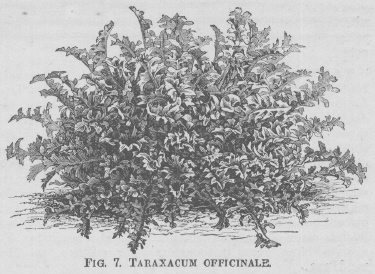
(from tarasso, to disturb, to alter; from its supposed effects upon the blood). Dandelion. SYN. Leontodon (of Adanson). Including Lasiopus. ORD. Compositae. A genus comprising, according to Bentham and Hooker, not more than half-a-dozen species of mostly hardy, nearly stemless herbs, broadly distributed. Flower-heads yellow, homogamous; ray florets ligulate, truncate at apex, five-toothed; involucre campanulate or oblong, the inner bracts one-seriate, the outer ones shorter and many-seriate; receptacle flat; achenes glabrous; scapes leafless, one-headed, or rarely branched at apex and two or three-headed. Leaves radical, entire, toothed, sinuate, or runcinate-pinnatifid. Only two species call for mention here. They thrive in ordinary soil, and may be increased by divisions. T. officinale is cultivated as a salad plant. For this purpose, seeds should be sown, in March or April, in drills 1ft. apart, or in a seed-bed, with a view to transplanting afterwards. All the after-attention necessary is that of an occasional hoeing between the plants. In the following spring, a quantity of new leaves will appear, and, in order to blanch them as they grow, the plants may be buried with sand, or covered with large, inverted flower-pots. The sand should be from 4in. to 6in. deep, and when the leaves show through it, they should be cut off at the crown, and the sand placed over others. The plants should, of course, never be allowed to flower and ripen seeds in a garden.
T. montanum (mountain). fl.-heads one or two on a hairy scape; involucral bracts recurved and acute at apex. August. l. spreading oblong, sub-runcinate, spiny-toothed, glabrous. Armenia, 1834. SYN. Lasiopus sonchoides (S. B. F. G. ser. ii. 346).
T. officinale (officinal). Common Dandelion. fl.-heads 1/3in. to 2in. broad, the outer ray florets often brown on the back; involucre campanulate, the outer bracts recurved, the inner erect. March to October. l. oblong-obovate or spathulate, toothed, sinuate, or runcinate-pinnatifid. Root long, stout, black. Europe (Britain), &c. A well-known medicine.(Sy. En. B. 802.)