Thrinax
(from thrinax, a fan; alluding to the form of the leaves). ORD. Palmae. A genus comprising about ten species of stove mediocre or dwarf, unarmed Palms; one is a native of Florida, and the rest inhabit the Antilles. Flowers sometimes long and slender, pedicellate; spathes many, papery-coriaceous, cut; spadices elongated, the rachis clothed with a tubular sheath, the primary branches alternate, paniculate, the branchlets slender. Fruit small, pea-like. Leaves terminal, orbicular or truncate at base, flabellately plicate and multifid; segments induplicately bifid; petioles slender, biconvex. Trunks solitary or tufted, annulated below, above covered with the persistent bases of fallen leaves. The genus includes some very beautiful plants, the best-known of which are here described. They succeed best, when young, in a compost of loam, peat, and sand; as they get older, turfy loam and sand is preferable. Propagated by seeds, which, like all Palm seeds, should be obtained when freshly imported, sown in well-drained pots or pans of sandy loam, and plunged in bottom heat.
T. argentea (silvery). Broom Palm; Silver Thatch, &c. fl., partial spathes three or four only; spadix 1ft. long, slightly paniculate. fr. small. l. shorter than the petioles, silvery-silky beneath; divisions united at the base; ligule concave, somewhat crescent-shaped. Trunk 12ft. to 15ft. high, 2in. to 3in thick. West Indies, 1830.
T. barbadensis (Barbados).* fl., spadix paniculate, 2ft. long. fr. 1/4in. in diameter. l. green, glabrous, very large, fan-shaped or digitate-multipartite; segments lanceolate, acuminate; petioles covered with a thick felt of small, white scales, and edged with black, hooked, ascending spines. Trunk 12ft. high. Barbados, 1875.
T. elegans (elegant). A garden synonym of T. radiata. T. excelsa (tall). fl., spathe rusty-tomentose; spadix with spreading-recurved branches, its axis 1ft. long, naked below. fr. globose, 1/4in. in diameter. l. 4ft. to 5ft. long, pale green above, hoary-glaucous beneath by minute, appressed down, about fifty-cleft; divisions about 2ft. long, 1in. to 3in. broad, united to about one-third their length. h. 7ft. and upwards. Jamaica, 1800.
T. gracilis (slender). A garden synonym of T. radiata.
T. graminifolia (grass-leaved). A synonym of T. multiflora.
T. multiflora (many-flowered).* fl., primary spathes twelve to fifteen, tubular, obliquely opening, acute, longitudinally nerved; secondary spathes funnel-shaped, compressed at base; spadices erecto-patent. l. six to ten, erecto-patent, sub-orbicular, peltately radiate; segments forty or more, united half-way, the middle ones 2 1/4ft. to 3ft. long, 2 1/2in. broad at base, the free part ensiform, long-acuminate, flat, acutely bifid at apex; sheaths 6in. to 9in. long. Caudex 6ft. to 8ft. high, 4in. to 5in. thick, deeply and irregularly annulate. Haiti. SYN. T. graminifolia (I. H. n. s. 187).
T. parviflora (small-flowered).* Palmetto Thatch; Royal Palmetto Palm. fl., perianth minute; spadix 2ft. to 3ft. long, paniculate. fr. dry, rather rough, 1/4in. in diameter. l. puberulous, glabrate and green beneath, 10in. to 2ft. long; divisions united one-sixth to one-quarter their length; ligule deltoid. Trunk 10ft. to 12ft. high. Jamaica, 1778.
T. pumilio (dwarf). l. digitately multipartite; segments ensiform, acuminate, green on both sides, the middle nerve ferruginous-ramentaceous beneath, the secondary ones six to eight, impressed on both sides; ligule triangular. Trunk short or mediocre. Trinidad. 1830.
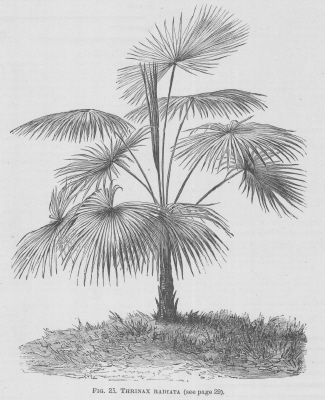
T. radiata (rayed).* fl., spadix 2ft. to 3ft. long, paniculate. l. green, glabrous or puberulous beneath, 1ft. to 2ft. long; divisions united to or beyond one-third their length; ligule broadly rounded, with a short, blunt appendage at the middle. Trunk short. Trinidad, 1838. SYNS. T. elegans and T. gracilis (of gardens).