Important: Safety Warning
This page recommends pest-control substances such as arsenic compounds, strychnine, or cyanide — in some cases applied to food crops. These substances are lethal to humans and animals, and their use is now banned or strictly controlled.
This information has been left in for historical purposes but should not be acted upon.
Thrips
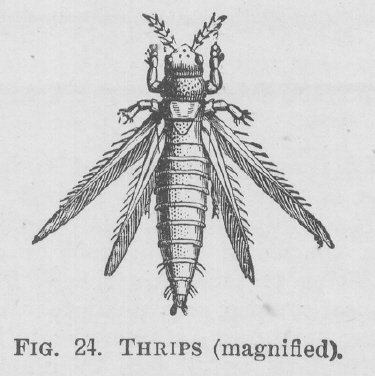
(a Greek word for a moth). The name given to a group of small insects that often do much harm to cultivated plants, by gnawing the surface of flowers and tender twigs and leaves, thus causing withered and distorted spots to appear on them. The genus Thrips, along with certain closely-related genera, is ranked in a family known as the Thysanoptera (from thysanoeis, fringed, and ptera, wings), or as Physopoda (from physa, a bladder, and poda, feet). Both names allude to characteristic features in the structure of the fully-developed insects. Thrips are very common in flowers, crawling about the interior of the corolla tube, and over the stamens, or living upon or in the fruits, or on the lower surface of the leaves. They feed upon the more delicate parts of the plants, causing them to become withered and blighted. The mature insects are very small, and are black or dark-coloured. They are long and narrow, and are furnished with four straight, narrow wings, which are fringed with long hairs, and have few, if any, veins They have three pairs of legs, on which the last joints end in a bladder-like swelling without claws. The mouth is provided with parts suited for piercing delicate tissues of plants, and for sucking their juices. The earlier stages in the development of the species of Thrips are much like the mature insects, save in colour (which is usually dull yellow), and in the wings being entirely absent from the larvae, and represented only by short wing-cases in the pupae. The structure just described renders the order intermediate between Orthoptera (to which Grass-hoppers, Locusts, &c., belong) and Hemiptera. See Insects. Many species have been described, so much alike as to render it very hard to distinguish them from each other; but gardeners do not require to spend time in determining their identity, as the habits of all are much alike, and the treatment is similar for all. The genera are distinguished chiefly by the presence or absence of veins in the wings, the hairy coating on the body, and differences of minor importance. One of the most hurtful kinds is Heliothrips haemorrhoidalis (? H. Adonidum, Hal.), which injures plants in hothouses, as well as in winter gardens. The leaves become paler in colour, or turn black, and fall off. The young twigs also are frequently attacked and killed. This species is dark brown, with the tip of the body red-brown, and the eyes and limbs pale yellow. It is only about 1/20in. long.
Remedies. Smoking the plants with tobacco, as for Aphides, or with insect-powder, washing them with infusion of tobacco, dipping them in soapy water, and keeping them for a time in the open air in summer, are methods that have been tried with success. There are no good remedies against the species of Thrips that feed on plants cultivated in the open air; but, fortunately, their attacks are seldom very hurtful to hardy plants. Choice subjects may be freed from their attacks by drawing the leaves between the finger and thumb, with sufficient pressure to crush the soft larvae, but not to injure the leaves.
T. Phylloxerae has been observed, in the United States of America, depositing eggs in the galls of Phylloxera vastatrix (see Grape or Vine Louse). The larvae hatched from these eggs destroy multitudes of the Phylloxera.