Thunbergia
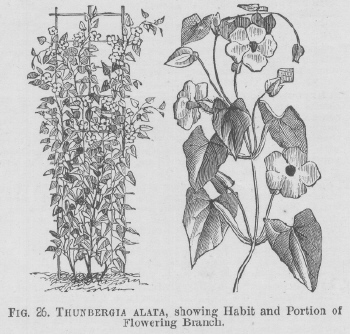
(named after of C. P. Thunberg, 1743-1822, a traveller in Batavia and Japan, and afterwards Professor at Upsala). Including Hexacentris and Meyenia (of Nees). ORD. Acanthaceae. A genus embracing nearly thirty species of beautiful, stove, twining or dwarf and sub-erect, annual or perennial herbs, inhabiting South and tropical Africa, Madagascar, and the warmer parts of Asia. Flowers purple, blue, yellow, or white, shortly pedicellate, solitary in the axils, or disposed in terminal racemes; calyx annular, short, truncate or ten to fifteen-toothed; corolla conspicuous, the tube ventricose, curved, the limb oblique, of five rounded lobes, twisted to the left in bud; stamens four, didynamous near the base of the corolla tube; disk cushion-shaped or annular; bracts at the base of the pedicels leaf-like; bracteoles large, the margins coherent, at least when young. Capsule thickly coriaceous, suddenly narrowed into a sword-shaped beak. Leaves opposite, ovate, lanceolate, cordate, or hastate. The best-known species are here described; all are perennial, except where otherwise stated. Nearly all flower during the summer months, but some of the woody ones blossom in spring or late winter. The plants are of easy culture in any moderately good soil, but thrive best in a rich compost of fibrous loam and sand, to which may be added a small quantity of well-decayed manure. If the plants are grown in a brisk, moist, stove temperature, and the pots well drained, success is assured. Attention must be directed to pruning unsightly or bare shoots, before growth commences in spring, or else the plants will become straggling. Propagated by seeds, and also by cuttings of moderately firm young wood, placed in a propagating frame, with a temperature of from 65deg. to 70deg. T. alata and its varieties succeed under warm greenhouse treatment, and may readily be raised from seeds, sown in 5in. pots, in March or April. When large enough to pot off, the seedlings may be placed singly in other pots or in baskets, when they will soon grow into flowering specimens. A rather rich soil--loam and leaf mould or decayed manure, in the proportion of one part of the latter to two of the former--will suit admirably. In the young stages of growth, the plants should be subjected to stove treatment. When in flower, these Thunbergias are admirably adapted for edging groups, of plants along with other dwarf-growing subjects. T. alata (winged).* fl., calyx twelve-cleft above the middle; corolla yellow, purple below, 1 1/2in. long, the tube curved, the limb campanulate; stigma funnel-shaped, entire, ciliated. l. cordate-sagittate, acute, repand, with a rather broad sinus, the lobes diverging, acute or mucronate; petioles winged. South Africa, 1823. A softly silky-villous, canescent annual twiner. See Fig. 26. (B. M. 2591; H. E. F. 17.) There are a few varieties, of which the principal are: alba (B. M. 3512; P. M. B. ii. 2 and iii. 28; S. B. F. G. ser. ii. 392), with white, and aurantiaca (L. B. C. 1045; H. E. F. 177; B. v. 238), with deep yellow, flowers.
T. a. Doddsii (Dodds'). fl. yellowish-orange, with an eye of rich purplish-violet, large. l. irregularly bordered with white. (F. d. S. 415.)
T. angulata (angular). fl., calyx twelve-parted; corolla pale blue with a yellow throat, 1in. long, the tube very short, the limb campanulate-infundibuliform, the segments rounded; bracteoles ovate, acuminate. l. on long petioles, cordate-sagittate, 1 1/3in. long, 3/4in. broad, with a deep sinus; segments truncate, slightly mucronate, long-acuminate. Madagascar, 1823. A scabrous-pubescent climber. (H. E. F. 166 and 177, f. 3; L. B. C. 1044.)
T. capensis (Cape). fl. yellow; calyx limb many-toothed; corolla tubular-campanulate. l. nearly round, slightly toothed, obtuse, very shortly petiolate, and, as well as the procumbent stems, hairy. Cape of Good Hope, 1824. Annual. (L. B. C. 1529.)
T. chrysops (golden-eyed). fl., calyx slightly fleshy, truncate; corolla campanulate-infundibuliform, the tube yellow, much contracted at base, expanded above, the limb of a beautiful purple, with a blue ring; peduncles axillary, solitary, shorter than the petioles, one-flowered. l. cordate-angular, rather obtuse with a mucrone, slightly pubescent-scabrous. Stem slender, puberulous. h. 3ft. Sierra Leone. Annual. (B. M. 4119; F. d. S. i. 5; P. M. B. 221.) T. coccinea (scarlet).* fl., calyx a minute rim; corolla varying from red to orange-rose, 1in. long, the lobes 1/4in. round; racemes 6in. to 18in. long, loose, pendent; bracts and bracteoles 1/2in. to 1in. long. Spring. l. 5in. to 8in. long, the lower ones ovate, the upper ones oblong, obtuse, cordate or angular at the base, acuminate, toothed; petioles 1/2in. to 2in. long, or wanting in the uppermost leaves. Pendent branches often 10ft. to 25ft. long. India, &c., 1823. A large, nearly glabrous climber. (B. M. 5124; F. d. S. 2447; H. E. F. 195; L. B. C. 1195.)
T. erecta (erect).* fl. axillary, solitary; corolla dark blue, with a rich orange throat and pale yellow tube, four times the length of the bracts. July. l. opposite, ovate or oblong, smooth, dark green. h. 6ft. West Africa, 1857. A very continuous blossomer, producing flowers nearly throughout the whole year. SYN. Meyenia erecta (B. H. vii. 18; B. M. 5013; F. d. S. 1093; I. H. iii. 99; R. H. 1863, 251). The variety known as alba has white flowers with a yellow tube, but in other respects resembles the type.
T. fragrans (fragrant).* fl., calyx 1/8in. long, twelve to sixteen-toothed; corolla pure white, fragrant, 1 1/4in. long; pedicels 1in. to 3in. long, one or rarely two in each axil; bracteoles 3/4in. long, broadly falcate-oblong. l. ovate or oblong, acute or obtuse, cordate or hastate at base, toothed, glabrous when mature, 2in. to 3in. long; petioles 1/2in. to 1in. long. Stem slender, climbing, retrorsely hairy or glabrate. India, &c., 1796. (A. B. R. 123; F. M. 325 L. B. C. 1913.)
T. f. laevis (smooth). fl., corolla not fragrant, the tube often greenish; pedicels often two in each axil, much thickened upwards in fruit. Plant glabrous or grey-puberulous. (B. M. 1881, under name of T. fragrans.) T. grandiflora (large-flowered). fl., calyx nearly entire; corolla blue, 2in. to 3in. long and broad; pedicels 1/2in. to 3in. long, opposite or fascicled; racemes usually stout, rarely slender and elongated, nearly glabrous; lower bracts often petioled, leaf-like. l. ovate, or the uppermost ones lanceolate, 6in. long, acute, cordate at base, toothed, often angularly lobed, pubescent, rarely glabrate; petioles 3in. long. India, &c., 1820. A large climber. (B. ii. 76; B. M. 2366; B. R. 495; L. B. C. 3?4; P. M. B. vii. 221.)
T. Harrisi (Harris'). A synonym of T. laurifolia.
T. Hawtayneana (Hawtayne's). fl. axillary; calyx a mere ring; corolla violet purple, with a yellowish tube, 1 1/2in. long, nearly glabrous; pedicels short, solitary, with a tuft of hairs at their base; bracteoles 3/4in. to 1in. long, ovate-oblong. l. sessile, cordate-elliptic or cordate-ovate, acute, entire, 3in. long, 1 1/4in. broad. Stem slender. India, &c., 1839. A handsome, nearly glabrous climber. SYN. Meyenia Hawtayneana (B. iv. 188; P. M. B. vi. 147).
T. Kirkii (Kirk's). fl. in short, two-flowered cymes; corolla 1 1/4in. long, the lobes violet-blue, spreading, but not horizontally, broadly obovate, retuse. September. l. 1 1/2in. to 3in. long, shortly petiolate, lanceolate, sub-acute or obtuse, entire or with each side dilated into an obtuse lobe. h. 2ft. to 3ft. Eastern Tropical Africa, 1876. Shrub. (B. M. 6677.)
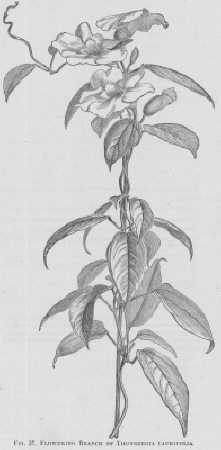
T. laurifolia (Laurel-leaved).* fl. as in T. grandiflora (which this species closely resembles). l. elliptic or oblong, acuminate, sinuate or denticulate, palmately three-nerved. India, &c., 1856. Plant glabrous, or the new parts puberulous. Perennial. A tall climber. See Fig. 27. (B. M. 4985; I. H. 1857, 151; R. G. xiv. 475.) SYN. T. Harrisi (B. M. 4998; F. d. S. 1275; R. G. ix. 281).
T. mysorensis (Mysore). fl., corolla 1 1/2in. long, the mouth 2in. in diameter, the tube purplish, the limb yellow (in cultivation, sometimes with a red border, as in L. & P. F. G. iii. 88; pedicels 1/4in. to 1 1/2in. long; racemes elongated, pendent; bracteoles 1in. long, falcate-elliptic, often coherent on one side, purplish-green. Spring. l. elliptic, acuminate, toothed, cuneate or rounded at base, 6in. long, palmately three-nerved. Branches pendent. Mysore, 1854. An extensive climber. SYN. Hexacentris mysorensis (B. M. 4786; F. d. S. 752, 942; L. J. F. iii. 285; R. G. 280).
T. natalensis (Natal). fl. horizontally drooping, large, handsome; corolla tube yellow, 2in. long, curved upwards; limb blue, large, the lobes obcordate, horizontally spreading; peduncles axillary, solitary, erect, single-flowered. July. l. opposite, the pairs rather approximate, sessile, ovate, acute or sub-acuminate, sinuate-serrate, glabrous above, hairy on the midrib and veins beneath. Stem erect, 2ft. or more high, shrubby below. Natal, 1857. (B. M. 5082.)
T. Vogeliana (Vogel's). fl. deep bluish-violet, with a yellow throat, about as large as those of T. erecta, but of greater substance. Summer. l. large, ovate or oblong, narrowed or rounded at base, dark green. Fernando Po, 1863. A handsome, erect-growing species. SYN. Meyenia Vogeliana (B. M. 5389).