Thuya
(from Thuia, the old Greek name used by Theophrastus). Arbor-Vitae. Sometimes spelt Thuja. Including Biota. Chamaecyparis is included, by Bentham and Hooker, under Thuya, but for garden purposes it is kept distinct in this work. ORD. Coniferae. A genus comprising about a dozen species of hardy, evergreen trees or shrubs, natives of North America and extratropical Eastern Asia. Flowers monoecious; males terminal, solitary; female catkins ovoid or oblong, rarely globose. Leaves small, opposite, scale-like, appressed, quadrifariously imbricated, all sub-equal, or those on the flattened branchlets deeply keeled. Cones ovoid or oblong, rarely globose; mature ones rarely exceeding 1/2in. in length. The species are readily raised from seeds, sown in spring, under glass, and the seedlings afterwards hardened off and planted out in the open ground. Cuttings, too, of half-ripened shoots, are easily struck; these may be put in heat, under bell glasses, or kept in a cool, shaded frame. About the middle of August is perhaps the best time for propagating without heat. Some of the variegated and other dwarf-growing forms are frequently grafted on seedling stocks of the common types.
T. acuta (acute). A synonym of T. orientalis.
T. Doniana (Don's). A synonym of Libocedrus Doniana.
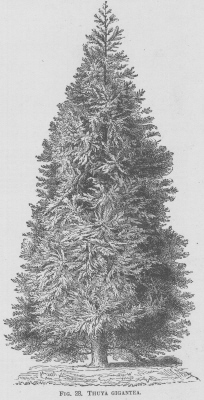
T. gigantea (gigantic).* White Cedar. l. in alternate, opposite pairs, closely imbricated; those on the branches more distant, decurrent, acute; those on the branchlets very flat, closely placed, irregularly imbricated in four rows, much shorter, more rounded, spiny-pointed. cones small, oval, tapering to both ends, nodding, solitary at the extremities of the smaller branchlets. Branches spreading, irregularly scattered; branchlets flattened, short, slender, flexible, undivided. h. 50ft. to 150ft. North-west America. A fine, graceful tree. See Fig. 28.
T. g. atrovirens (dark green). Branches spreading; branchlets open, broad, and flat. A fine, robust, very dark glossy-green variety.
T. g. erecta (erect). A much closer and more upright-growing kind than the type.
T. g. pumila (dwarf). A distinct variety, more diffuse in habit than the type, and much smaller in all its parts; the branchlets are also much closer-set, and of a brighter green.
T. g. variegata (variegated). A handsome, variegated variety, with a considerable portion of the branchlets pale yellow, distributed irregularly all over the plant.
T. gigantea (gigantic), of Carriere. A synonym of Libocedrus decurrens.
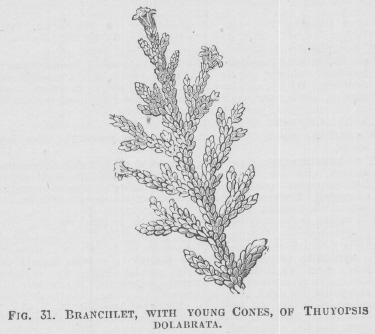
T. laetevirens (pleasing green). A synonym of Thuyopsis dolabrata laetevirens.
T. occidentalis (Western).* American Arbor-Vitae; White Cedar. l. very small, in opposite pairs, ovate-rhomboid, blunt-pointed, closely imbricated and flattened, thickly pressed along the branchlets in four rows; those on the older branches more distant, acute, decurrent, dull yellowish-green. cones obovate, 1/3in. long, on short footstalks. Branches distant, horizontal, irregularly scattered along the stem; branchlets laterally spreading. h. 40ft. to 50ft. North America, 1596. A large bush or tree. Gordon, in "The Pinetum," enumerates the following varieties:
T. o. alba (white). Tips of the young branchlets silvery-white during spring and early summer.
T. o. argentea (silvery). Some of the branchlets in this variety are silvery-white.
T. o. aurea (golden). A nice, golden, self-coloured variety, of American origin.
T. o. compacta (compact). Bagshot Park Arbor-Vitae. A conical-shaped and very compact variety.
T. o. cristata (crested). Branchlets small, deep green, closely arranged, spreading, frequently recurved, cockscomb-shaped towards the ends of the branches.
T. o. densa (dense). l. regularly imbricated, ovate, compressed, glossy-green, quadrifarious. Branches short, stout, compact; branchlets horizontal, flat, fan-shaped, of a rich, glossy colour.
T. o. Elwangeriana (Elwanger's).* l. dimorphous, scale-like, and closely imbricated in four rows, or linear, acute, and spreading. Branches sub-erect; branchlets slender. A dwarf-growing, dense bush.
T. o. globosa (globular). A dwarf, dense, globular bush, resembling the type except in size.
T. o. gracilis (slender). Branches long and slender, drooping regularly on all sides; branchlets open, rather thinly placed, furnished with rather long, slender, bright green laterals. A distinct variety.
T. o. Hoveyi (Hovey's). l. ovate, bright green, closely imbricated. Branches numerous, flat. Spray strap-shaped. A round, compact bush.
T. o. pendula (pendulous). Principal branches along the main stem in a reverted position; branchlets more densely clustered or tufted towards the ends of the branches, and in a more declining position, than in the type.
T. o. variegata (variegated). Some of the branchlets in this variety are pale yellow.
T. o. Vervaeneana (Vervaene's).* Belgian Variegated Arbor-Vitae. A pretty, gold-tinted variety, with very slender branchlets.
T. o. walthamensis (Waltham Cross).* A very fine, densely pyramidal bush, from 6ft. to 8ft. in height.
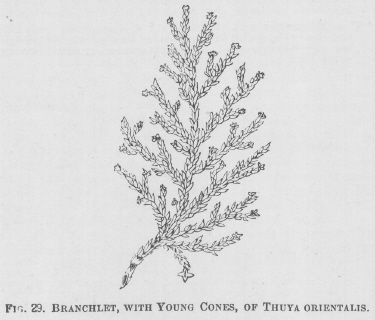
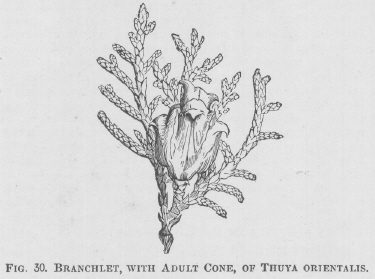
T. orientalis (Eastern).* Chinese Arbor-Vitae. l. on the adult plant very small, in four rows, ovate-rhomboid, acute, imbricated, adpressed, decurrent, the outer or marginal one lapping over on both sides. cones ovate-elliptic, solitary at the ends of the small branchlets, 1/2in. long, composed of six scales. Branches at first somewhat vertical and horizontal, finally fastigiate; branchlets tow-rowed, densely crowded along the extremities of the branches. h. 18ft. to 20ft. China and Japan, 1360. A low tree or pyramidal bush. SYN. T. acuta. For general garden purposes the best name for this is Biota orientalis. Gordon mentions the following varieties, but regards pendula as a species:
T. o. argentea (silvery). This only differs from variegata in the white colour of a portion of its branchlets.
T. o. ascotensis (Ascot). A very nice, variegated form; a good portion of the upright branchlets are bright golden.
T. o. athrotaxoides (Athrotaxis-like). A dwarf, dense bush, with curiously-contorted branchlets.
T. o. aurea (golden). Branches short, slender, assuming during winter and spring a golden-yellow colour. A very neat, dwarf, dense bush, seldom exceeding 4ft. in height.
T. o. elegantissima (very elegant).* Tips of the young shoots golden-yellow during summer and autumn. The best of the golden-tinted varieties.
T. o. falcata (sickle-shaped). cones large. A very upright and pyramidal form, admirably suited for forming edges, to which purpose it is put by the Japanese.
T. o. funiculata (rope-like). l. small, open, acute. Branchlets slender, little-divided, bright green, thinly furnished with leaves. Said to be a hybrid between the type and T. o. pendula.
T. o. glauca (glaucous). l. (as well as the branchlets) covered with a fine, glaucous powder, imparting a beautiful silvery appearance to the plant.
T. o. gracilis (slender). This differs from the type in being much slenderer, more compact and erect in all its parts, and in having much smaller and more acute leaves. Nepaul.
T. o. macrocarpa (large-fruited). Branches drooping, slender; branchlets rather distant, alternate, flattened, regularly furnished laterally with small, bright green spray. A dwarf, loose-growing form, supposed to bear somewhat larger cones than the type.
T. o. monstrosa (monstrous). l. thickened, ovate, obtuse, rarely acute. Branchlets few, short, gross, much contorted, often four-sided.
T. o. pekinensis (Pekin). l. very small, the marginal ones lapping over on both sides. cones small, globular, 1/2in. in diameter, mostly consisting of eight scales. Branches rather long and somewhat spreading; branchlets slender. h. 50ft. to 60ft. Pekin, 1861. A splendid tree.
T. o. pendula (pendulous). Weeping Arbor-Vitae. l. in opposite pairs, very small, rather distant, scale-like or ovate-lanceolate, loosely imbricated. cones globose or ovate-oblong. Branches spreading, slender, very long, recurved; branchlets thread-like, sometimes forked, loosely drooping. h. 10ft. to 15ft. Japan. SYN. Biota pendula.
T. o. pyramidalis (pyramidal). A fine variety, with a tall, narrow, fastigiate head; the leaves and branches are more robust than in the type. h. 20ft. to 30ft.
T. o. semper-aurescens (always golden). This desirable form resembles T. o. aurea, but retains its golden hue throughout the year.
T. o. Sieboldii (Siebold's). Branchlets short, numerous, bright green. Head dwarf, compact, conical.
T. o. triangularis (triangular). Branchlets arranged in a triangular manner, not flat or fan-shaped, as is usually the case.
T. o. variegata (variegated). A very effective variety, the branchlets being bright golden and green, equally intermixed all over the plant.
T. o. Zuccariniana (Zuccarini's). A nice, compact, dwarf variety, globular in form, and bright green, which colour it retains throughout the winter.
T. plicata (folded). l. on adult plants ovate, blunt-pointed, regularly imbricated in four rows, quite flat, smooth, bright green above, dull glaucous-green beneath; those on the young plants very much pointed. cones small, solitary, nodding, scattered, ovate-oblong. Branches horizontal, rather short, spreading, scattered; branchlets long, straight, linear, regularly pointed. h. 20ft. Nootka Sound, 1796. Tree.
T. p. minima (smallest). A compact, miniature variety. Its annual growth does not exceed 1in.
T. p. variegata (variegated). This differs from the type in having a portion of its leaves and lesser spray of a pale yellow, intermixed all over the plant in a variegated manner.
T. Standishi (Standish's). l. ovate, blunt-pointed, in opposite pairs, closely imbricated in four rows along the branchlets, deep glossy-green above, dull glaucous-white below. cones small, composed of valvate scales. Branches scattered, distantly placed, spreading; branchlets and smaller spray flat, alternate, two-edged, quite straight. Japan, 1861. Tree.
T. tatarica (Tartarian). l. in opposite, alternate pairs, closely imbricated in four rows, bluntly oval, somewhat flattened. cones similar to those of T. occidentalis Branches thickly set, somewhat horizontal, rather flat, dense, compact, fan-shaped, thickly placed in two horizontal rows along the lesser spray. h. 8ft. to 10ft. A dense, conical bush, of garden origin. SYN. T. Wareana.
T. tetragona (tetragonal). A synonym of Libocedrus tetragona.
T. Wareana (Ware's). A synonym of T. tatarica.