Tradescantia
(named in honour of John Tradescant, gardener to Charles I.; he died in 1638). Spiderwort. SYN. Ephemerum. Including Descantaria, Pyrrheima. ORD. Commelinaceae. A genus comprising about thirty-two species of stove, greenhouse, or hardy, perennial herbs, natives of North and tropical America. Flowers more or less pedicellate, numerous or few in a cyme, very rarely solitary; sepals distinct, concave, green or coloured; petals distinct, obovate or orbicular, sub-equal; stamens six, all usually perfect; cymes simple, variably disposed. Leaves variable. Stem simple or branched, diffuse, ascending, or erect. The best species are here described. They are amongst the easiest of plants to cultivate. Cuttings of the stove and greenhouse species root readily at almost any season, if inserted in light soil, in moderate heat. The hardy Tradescantias, of which T. virginica is one of the best, may readily be propagated by division; the plants succeed in ordinary garden soil.
T. caricifolia (Sedge-leaved). A synonym of T. virginica.
T. crassifolia (thick-leaved). fl. resembling those of T. virginica; sepals whitish, woolly; petals purplish-rose or blue; umbels three to six on a branch, sessile, axillary, the upper with two bracts, the lower with one. August. l. ellipsoid or narrow-lanceolate, woolly-villous beneath. Stem scarcely divided. Root a large tuber. h. 2ft. Mexico, 1796. Half-hardy. (B. M. 1598.)
T. c. acaulis (stemless). Stem shorter or scarcely any. (B. R. 1840, 34, under name of T. iridescens.)
T. c. glabrata (glabrous). fl., sepals white-woolly. l. glabrous on both sides, the margins white-woolly. SYN. T. speciosa.
T. crassula (rather thick). fl., sepals hairy-pilose; petals white; umbels many-flowered, loose, mostly terminal, rarely also one or two in the axils; pedicels glabrous. July. l. oblong, rather obtuse, 4in. long, glabrous, ciliated-pilose on the margins. Stem glabrous, sub-corymbosely branched. h. 1 1/2ft. Brazil, 1825. Stove. (B. M. 2935; L. B. C. 1560.) T. discolor (discoloured). A synonym of Rhoeo discolor.
T. elata (tall). A synonym of T. virginica.
T. erecta (erect). A synonym of Tinantia fugax erccta.
T. fuscata (fuscous). fl., sepals rather thick, densely rusty-hairy outside; petals bluish-purple, round; peduncles axillary, crowded, one to three-flowered. September. l. 6in. to 8in. long, oblong, acute, scarcely acuminate, narrowed or attenuated at base, more or less petiolate. Stem short or scarcely any, clothed with dark sanguineous hairs. Brazil, 1820. Stove. (B. M. 2330; B. R. 482; L. B. C. 374.) SYN. Pyrrheima Loddigesii (of gardens).
T. glabra (smooth). A synonym of T. virginica.
T. iridescens (iridescent). A synonym of T. crassifolia acaulis.
T. latifolia (broad-leaved). A synonym of Tinantia fugax erecta.
T. multiflora (many-flowered). fl., sepals ovate, hairy, equalling the white petals; umbels terminal and axillary; peduncles hairy, shorter than the leaves. June. l. ovate, sub-cordate-rounded at base, pointed, 1in. to 2in. long. Stem ascending. Jamaica, 1824. Stove. SYN. T. procumbens.
T. navicularis (boat-shaped). fl. similar to those of T. virginica; petals of a beautiful pink, twice the length of the navicular sepals; umbel terminal, solitary, many-flowered. Summer. l. 3/4in. long, sessile, fleshy, navicular, ovate, acute, ciliated on the margins, very thickly dotted beneath. Stem stoloniferous at base, scarcely branched; floriferous branches geniculate-ascending. Peru. Stove. (R. G. 901.)
T. pilosa (pilose). A synonym of T. virginica pilosa.
T. procumbens (procumbent). A synonym of T. multiflora. T. pulchella (pretty). fl., sepals and pedicels nearly glabrous; petals rose-coloured or bluish. July. l. elliptic-lanceolate or lanceolate, sessile, 2in. long, acute, often rounded and somewhat stem-clasping at base, glabrous. Stem procumbent; branches sub-erect, glabrous. Mexico, 1825. Greenhouse.
T. rosea (rose-coloured). fl. 1/2in. in diameter; petals bright rose-coloured, three times as long as the ovate-lanceolate sepals; cymes solitary or in pairs, few-flowered; peduncles terminal, 3in. to 6in. long. June to August. l. linear-lanceolate, fringed on the margins. Stem simple, slender, smooth, 6in. to 8in. high. North Carolina, 1802. Hardy. (L. B. C. 370; S. B. F. G. 183.)
T. speciosa (showy). A synonym of T. crassifolia glabrata.
T. sub-aspera (rather rough). A synonym of T. virginica.
T. tumida (tumid). A synonym of T. virginica tumida.
T. undata (waving). A synonym of Tinantia fugax erecta.
T. velutina (velvety). fl., sepals and pedicels softly pubescent; petals purplish-rose; umbels terminal and axillary, many-flowered. May. l. 5in. long, sessile, oblong-lanceolate, acute, densely and softly pilose above, very shortly silky-villous beneath. Stem branched, softly whitish-villous. h. 1 1/2ft. Guatemala, 1850. Stove.
T. virginica (Virginian).* Flower of a Day; Common Spiderwort. fl. 1in. in diameter, closely packed in two rows in the bud, each with an ovate, scarious bract at the base; petals violet, purplish, or whitish, like the style and densely-bearded filaments, twice as long as the lanceolate-ovate sepals; cymes axillary and terminal, sessile, many-flowered. March to May. l. linear, broadest at base, mostly purple-veined. Stems 6in. to 2ft. high. Florida and northward, 1629. Hardy. (B. M. 105.) SYNS. T. caricifolia (B. M. 3546), T. elata (L. B. C. 1513), T. glabra, T. sub-aspera (B. M. 1597). Of this species there are several varieties.
T. v. alba (white). A variety having white flowers. (B. M. 3501.)
T. v. pilosa (pilose). fl., upper umbels many, sessile in the axils of the leaves; lower ones pedunculate, with two lanceolate-linear bracts. (B. R. 1055.) SYN. T. pilosa (B. M. 3291).
T. v. tumida (tumid). fl., umbels sessile in the axils. Stem thickened. SYN. T. tumida (B. R. 1840, 42).
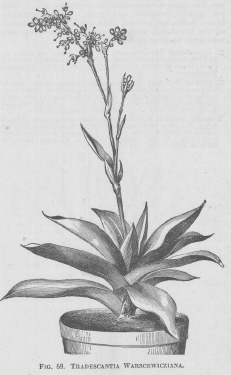
T. Warscewicziana (Warscewicz's). fl. many, densely crowded in a branched panicle; sepals and pedicels lilac; petals purple. May. l. narrow-oblong, about 8in. long, acuminate, sessile. Stem robust, erect, 4in. to 16in. high. Guatemala. Stove.(B. M. 5188.)
T. Zebrina (Zebrina). A synonym of Zebrina pendula.