Tragopogon
(from tragos, a goat, and pogon, a beard; alluding to the long, silky beard of the seeds). Goat's Beard. Including Geropogon. ORD. Compositae. A genus of hardy, biennial or perennial herbs, natives of Europe, North Africa, and temperate and sub-tropical Asia. About forty species have been described, but the number may be considerably reduced. Flower-heads yellow or blue (or purple ?), terminal, homogamous; ray florets ligulate, truncate, five-toothed; involucre cylindrical or narrowly campanulate, the bracts one-seriate, often much elongated; receptacle flat or at length convex, foveolate; achenes glabrous or slightly hispid; pappus bristles indefinite, one-seriate. Leaves alternate, linear, entire, amplexicaul, often grass-like. A selection of the introduced species is given below. Seeds only require to be sown in ordinary garden soil.
T. crocifolius (Crocus-leaved). fl.-heads violet, on terete peduncles; involucre five or six-leaved; achenes muricate-scabrous. June. l. narrow-linear, straight. h. 1ft. Italy, 1739. A glabrous biennial. T. glaber (smooth).* fl.-heads purplish, solitary at the slightly-thickened tips of the stems or branches; involucre eight-leaved, as long as the rays. July. l. elongated, half-amplexicaul. Stem simple or rarely branched, terete. h. 1 1/2ft. South Europe, 1704. A glabrous biennial. SYN. Geropogon glaber (B. M. 479).
T. major (greater). fl.-heads yellow; involucre of twelve to fifteen scales, the outer ones exceeding the ray florets; peduncles obconical-fistulose at apex. May. l. straight, lanceolate-linear, acuminate. h. 5ft. Austria, 1788. A glabrous perennial. (J. F. A. 29.)
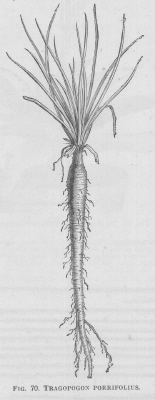
T. porrifolius (Leek-leaved). Salsafy; Vegetable Oyster, &c. fl.-heads rose-coloured or flame-purple; involucre of eight scales; peduncles obconical-fistulose at apex. May and June. l. straight, lanceolate-linear, acuminate, the sheaths slightly dilated. h. 3ft. North Europe (naturalised in England). A glabrous biennial.(Sy. En. B. 801.) For culture, &c., see Salsafy.
T. pratensis (meadow-loving). Common Goat's Beard; Noon-flower; Shepherd's Clock; Star of Jerusalem, &c. fl.-heads yellow, 1/2in. to 2in. in diameter; involucre obconical, of about eight bracts, often streaked with brown; scapes scarcely thickened upwards. June and July. l. flexuous, gradually contracted upwards; radical ones channelled above. Stems stout, erect, 1ft. to 2ft. high. Europe (Britain). Plant glabrous, or the involucre slightly cottony. Biennial. (Sy. En. B. 798-800.)
T. roseus (rose-coloured). A synonym of T. ruber.
T. ruber (red). fl. rose-coloured or diluted with purple, on terete peduncles; involucre of about eight bracts. May. l. lanceolate-linear, slightly undulated, glaucous. Stems erect, leafy, glaucous. h. 1 1/2ft. Siberia, 1826. Young plant cobweb-woolly. Perennial. SYN. T. roseus.