Trapa
(abridged from calcitrapa, the Latin name of an instrument called Caltrops, furnished with four spines, formerly used in war to impede the progress of cavalry). Water Caltrops. ORD. Onagrarieae. A small genus (about three species) of curious, stove or hardy, floating herbs, inhabiting Central and Southern Europe, and tropical and sub-tropical Asia and Africa. Flowers axillary, solitary, peduncled; calyx tube short, the limb four-parted, two or all the segments persistent and becoming spinescent on the fruit; petals four, white, small; stamens four. Fruit bony, one-celled, large, abovoid, with four angles, indehiscent, with a short, cylindric beak at the top. Leaves dimorphic; sub-merged ones opposite, root-like, pinnatipartite, with filiform segments; floating ones rosulate, rhomboidal, the petioles having a spongy dilatation near the apex. The large seeds of T. bispinosa are sweet and edible; in Cashmere, and other parts of the East, they are common food, and are known under the name of Singhara Nuts. The species require a rich, loamy soil, and to be grown in a cistern, or a large pot or tub of water. Propagation may be effected by seeds.
T. bispinosa (two-spined). Singhara Nut-plant. fr. 3/4in. long and broad, glabrous or hairy; two opposite angles each with an often retrorsely scabrous spine, the other two angles sometimes obsolete. l., floating ones 2in. by 2 1/2in. to 3in., very villous beneath, the posterior margin entire, the anterior lightly crenate; petioles 4in. to 6in. long, woolly. India and Ceylon, 1822. Stove. Doubtfully distinct from T. natans.
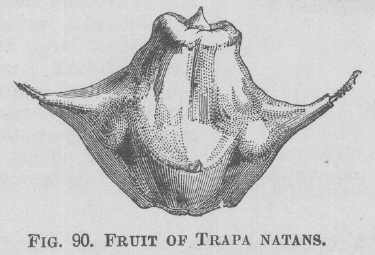
T. natans (swimming).* Jesuit's Nut; Ling; Water Caltrops; Water Chestnut. fr. 3/4in. broad, the four angles all spinescent, but the two lateral spines shorter. l., floating ones 1in.long, toothed or incised-toothed on the anterior margin, sparingly villous on the nerves beneath; petioles 2in. to 4in. long, glabrescent. Persia to Europe and the Upper Nile, 1781. Hardy.(B. R. 259; G. C. n. s., x., p. 212.)
T. verbanensis (Lago Maggiore)*. fr. trigonous, compressed, with two short horns. l. deltoid, the two upper sides dentate, with bimucronulate teeth. Lago Maggiore, 1886. Hardy. Whole plant glabrous.