Trichopilia
(from thrix, trichos, a hair, and pilion, a cap; the anther is concealed below a cap surmounted by three tufts of hair). SYNS. Leucohyle, Pilumna. Including Helcia, Oliveriana. ORD. Orchideae. A genus embracing about sixteen species of beautiful, greenhouse, epiphytal Orchids, inhabiting the warmer parts of America. Flowers showy, pedicellate; sepals sub-equal, free, narrow, erecto-patent, often twisted; petals similar; lip with the claw adnate to the column, which it closely invests above, the limb spreading, the slightly--dilated lateral lobes connivent, the middle one continuous and undulated; pollen masses two, obovoid-oblong, exappendiculate; bracts small; scapes springing from a short rhizome, leafless, few-sheathed, one, two, or rarely three to five, flowered. Leaf fleshy, erect, complicated at base, narrow or rather broad. Pseudobulbs one-leaved. Trichopilias may be grown in pots, or in hanging baskets; in the latter their flowers are seen to the best advantage. The plants should be kept well elevated above the rims of the pots or baskets, in order that good drainage may be insured; the flower scapes also proceed from beneath the leaves and pseudobulbs. Fibrous peat and living sphagnum, with some pieces of charcoal intermixed, afford a suitable compost. A moderate supply of water should be given during the growing season, but very little is requisite in winter; still, the plants must not be allowed to suffer for want of it. Trichopilias in good health blossom very freely; the plants succeed best in the Mexican house. Sickly specimens--the result of growing in too high a temperature--are frequently met with. Propagated by carefully-made divisions.
T. albida (whitish). fl., sepals and petals pale greenish-yellow, nearly straight, the margins slightly hyaline; lip longer than the petals, four-lobed; the lobes whitish, the throat with scattered, ochraceous-yellow dots; hood trilobed; raceme pendulous, about three-flowered. l. oblong-lanceolate, flat, sub-cordate at base, acuminate at apex, recurved. Caraccas, 1851.
T. Backhousiana (Backhouse's). fl. more fleshy than in T. fragrans (which this species closely resembles); lip much narrower and lobed near each end, but twice as broad in the middle as that of T. fragrans. l. faintly spotted and clouded with darker patches. New Grenada, 1876. Whole plant paler green than T. fragrans.
T. coccinea (scarlet). A garden synonym of T. marginata.
T. crispa (curled).* fl., sepals and petals light cherry-crimson, faintly edged with white, the margins crispate-crenate; lip white outside, somewhat deeper in colour than the sepals, large, the margin irregularly crisped, the throat rich deep crimson. April to June. Central America, 1857. A charming and rare species, resembling T. marginata.
T. c. marginata (margined). fl. large and very show; sepals and petals pale purplish-red, white at the edges; lip white externally, the central lobe dull crimson, the throat of a darker and richer crimson, the limb narrowly edged with white. (F. d. S. 1925-6; W. S. O. i. 5.)
T. fragrans (fragrant).* fl. deliciously sweet-scented; sepals and petals pale yellowish-green, 2 1/2in. to 3in. long, wavy, and slightly twisted; lip pure white, orange-spotted towards the base; racemes pendent, three or four together. Winter. l. broadly oblong-lanceolate. Pseudo-bulbs oblong, 4in. to 6in. long, slightly compressed. New Grenada, 1858. SYN. Pilumna fragrans (B. M. 5035).
T. fragrans (fragrant). A garden synonym of T. nobilis. T. Galeottiana (Galeotti's).* fl., sepals and petals cuneate-lanceolate, acute, the latter somewhat broader, pale green, with a central bar of olive-brown; lip closely folded round the column, the front lobe obreniform, the disk pale yellow, with bars and lines of crimson-purple, the margin passing to white; peduncles one-flowered. August and September. l. cuneate-oblong, acute, dark green. Pseudo-bulbs tall, ligulate, ancipitous. Mexico, 1860. SYNS. T. picta (I. H. 225), T. Turialvae, of Bateman (B. M. 5550).
T. grata (pleasing). fl. sweetly-scented; sepals and petals yellowish-green; lip expanded, white, blotched with yellow on each side of the keel; racemes few-flowered. l. oblong-ligulate. Pseudo-bulbs elongated, ancipitous, two-leaved. Peru, 1868. This species is allied to T. fragrans.
T. hymenantha (membrane-flowered). fl. white, small; sepals and petals slightly twisted; lip sessile, nearly flat, with erose edges, speckled with deep sanguineous-purple towards the base and sides; racemes six to eight-flowered, drooping. Summer. l. thick, fleshy, elongated-ensiform, acuminate, narrowed to the base, the lower part representing a stem or pseudo-bulb. New Grenada, 1854. (B. M. 5949; R. X. O. i. 7.)
T. Kienastiana (Kienast's). fl. white, with a few yellow lines or spots on the disk of the lip; sepals and petals linear-ligulate; lateral lobes of lip median, obtuse-angled; anterior lobes porrected, wavy, emarginate; peduncle usually two-flowered. l. and pseudo-bulbs much like those of T. suavis. Habitat unknown. 1883.
T. lepida (pretty). fl. handsome, 4in. to 5in. in diameter; sepals and petals pale rosy-lilac, irregularly margined with white; lip prominent, fimbriated, in front deep purple-crimson with an irregular margin of white; peduncles deflexed. Spring. l. oblong-ovate, acute, leathery. Pseudobulbs oblong, obtuse, ancipitous. Costa Rica, 1873. (F. M. ser. ii. 98; W. O. A. v. 197.) T. marginata (margined).* fl. 4in. to 5in. across; sepals and petals brownish-red, with greenish-yellow margins, narrow, once twisted; lip white outside, the mouth three-lobed, the lateral lobes roundish and the central ones emarginate, wavy, reddish-purple, sometimes edged with white, becoming deep crimson in the throat, or with the limb white and the throat only deep crimson; peduncles drooping, one-flowered. May and June. l. lanceolate, shortly acuminate, recurved at tip. Pseudo-bulbs clustered, oblong, furrowed, recurved at tip. Central America, 1880. (G. M. B. iii. 185.) SYN. T. coccinea (B. M. 4857; L. J. F. 184; L. & P. F. G. ii. 54).
T. m. flaveola (yellowish). fl., sepals and petals greenish-yellow; lip and column white. 1880.
T. mutica (beardless). fl. dirty-white, slightly tinged with red; sepals and petals linear, acute; lip parallel with the column, cordate-ovate, cucullate at base; raceme few-flowered, weak. August. l. linear-lanceolate, convex at back. Said to be a native of Trinidad, 1821. SYN. Macradenia mutica.
T. nobilis (noble).* fl. larger than those of T. fragrans, sweet-scented; sepals and petals white, undulated; upper lobes of lip rounded and meeting over the throat, the front one pure snow-white, 1 1/4in. broad, having on each side of the throat an orange-coloured blotch, the two blotches meeting to form a central, eye-like spot; scapes erect, four or five-flowered. l. broadly oblong, acute. Pseudo-bulbs elongated, oblong, compressed, clustered. Columbia. A beautiful species, perhaps a variety of T. fragrans (under which name it is figured in F. M. ser. ii. 21, I. H. ser. iii. 94, and W. O. A. iii. 128).
T. picta (painted). A synonym of T. Galeottiana.
T. rostrata (beaked). fl., sepals and petals pale whitish-green, linear, acute, the petals twice twisted; lip white, with pale orange rays, flabellate, trifid towards the apex; peduncle two-flowered. l. broadly ligulate, acute. Pseudobulbs linear-lingulate, the basilar scales slightly dotted. New Grenada, 1872.
T. sanguinolenta (dark-bloody). fl. rather showy, 2 1/2in. across; sepals and petals yellowish-olive, marked with transverse bands or ocellate markings of brownish-crimson; lip emarginate, recurved, white, flabellately veined, the veins in the basal half marked out by broken lines of crimson. l. undulated, petiolate, 4in. to 6in. long. Pseudo-bulbs ovate, elongated. Ecuador, 1843. SYN. Helcia sanguinolenta (I. H. ser. iii. 21; L. & P. F. G. ii. 182).
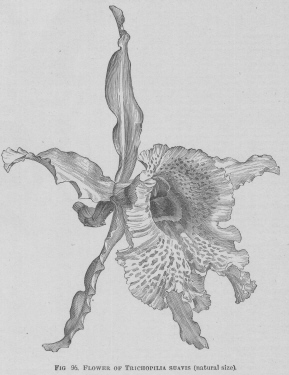
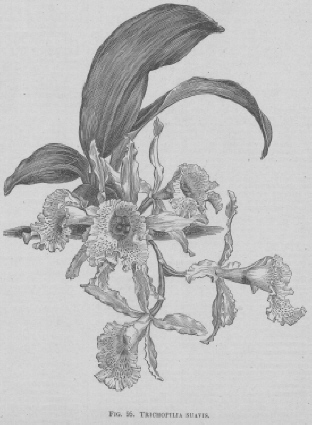
T. suavis (sweet).* fl. white or creamy-white, delicately Hawthorn-scented; sepals and petals narrowed to the base, scarcely twisted; lip yellow in the throat, spotted with pale violet-rose on the front part and on the sides, closely rolled up at the base, spread out in a funnel-shaped from, three-lobed in front; peduncles three or four-flowered. March and April. l. large, broad-oblong, acute, wavy, nearly sessile. Pseudo-bulbs oblong-obcordate, ancipitous, clustered. Costa Rica, 1850. A fine species. (B. M. 4654; F. d. S. 761; L. J. F. 227; L. & P. F. G. i. 11; W. S. O.iii. 8.)
T. s. alba (white). fl., sepals and petals pure white; lip white, marked in the throat with a yellow stain. May and June. (W. O. A. i. 14.)
T. s. grandiflora (large-flowered). fl. more highly coloured than in the type, and expanding better; sepals and petals white; lip upwards of 3in. in diameter, white, with large, rich crimson spots, the throat deep, orange. l. (as well as the pseudo-bulbs) very large. A lovely variety.
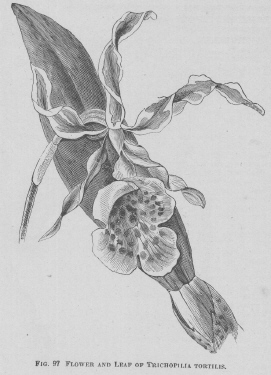
T. tortilis (twisted). fl. drooping, large and attractive; sepals and petals yellowish-green, with lurid brownish-purple blotches along the middle part, spirally twisted, narrow-lanceolate; lip white outside, yellowish-white or white within, thickly spotted with rose-colour and blotched with yellow about the throat, the base closely rolled in, the front part spreading out and three-lobed; peduncle one-flowered. l. oblong, acute. Pseudo-bulbs oblong or ligulate, compressed, 2in. to 4in. long. Mexico, 1835. An interesting species. (B. iii. 122; B. M. 3739; B. R. 1863.) There are several varieties of this species. One--candidum--has white, and another brighter-coloured, flowers.
T. Turialvae (Turialva), of Bateman. A synonym of T. Galeottiana.