Trichosanthes
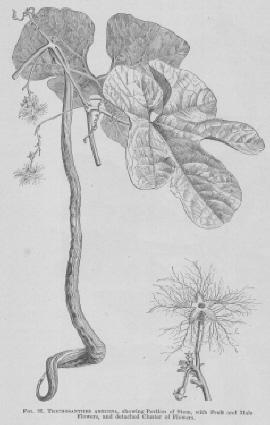
(from thrix, trichos, a hair, and anthos, a flower; alluding to the fringed corolla). Snake Gourd. Including Eopepon. ORD. Cucurbitaceae. A genus comprising about thirty species of stove, greenhouse, or half-hardy, climbing, annual or perennial herbs, sometimes shrubby at base, occasionally tuberous-rooted; they are found in tropical Asia, North Australia, and Polynesia. Flowers white, dioecious, less often monoecious; calyx long-tubular, with five lanceolate, entire, serrated, or torn segments; corolla five-cleft nearly to the base, the lobes long-fringed. Stamens of the males three; peduncles usually in axillary pairs, one one-flowered and caducous, the other racemose; bracts occasionally wanting. Female flowers solitary; ovary inferior, at the base of the calyx tube, one-celled, the style three or six-cleft at apex. Fruit lanceolate or globose, smooth, often large. Leaves entire or three to nine-lobed, denticulate; tendrils usually two or three-cleft. The common name of T. anguina refers to its fruits, which are eaten as a vegetable in India. Seeds of the species here described should be sown on a hotbed, in spring, and the plants afterwards treated like Cucumbers.
T. anguina (snake-like).* Common Snake or Viper Gourd; Serpent Cucumber. fl., calyx tube 1in. long; the earlier male peduncle occasionally replaced by a female. fr. elongated, cylindrical, sometimes twisted, edible. l. cordate-sub-reniform, three to seven-lobed or five-angular; lobes pubescent or puberulous on both surfaces, not acuminate. Stems twining, more or less pubescent. India, &c., 1735. Half-hardy. (B. M. 722.) SYN. T. colubrina (B. R. xxxii. 18).
T. colubrina (snake-like). A synonym of T. anguina.
T. japonica (Japanese). fl., male racemes few-flowered; bracts large, broadly ovate, deeply subulate-toothed; peduncle robust, sulcate. fr. ovoid, slightly acute at base and apex. l. membranous, broadly ovate, glabrous and smooth, three to five-lobed; lobes triangular, acute, entire or undulate-denticulate on the margins. Stem slender. Japan, 1872. Greenhouse. (R. G. 714.) T. Kirilowii (Kirilow's). fl. dioecious; male racemes few-flowered at apex, the bracts acutely toothed. fr. ovoid or ovoid-oblong. l. sub-orbicular, often deeply palmately five to seven-lobed; lobes oblong or oblong-lanceolate, acute, deeply incised-serrated or lobulate. Stem annual, branched. Root perennial. China, 1872. Greenhouse. SYN. Eopepon vitifolius.
T. palmata (palmate-leaved).* fl., male racemes on long, stout peduncles, at first short and head-like, at length elongated, with a toothed or jagged bract, at least 1in. across, under each pedicel; female flowers shortly pedicellate. fr. nearly globular, 2in. to 3in. in diameter. l. broad, palmately three to seven-lobed, pubescent. India and North Australia, 1825. Stove. (B. M. 6873.)
T. tuberosa (tuberous-rooted). fl., corolla white, the tube intimately united and incorporated with the tube of the calyx; limb free, of five long, deeply bifid segments, the divisions forked at the extremity. September. l. distant, formed of three deeply-cut, linear-oblong, divaricating lobes, acute at the points, the lower ones with a smaller, unidentate lobe at the base. Stems green, climbing. Root a large, rounded tuber. West Indies. Stove. (B. M. 2703.)