Home › T › Tritonia (From triton a weathercock)
Tritonia (From triton a weathercock)
(from triton, a weathercock; alluding to the variable direction of the stamens in different species). SYNS. Aletris, Waitzia (of Reichenbach). Including Montbretia. ORD. Irideae. A genus including about two dozen species of cool greenhouse or hardy, bulbous plants, indigenous to South Africa. Flower one in a spathe, sessile; perianth tube slender, straight, sometimes very short, sometimes elongated, rarely loosely incurved at apex; limb concave or broadly campanulate, nearly regular or slightly oblique, the lobes broad, all similar, or the three lower ones thickened or marked with a spot at the base, or sometimes slightly smaller; stamens affixed to the base of the limb; filaments filiform, free; spathes at the sides of the peduncle or on a few scattered branches, short, membranous, often three-toothed. Leaves few, narrow-linear or broader and ensiform, often falcate. Stem simple or slightly branched. The most important garden species are here described. All thrive in the cool greenhouse, except where otherwise indicated. The hardy species like a well-drained, sunny border, and luxuriate in a fairly dry, rich soil. Some of the greenhouse species do well in the open air if planted in a sheltered, sunny spot---such as the foot of a south wall; they should, however, be housed during winter. When grown in pots, Tritonias require plenty of water during the period of growth, and a light, airy place close to the glass. When the leaves turn yellow, water should be gradually withheld, and the roots kept dry, or nearly so, until growth recommences. Propagated by division, or by seeds.
T. aurea (golden). A synonym of Crocosmia aurea.
T. capensis (Cape). fl. three to five, pale reddish or yellowish-white; perianth tube pale rose, twice as long as the segments; segments unequal, the lower ones red-spotted; spathe unequal-valved, straw-colour; scape 1ft. high, branched or simple, terete, flexuous at apex. September. l. linear-ensiform, nerved, attenuated. long-sheathing at base, shorter than the scape. 1811. (B. M. 618, 1531.) SYN. Montbretia capensis.
T. crispa (curled). fl. four to eleven, second; perianth yellowish-white, funnel-shaped, the tube thrice as long as the segments; segments irregular, the upper ones slightly gaping, oblong-ovate, obtuse, unguiculate, flat, the lower ones narrower, obtuse, ligulate, slightly ventricose, connivent, purple-spotted in the middle; scape 6in. to 10in. long, terete, six-leaved, flexuous. April. l. broadly lanceolate-ensiform, undulate-crisped, margined with minute bristles. 1787. (B. M. 678.) SYN. Gladiolus crispus (A. B. R. 142).
T. crocata (saffron-coloured).* fl. seven to nine, distichous; perianth saffron-coloured, campanulate, 1in. long, the tube equalling the spathe, sub-erect, the segments sub-equal, obovate, hyaline-fenestrate at base; scape terete, flexuous, leafy at base, nearly 2ft. long. June. l. broadly linear-ensiform, curved, striated, acute, shorter than the scape. 1758. SYN. lxia crocata (B. M. 184).
T. crocosmiflora (Crocosmia-flowered).* fl., perianth about 1 1/2in. long, funnel-shaped, with a slender, curved tube, and a spreading, six-parted, orange-scarlet limb; panicle many-flowered, erect, bent in a zigzag fashion. A handsome, hardy hybrid, raised between T. Pottsii and Crocosmia aurea. (F. M. n. s. 472; R. H. 1882. p. 124.) T. deusta (copper-coloured). fl. five to ten, spicate, secund; perianth cinnabar-red, 1in. long, campanulate-infundibular, the tube short, erect; segments broadly ovate, the three inner ones carinate and spotted beneath with dark purple; spathe scarious; scape terete, flexuous, 6in. to 12in. long. May. l. broadly lanceolate-ensiform, acute, shorter than the scape, sheathing at base. (B. M. 622) SYN. Ixia crocata nigro-maculata (A. B. R. 134). T. fenestrata (window-like). A synonym of T. hyalina. T. flava (yellow). fl. three or four, second, irregularly funnel-shaped; perianth yellow, 1in. long, the tube cylindric, erect, enlarged; segments ovate, acute, the lower ones narrower; scape 6in. to 9in. long, terete, leafy at base. February. l. lanceolate-ensiform, acute, curved, sheathing at base, shorter than the scape, two lines broad. 1780. (B. R. 747.) SYN. Montbretia flava.
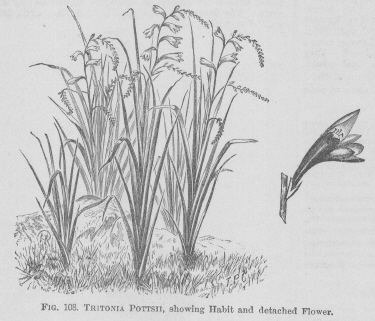
T. hyalina (hyaline). fl. seven to nine, spicate, distichous; perianth rose-colour, 1in. long, the tube short and erect; segments regularly spreading, rounded and unguiculate at apex; scape terete, 1ft. long, curved above, leafy at base. May. l. broadly lanceolate-ensiform, acute, thickly striated. 1801. See Fig. 107. SYN. T. fenestrata (B. M. 704). T. lineata (lined). fl. two to seven, spicate; perianth straw-colour, veined, with orange spots, 1in. long, the tube short and sub-erect; segments sub-equal, elliptic, the lateral ones retuse, the inner ones marked with three parallel, yellow lines; scape 8in. to 18in. long, terete, erect, curved at apex, leafy at base. May. l. lanceolate-ensiform, acute, white-ribbed and margined. 1774. SYNS. Gladiolus lineatus (B. M. 487), Montbretia lineata. T. miniata (scarlet).* fl. two to fourteen, secund or distichous; perianth scarlet, spreading-infundibular, 2/3in. to 1in. long, with a short, erect, enlarged tube, and nearly regular, ovate segments; scape terete, 9in. to 12in. long, erect, curved at apex, six to eight-leaved at base. August. l. broadly lanceolate-ensiform, long-acuminate, yellow-striated. 1795. (B. M. 609.) T. Pottsii (Potts').* fl., perianth bright yellow, flushed on the outside with brick-red, about 1in. long, funnel-shaped, the sub-equal, oblong-obtuse segments about half as long as the tube, which is cylindrical at the base, dilated suddenly at the middle; spikes 6in. to 9in. long, equilateral, 2in. broad when expanded, twelve to twenty-flowered. August. l. about four in a distichous rosette at the base of the stem, linear-ensiform, 1 1/2ft. to 2ft. long, 1/2in. to 3/4in. broad. Stem 3ft. to 4ft. long. Bulb globose 1877. A very valuable and ornamental, hardy plant. See Fig. 108. (B. M. 6722.) SYN. Montbretia Pottsii (Gn. 1880, p. 84).
T. scillaris (Squill-like). fl. scentless; perianth reddish, varying to white; perianth segments regularly and equidistantly disposed; tube capillary, twice or thrice as long as the spathe. May. l. narrow, Grass-like. SYNS. Ixia polystachya (B. M. 629), I. p. incarnata (A. B. R. 128), I. reflexa (A. B. R. 14).
T. securigera (hatchet-bearing). fl. spicate, secund; perianth brown, 1in. long, with an erect, enlarged tube, and equal, ovate, obtuse segments; scape terete, nearly 1ft. long, curved at apex, leafy at base. May. l. lanceolate-ensiform, flat, acute, striated, shorter than the scape, sheathing at base. 1774. SYN. Gladiolus securiger (B. M. 383). T. squalida (squalid). fl. distichous, infundibular-campanulate; perianth whitish-rose, 1in. long, with a short, erect tube, and equal, rounded-ovate, unguiculate segments; scape erect, simple, 2ft. high, leafy at base. May. l. lanceolate-ensiform, thick, yellow-ribbed and margined, acute. 1774. (B. M. 581.) T. Undulata (wavy). fl. three or four, scentless; perianth red (said to vary through white and blue), the segments obovate, blunt, spreading; spathe membranous. June. l. six, linear elegantly waved, half the length of the scape. Bulb somewhat oblong, attenuated upwards. h. 1ft. 1787. SYN. Ixia crispa (B. M. 599).
T. viridis (green). fl. four to seven; perianth green, the tube twice as long as the segments, somewhat arcuate-reflexed, the segments linear-oblong, sub-equal, obliquely nodding, rotate-reflexed; scape triquetrous, nearly 1ft. long, dichotomous, flexuous at apex. July l. flabelloid-distichous, wavy-crisped on the margins, acute, shorter than the scape. 1788. (B. M. 1275.) T. Wilsoni (Wilson's). fl., perianth white, flushed with purple, the obovate, cuspidate segments twice as long as the tube; spikes simple or forked, lax four to seven-flowered; scape 2ft. long below the spikes. l. five or six, narrow-linear, 1ft. to 1 1/2ft. long, nearly quadrangular in section. 1886. Greenhouse.