Tulipa
(the Italian rendering of the Turkish tulbend, a turban, which the flower resembles). Dalmatian Cap; Tulip. Including Orithyia. ORD. Liliaceae. A genus comprising, according to Mr. Baker, upwards of sixty species of very beautiful, hardy, bulbous plants, inhabiting Europe, North Africa, Western and Central Asia, and extending as far as Japan. Flowers erect or very rarely nodding, showy; perianth deciduous, campanulate or nearly funnel-shaped; segments distinct, erect or erecto-patent, sub-equal, often spotted inside near the base; stamens six, hypogynous, shorter than the perianth; filaments more or less complanate, attenuated or shortly filiform at apex; anthers oblong-linear, erect, the cells laterally dehiscing. Leaves linear or rather broad. Stem simple, few-leaved, one, or rarely two or three, flowered. Bulb tunicated, the tunics sometimes woolly within. "In the middle of the seventeenth century, Tulips became the object of a trade such as is not to be met with again in the history of commerce, and by which their price rose above that of the most precious metals. It is a mistake, however, to suppose that the high prices paid for bulbs--amounting, in some instances, to 2,500 and even 4,600 florins--represented the estimated value of a root, since these large sums often changed hands without any transfer of property. Bulbs were bought and sold without being seen--without even being in existence. In fact, they were the subject of a speculation not unlike that of railway scrip in this country at no very distant date" (Lindley and Moore). Tulips still take front rank amongst the most familiar and beautiful of hardy, bulbous plants. Many hundreds of varieties have been raised by means of careful hybridisation; and they are mostly offered at prices that place them within the reach of the average amateur gardener.
Propagation. New varieties of Tulips are obtained from seeds, and some of the species which increase but slowly by offsets may be similarly raised. The most general method of propagation for perpetuating varieties is that of offsets, which are generally produced in fair quantities. Seeds may be sown in boxes of light, sandy soil, about February, and placed in a cold frame, where they will germinate in due course, and may be protected during the following winter. The next season the young bulbs should be planted in a prepared bed outside, for growing on into a flowering size. This takes four or five years, and the first flowers which appear are usually self-coloured; after another period, the length of which is quite an uncertainty, these flowers, which at the first are called "breeders," break into other colours and markings, which admit of their being placed into one or another of the several classes adopted. The process of raising flowering bulbs of Tulips from seed is, therefore, a very slow one. Offsets may be detached from established bulbs, when they are lifted, and grown by themselves until large enough for flowering. The chief supplies of Tulips are imported from Holland, where,--with other, commonly called, Dutch bulbs--they are grown in immense quantities for exportation to all parts of the world. When young seedlings and offsets are raised in gardens, they should be planted in a border or bed prepared with sandy loam, leaf mould, and light manure, and provided with efficient drainage, which, if possible, should be secured by selecting a position where the subsoil is gravelly. A situation exposed to sun and air is preferable, but sheltered from rough winds, which blow the plants about, and break their leaves.
Cultivation. Planting of all kinds of Tulips is best performed in October, and early in November; the bulbs should be placed from 3in. to 4in. deep, to preserve them against injury from severe frost; a little sand round each is generally recommended, but in light, sandy soil this need not be considered absolutely essential--except, perhaps, with scarce sorts or valuable seedlings. Planting with a trowel is best, as the soil is better adapted for the roots to enter than when a dibber is used. A distance of 6in. between the bulbs is sufficient; but when there are not many to be planted they may be more widely disposed. In the spring, so soon as the flowers begin to expand, a light awning placed over the bed will preserve those of any particular variety for a longer period than if they were exposed; but flower-beds filled with Tulips for a spring display cannot receive such attention. The bulbs may be lifted after the foliage turns brown and the stalks become limp, and placed in a cool, airy place, not in the sun. When thoroughly ripened, they may be stored in drawers or bags, where provision can be made for air circulating amongst them, until planting time again arrives. If it becomes necessary to lift the bulbs to clear flower-beds for summer occupants, they should be planted again in reserve beds, and allowed to ripen there.
The arrangement of colours, and the selecting of showy varieties which flower at about the same period, are matters of great importance in planting beds of Tulips. Both single and double kinds succeed admirably, but preference must be accorded the former, which are very distinct and beautiful.
For pot-culture and forcing, Tulips--at least, the early-flowering varieties--are invaluable. So soon as the annual consignments arrive from Holland, the supply for the season should be procured, and a portion potted. From three to five bulbs, according to size, are requisite for a 5in. pot, and a compost of two parts loam to one of light manure, with some sand intermixed, is suitable. Afterwards plunge the pots in ashes or cocoa-nut fibre outside, and introduce into gentle heat when the bulbs are well rooted, and begin to push their shoots. Successional supplies should be similarly treated, according to requirements, and the quantity of bulbs at command. The species here described are those best known in gardens, and are based on Mr. Baker's admirable monograph of the genus, which appeared in the "Gardeners' Chronicle" for 1883. His synopsis of the species, adjusted to the requirements of this work, is given below.
Sub-genus I. Tulipa proper.
Ovary with a sessile stigma.
SECTION 1. ERIOBULBAE. Perianth bright red; filaments without a tuft of hairs at the base. Lower leaf usually oblong-lanceolate. Outer bulb coats densely coated inside with soft, intertangled, cottony hairs. maleolens montana Oculus-solis praecox
SECTION 2. CLUSIANAE (type, T. Clusiana). Flowers mainly white, between funnel-shaped and campanulate; filaments without a tuft of hairs at the base. Leaves narrow and grass-like. Outer bulb coats densely hairy inside.
Clusiana Stellata
SECTION 3. GESNERIANAE (type, T. Gesneriana). Perianth usually bright red, campanulate; filaments without a tuft of hairs at the base. Lower leaf broad, with two or three exceptions. Bulb coats glabrous, or with only a few adpressed hairs inside. This is the largest section of the genus, and the one to which all the species most valuable for garden purposes belong. It may be best divided into groups by characters derived from the shape of the perianth segments and the vestiture of the peduncles:
Group 1. Perianth segments all uniform and acuminate. acuminata elegans retroflexa
Group 2. Perianth segments all, or the three outer, oblong, acute; peduncle glabrous. brachystemon cruciata Didieri Elwesii Kesselringii Kolpakowskiana triphylla undulatifolia Group 3. Perianth segments all broadly rounded at the apex, with a small cusp in the centre; peduncle glabrous. Borsczowi Gesneriana macrospeila Ostrowskiana
Group 4. Perianth segments all narrowed to an acute point. altaica Kaufmanniana strangulata suaveolens
Group 5. Perianth segments all obtuse; peduncle permanently pubescent. Alberti Eichleri Greigi iliensis maculata pubescens
SECTION 4. SAXATILES. Perianth red or lilac; filaments furnished with a tuft of hairs at the base. These are a little group of fine species, all belonging to the oriental flora, and all, as yet, little known in cultivation. Aucheriana Hageri pulchella saxatilis
SECTION 5. SYLVESTRES. Perianth always yellow or yellowish-white; filaments with a tuft of hairs at the base. The species of this section have been comparatively little cultivated, and are of much less interest from a horticultural point of view than those of any of the foregoing. They may be divided into three groups by the colour of the flower:
Group 1. Flowers bright yellow, flushed with green on the outside. Biebersteiniana fragrans Grisebachiana sylvestris
Group 2. Perianth bright yellow, flushed with red on the outside. australis humilis Orphanidea
Group 3. Perianth pale yellow or whitish inside, tinged with green or reddish outside. biflora patens primulina turkestanica
Sub-genus II. Orithyia.
Ovary narrowed gradually into a distinct style, which is tipped with three small stigmas. The species of thus sub-genus are all dwarf, small-flowered, fragile plants, of little horticultural interest, natives of Siberia, China, and Japan. They may be arranged in three groups, according to leafage:
Group 1. Leaves two, sub-opposite, placed about the middle of the stem. uniflora
Group 2. Leaves three, crowded near the base of the stem. thianschanica
Group 3. Leaves, two large ones low down on the stem, and two to four small ones near each flower. edulis
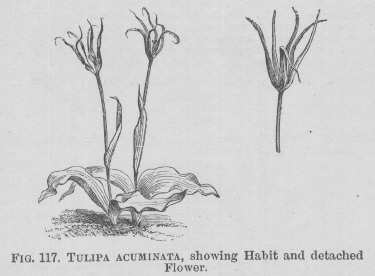
T. acuminata (acuminate). Turkish Tulip. fl., perianth variable in colour, 3in. to 4in. long, the segments all alike, narrowed gradually into a very long point; peduncle glabrous. April. l. (and bulb) as in T. Gesneriana. Native country unknown. A distinct type. See Fig. 117. SYN. T. cornuta (B. R. 127).
T. Alberti (Albert Regel's). fl., perianth orange-scarlet, the base faintly blotched with red-brown on a yellow groundwork, campanulate, 2in. long, the three inner segments obtuse, the three outer sub-acute; filaments yellow, exceeding the dark purple anthers; peduncle erect, pubescent, 6in. to 9in. long. April. l. glaucous-green, lanceolate, without blotches. h. 2ft. Central Asia, 1877. (B. M. 6761; R. G. 912.)
T. altaica (Altaian). fl., perianth usually yellow, rarely red, 1in. to 1 1/2in. long in wild specimens, the segments oblong and decidedly acute, without any basal blotch; peduncle pubescent, 3in. to 4in. long. April. l. usually three, the lowest lanceolate, about 1in. broad. Stem 6in. to 9in. long. Bulb 3/4in. to 1in. in diameter, the outer tunics without any hairs inside. South-central Siberia. The red-flowered variety is figured in R. G. 942.
T. Aucheriana (Aucher Eloy's). fl. strongly fragrant; perianth oblong-infundibular, 1in. to 1 1/4in. long, all the segments mauvelilac, nearly alike, oblong, acute, 1/2in. broad, with a bright yellow claw; stamens 3/4in. long, the yellow filaments twice as long as the anthers, densely hairy at base; peduncle slender, glabrous. April. l. three or four, linear, glabrous, acute, 4in. to 6in. long, 1/2in. broad, gradually narrowed from the middle to the base and apex. Stems 4in. to 8in. long, slender, glabrous, one-headed. Bulb ovoid, medium-sized. Teheran, 1880.
T. australis (Southern).* This is distinguished from T. sylvestris by its more funnel-shaped perianth, flushed with red on the outside, 1in. to 1 1/4in. long, its narrower leaves, and its more slender habit. Savoy. SYNS. T. Breyniana (B. M. 717), T. Celsiana. T. humilis is a dwarf species closely allied to T. australis; it is a native of the mountains of Persia.
T. Biebersteiniana (Bieberstein's). This resembles T. sylvestris, but the perianth is smaller and more funnel-shaped, and the plant is less robust in habit. Asia Minor, Siberia, &c., 1820.
T. bilfora (two-flowered). fl., perianth white inside, with a yellow eye, tinged green outside, oblong, infundibular, the segments oblong, acute; anthers minute. April l. two or three, 1/4in. to 1/2in. broad. Stems 3in. to 6in. long, with often two or three, rarely four or five, flowers. Bulb ovoid, the outer tunics woolly outside. Caucasus, 1806. This is a connecting link between the sub-genus Orithyia and the true Tulips. (B. M. 6518; B. R. 535; R. G. 239.)
T. Bonarotiana (Buonarotti's). A form of T. strangulata. T. Borszczowi (Borszczow's). fl., perianth bright red, 1ft. to 1 1/2ft. long, all the segments obovate-oblong, obtuse, with a cusp at the tip, and furnished with a large, brown-black, basal blotch, margined with yellow, as in T. Oculus-solis; peduncle glabrous. Spring. l. four, with a distinct, cartilaginous, very crisped border, the lower one lanceolate. Dwarfer than T. Gesneriana. Central Asia. (R. G. 1175.) The form figured in B. M. 6635 has the flowers yellow without any basal blotch.
T. brachystemon (short-stamened). This is very near T. Kesselringii, from which it is said to differ by the flower being smaller with more acute segments, and the leaves being narrower and only two in number. Turkestan. (R. G. 1099, fig. 2.)
T. Breyniana (Breyne's). A synonym of T. australis.
T. Celsiana (Cels'). A synonym of T. australis.
T. camptopetala (flexible-petaled). A form of T. Didieri.
T. Clusiana (Clusius').* Lady Tulip. fl., perianth delicate white, flushed with red on the outside, with a conspicuous, purplish, black base, middling-sized; anthers and filaments black. July. l. four or five, long-linear, acuminate, channelled. Stem slender, 1ft. to 1 1/2ft. long. Bulb small, densely pilose. Mediterranean region, 1636. (B. M. 1390; S. F. G. 329.)
T. cornuta (horned). A synonym of T. acuminata.
T. cruciata (cruciate). fl., perianth bright cherry-red inside, campanulate, 1 1/4in. to 1 1/2in. long, the outer segments acute, the inner obtuse, both having a large, black blotch with a yellow border filling up the whole claw; stamens black, 1/2in. long; peduncle obscurely glandular-pubescent. Spring. l. four or sometimes five, crowded, spreading, linear; lowest 6in. to 9in. long, 1/2in. broad. Bulb middle-sized, with a long neck. Asia Minor, 1874. T. Didieri (Didier's). fl., perianth bright red, campanulate, 2in. to 2 1/2in. long, with a black blotch 1/2in. to 3/4in. long, and having a yellow or whitish border covering the whole of the claw; the three outer segments oblong, acute, the three inner ones more obovate and obtuse; stamens blackish-purple, the anthers equalling in length the glabrous filaments. May. Bulb-coats scarcely hairy inside. Stature, leaves, and peduncle, as in T. Gesneriana. Alps. (B. M. 6639.) SYN. T. Fransoniana.
T. edulis (edible). fl., perianth pale yellow, sometimes flushed with red, strongly tinged with green on the outside, funnel-shaped, 3/4in. to 1in. long, all the segments acute. May and June. l., two lower ones linear, flaccid, 6in. to 12in. long; tow below each flower small, linear, erecto-patent. Stem slender, 3in. to 9in. long, one to three-headed. Bulb ovoid, the outer tunics densely woolly inside. Japan.
T. Eichleri (Eichler's).* fl., perianth bright crimson, having a distinct, black blotch spread over the whole claw, with a yellow border; segments obovate, obtuse. April and May. Georgia, 1874. This fine plant closely resembles T. Gesneriana, but differs in having a pubescent peduncle. (B. M. 6191; R. G. 799.)
T. elegans (elegant).* fl., perianth bright red, campanulate, with a yellow eye, the six nearly uniform, oblong segments gradually narrowed to a very acute point; stigma moderately large; peduncle finely downy. End of April. Probably a hybrid between T. acuminata and T. suaveolens.
T. Elwesii (Elwes'). fl., perianth bright scarlet, erect, campanulate, 1 1/2in. long, all the segments having a small, black blotch with a yellow margin filling up the whole claw, the three outer ones oblong, acute, the three inner ones obovate; stamens dark purple; peduncle erect, glabrous. Early in April. l. three, rather glaucous, glabrous; lowest lanceolate, 5in. to 6in. long, 1/2in. to 3/4in. broad, concave down the face above; two upper much smaller, linear. Stem slender, 6in. to 8in. long. Bulb ovoid, 1/2in. in diameter; tunics dark brown, glabrous inside. Teheran. (R. G. 1147.) T. fragrans (fragrant). A synonym of T. sylvestris.
T. Fransoniana (Franson's). A synonym of T. Didieri.
T. fulgens (brilliant). A form of T. Gesneriana.
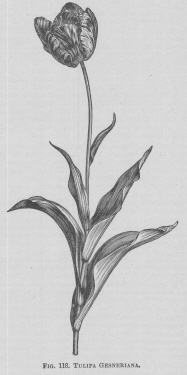
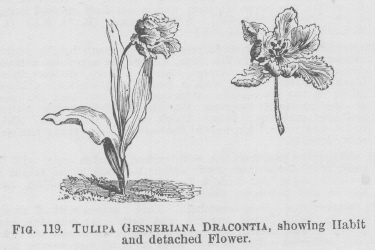
T. Gesneriana (Gesner's).* fl., perianth large, campanulate, the segments variable in colour, when bright red having only an obscure basal blotch, broadly rounded at the apex; stigmas crisped, 1/2in. in diameter; peduncle glabrous, erect. May and June. l. (in a wild state) three or four (often more numerous when growing vigorously under cultivation), broad. Bulb large, the outer coats having a few adpressed hairs on the inside. h. 2ft. Levant, &c., 1577. "This is evidently the original stock of most of the late-flowering garden forms" (Baker). See Fig. 118. (B. R. xxiv. 46; f. & P. 537, under name of T. G. Strangwaysii.) SYN. T. Schrenki (B. M. 6439). T. fulgens is a form having bright scarlet flowers with a yellow eye and yellow stamens. The variable race of Parrot Tulips are referred to T. G. Dracontia. See Fig. 119. (F. d. S. 2211, under name of T. turcica.)
T. G. spathulata (spathulate).* This differs from the type in its larger flowers, of a brilliant-red colour, with a large, purplish-black botch at the base of each of the segments. Italy. Probably the largest of all the wild Tulips. SYN. T. spathulata. This is catalogued by many bulb-growers as T. G. vera.
T. G. Strangwaysii (Strangways'). A synonym of T. Gesneriana.
T. G. vera. See T. G. spathulata.
An' enormous number of garden forms, both double and single varying most widely in colour, have originated from T. Gesneriana See Figs. 120, 121, 122, and 123.
T. Greigi (Greig's).* fl., perianth bright flame-red, campanulate, 2 1/2in. to 3in. long, all the segments very obtuse and furnished with a very distinct, linear-oblong, black blotch, sometimes 1in. long, with a yellow border; stigma large; anthers bright yellow; peduncle pubescent. April. l. broad-oblong, glaucous, with numerous distinct, brown blotches. h. 9in. Turkestan, 1873. A showy and robust species. See Fig. 124. (B. M. 6177; F. d. S. 2261; F. & P. 1876, 217; R. G. 773.
T. Grisebachiana (Grisebach's). fl. faintly scented; perianth of a lemon-yellow colour, less than 2in. long; peduncle 1ft. long, one-flowered, glaucous. Spring. l. three, very glaucous, erect, 6in. to 7in. long, 1/3in. to 3/4in. broad, concave. Bulb ovoid, the outer tunics brown, glabrous. Herzegovina, 1884. Closely allied to T. sylcestris.
T. Hageri (Hager's). fl., perianth campanulate, 1 1/2in. to 2in. long, the segments bright red, often tinged with yellow outside, oblong, acute, 1/2in. to 3/4in. broad, furnished with a large, rhomboid, blue-black blotch on the claw, with a yellow border; stamens purplish-black, under 1in. long; filaments densely pilose at base; peduncle glabrous, stiffly erect. April. l. three or four, linear, green, acute, channelled down the face, the lowest 6in. to 8in. long, 1/2in. broad. Stem one-headed, 1ft. long. Bulb ovoid, middle-sized. Attica, 1874. (B. H. 1877, 2; B. M. 6242; R. G. 790.)
T. humilis. See T. australis.
T. iliensis (Trojan). Cowslip-scented Tulip. fl., perianth lemon-yellow, not more than 1in. long, all the segments obtuse; stigma minute; filaments twice as long as the yellow anthers; peduncle lender, pilose. Spring. l. four, linear, aggregated near the base of the peduncle, all under 1/2in. broad. Bulb small, ovoid, the outer tunics slightly pilose inside. Central Asia, 1879. (B. M. 6518, B; R. G. 975, 982.) T. Kaufmann'ana (Kaufmann's). fl., perianth bright yellow, slightly tinted with red outside towards the top, nearly 3in. long; the segments oblong, acute, without any basal blotch; peduncle erect, downy, 5in. to 6in. long. Spring. l. three, glaucous; the lowest oblong-lanceolate, 1 1/2in. to 2in. broad. Stature of T. Gesneriana. Central Asia, 1877. (B. M. 6887; R. G. 906, figs. 6-10.)
T. K. albo-variegata (white-variegated). fl., perianth white inside, yellow towards the base, with the back of the three outer segments rose-coloured and white-margined. 1877.
T. K. luteo-variegata (yellow-variegated). fl., perianth pale yellow inside, with a red spot below the middle, the three outer segments rose-coloured on the back, with yellow margins. 1877.
T. Kesselringii (Kesselring's). fl., perianth bright yellow, oblong, 1 1/2in. to 2in. long, the six segments all oblong and sub-acute, the three outer flushed with red down the back; stamens bright yellow; peduncle obscurely puberulent. April. l. four, linear, channelled, glabrous, not undulated, the lowest 6in. long. Dwarfer than T. Gesneriana, with a smaller bulb, the outer tunics of which are slightly rugose inside. Turkestan, 1879. (B. M. 6754; R. G. 964.)
T. Kolpakowskiana (Kolpakowski's). fl., perianth faintly scented, campanulate, 2in. to 2 1/2in. long, all the six segments varying from bright scarlet to bright yellow, when red having only a small, black-yellow blotch at the base without any distinct border, oblong, acute, the three outer ones spreading away from the three inner; filaments in the red-flowered form glabrous, shorter than the dark purple anthers; peduncle 6in. to 9in. long, obscurely pubescent. April. l. three or four, lanceolate, the lower 1ft. long, with a minutely ciliated margin. h. 2ft. Central Asia, 1577. A fine species. (B. M. 6710; G. C. n. s., xiii., p. 652; R. G. 951.) T. macrospeila (broad-stained).* fl., perianth bright crimson, campanulate, 2 1/2in. to 3in. long, all the six segments decidedly obtuse, 1 1/4in. to 1 1/2in. broad, having a large, distinct, nearly black, cuneate blotch, with a broad, yellowish-white border, filling up the whole claw; stamens black, one-third the length of the perianth; stigmas 1/2in. in diameter, much crisped; peduncle glabrous. May. Habit of T. Gesneriana. Origin unknown; probably a hybrid between T. Gesneriana and some other species.
T. maculata (spotted). A well-marked, garden race, with the habit of T. Gesneriana, from which it differs by its bright red perianth segments. with a broad, black basal blotch, small stigma, and pubescent peduncle. End of May.
T. maleolens (strong-smelling). This "agrees with T. Oculussolis in bulb, leaves, stature, and peduncle; but the black blotch at the base of the perianth segments covers the whole claw" (Baker). The flowers have a faint, unpleasant scent. Italy, 1827. (B. R. 1839, 66.) variegate is a variegated form. (S. B. F. G. ser. ii. 153.)
T. montana (mountain-loving). fl., perianth bright red, erect, 1 1/2in. to 2in. long, with oblong, acute outer, and often obovate, obtuse inner, segments, with a very distinct, black basal blotch; peduncle glabrous. July. l. three or rarely four, often curved and much crisped at the edges; lowest at most 6in. long, and about 1in. broad. Stems about 6in. long. Bulb large, ovoid. Persia, &c., 1826. (B. R. 1106.) There are several varieties of this species, exhibiting marked differences in the colour of the flowers.
T. neglecta (neglected). A form of T. strangulata.
T. Oculus-solis (sun's-eye).* fl. scentless; perianth 2 1/2in. to 3in. long; segments bright red, having a great, oblanceolate, black blotch, 1in. or more long. with a yellow border, in the centre of the base. April. l. three or four; lowest 1ft. long when fully developed, 1 1/2in. broad. Stem 1ft. to 1 1/2ft. high. South of France, 1816.
T. Orphanidea (Orphanides'). fl., perianth bright yellow, 2in. to 3in. long, the acute segments tinged with red on the outside; anthers oblong, 1/4in. long; peduncle long, one-headed. May. l. three, linear, channelled. Stem 1ft. to 2ft. long. Mountains of Greece, 1862. (B. M. 6310; R. G. 373.)
T. Ostrowskiana (Ostrowski's). fl., perianth bright red, 2in. or more in diameter, each of the segments having a black spot at the base; filaments very short, dilated, and, as well as the anthers, purple. Spring. l. linear-lanceolate, glaucescent. Turkestan, 1884. Closely allied to T. Oculus-solis. (B. M. 6895, R. G. 1144, figs. 1, 2.)
T. patens (spreading). fl., perianth whitish, oblong-infundibular, 3/4in. to 1in. long, with a yellow eye inside, tinged green outside; stamens half as long as the perianth. April. l. two or three, 1/4in. to 1/2in. broad. Stems 3in. to 9in. long, usually one, rarely two, flowered. Bulb-tunics obscurely pilose inside upwards. Central Siberia, 1817. SYNS. T. sylvestris tricolor (R. G. 827), T. trico'or (B. M. 3887).
T. praecox (early).* This "cannot be regarded as distinct specifically in a broad sense from T. Oculus-solis, from which it differs in its more robust habit of growth, earlier flowering, and ovate, more imbricated perianth segments, with a less clearly marked basal blotch" (Baker). Italy, 1825. (S. B. F. G.) 157; B. R. 380, under name of T. Gesneriana; B. R. 204, 1143, 1419, under name of T. Oculus-solis.)
T. primulina (Primrose-like). fl. strongly scented; perianth pale primrose-yellow, funnel-shaped, 1in. long; outer segments lanceolate, tinged with bright red all over the back; inner oblong; peduncle glabrous, 2in. to 3in. long. Spring. l. four to six, crowded near the surface of the ground, linear, green, glabrous, channelled down the face, the outer ones 3in. to 4in. long. Stem less than 6in. above the surface, one-flowered. Bulb ovoid, 1in. thick, with bright red-brown outer tunics. Eastern Algeria, 1882. (B. M. 6786.) T. pubescens (downy).* fl. faintly scented; perianth widely varying in colour. This is probably a hybrid between T. Gesneriana and T. suaveolens. It has the large stigma and six obtuse segments of the former, and the downy peduncle of the latter; the bright red forms have no blotch at the base of the perianth segments. (S. B. F. G. 78; B. M. 2388, under name of T. suaveolens latifolia.) To this belong several of the April-flowering garden races, such as BRIDE OF HAARLEM, DUKE OF YORK, and POTTEBAKKER.
T. pulchella (pretty). fl., perianth funnel-shaped, 1 1/2in. long; segments mauve-red in the upper two-thirds, nearly uniform, oblong, acute, the claw slate-violet, with a yellow base; filaments whitish, densely pilose at base; peduncle slender, glabrous, 1in. to 2in. long. April. l. three, crowded near the surface of the ground, green, channelled down the face, obscurely ciliated; outer one about 3in. long and 1/2in. broad, the inner ones narrower. Bulb ovoid, 1in. in diameter; outer tunics rigid, dark chestnut-brown. Cilician Taurus, 1877. (B. M. 6304.)
T. retroflexa (retroflexed).* fl., perianth bright yellow, about 3in. long, with six uniform, oblong segments, narrowed gradually to an acute point; stamens yellow. Early in May. A garden plant, probably a hybrid between T. acuminata and T. Gesneriana.
T. saxatilis (rock-loving). fl. faintly Primrose-scented; perianth oblong-infundibular, 2in. to 2 1/2in. long; segments bright mauve-purple in the upper two-thirds, and bright yellow on the claw, without any spot, the inner ones obovate-cuspidate, 1 1/4in. broad, the outer oblong, less than 1in. broad; stamens nearly 1in. long; filaments bright yellow, twice the length of the blackish anthers; peduncle glabrous. March. l. three or four, lanceolate or linear, glabrous, the lowest above 1ft. long, 1in. to 1 1/2in. broad. Stems 1ft. or more long, often two-headed. Bulb medium-sized, ovoid. Crete, 1827. (B. M. 6374.)
T. Schrenki (Schrenk's). A synonym of T. Gesneriana.
T. spathulata (spathulate). A synonym of T. Gesneriana spathulata. T. stellata (star-like). A near ally of T. Clusiana, with similar leaves and habit, but the perianth segments are more obtuse, and without the distinct purplish-black eye. February. Himalayas, 1827. (B. M. 2672.) There is a bright yellow variety, with the flower sometimes self-coloured, sometimes flushed with red on the outside.
T. strangulata (constricted). fl., perianth segments furnished at the base with a large, black blotch, both in the typical red-flowered form, and also in some of the yellow varieties. April. This is very like T. suaveolens, but much taller. T. Bonarotiana, T. neglecta, and T. vario-picta are doubtless mere colour varieties. Four of the forms are figured in B. R. 1990, under name of T. scabriscapa.
T. suaveolens (sweet-smelling).* Van Thol Tulip. fl. fragrant; perianth red and yellow, large, with six equal, oblong, acute segments; stigma large; peduncle very downy. March and April. l. broad. h. 6in. South Europe, 1603. See Fig. 125. (B. M. 839; F. d. S. 1223.) Mr. Baker regards this as the original stock of many of our early-flowering garden forms.
T. s. latifolia (broad-leaved). A synonym of T. pubescens.
T. sylvestris (sylvan).* Wild Tulip. fl. fragrant; perianth bright yellow, 2in. long, the segments elliptic-lanceolate; filaments woolly at base. April and May. l. few, 6in. to 10in. long, linear, 1/2in. to 1in. broad, glaucous. Stem 1ft. to 2ft. long, terete, flexuous. Bulb small, ovoid, stoloniferous; scales chestnut-brown. Europe (Britain). See Fig. 126. (B. M. 1202: Sy. En. B. 1520.) SYN. T. fragrans. Forms with two-flowered peduncles are not uncommon in cultivation.
T. s. tricolor (three-coloured). A synonym of T. patens. T. thianschanica (Thians-chan). fl., perianth segments obovate-oblong, obtusely or minutely apiculate, less than 1in. in length; peduncle glabrous, much shorter than the leaves. l. three, linear-lanceolate, falcate, minutely denticulate on the edge. Bulb having its outer tunics strigose towards the tip. Thian-schan Mountains.
T. tricolor (three-coloured). A synonym of T. patens.
T. triphylla (three-leaved). fl., perianth bright lemon-yellow inside, tinged with green outside, rather funnel-shaped, erect, 1in. to 1 1/4in. long, the outer segments oblong and sub-acute, the three inner more obtuse; stamens less than 1/2in. long; peduncle glabrous, very slender. March. l. three or four, crowded near the base of the peduncle, falcate, linear, 3in. to 4in. long, 1/4in. to 1/2in. broad. Bulb small, with a few hairs inside the outer tunics. h. 6in. to 8in. Central Asia. (B M. 6459; R. G. 942.)
T. t. Hoeltzeri (Hoeltzer's). fl. small; perianth yellow, the three outer segments purplish. l. linear-oblong, glaucous, undulated, lying on the ground. Turkestan, 1884. (R. G. 1144, figs. 3, 4 a-b.)
T. turcica (Turkish). A synonym of T. Gesneriana Dracontia.
T. turkestanica (Turkestan). fl. one to six. l. two, falcate, lanceolate. Bulb small, ovoid, the outer tunics densely hairy inside. Chiva. A near ally of T. biflora, from which it mainly differs in the long cusps of the valves of its capsule. (R. G. 1050, fig. 2.)
T. undulatifolia (undulated-leaved). fl., perianth bright crimson-red inside, greenish-red outside, campanulate, 1 1/2in. to 2in. long, the uniform segments gradually narrowed to an acute point, a black blotch with a yellow border covering the whole claw; stamens 1/2in. long, with black filaments and very small anthers; peduncle glabrous or pubescent. May. l. three, glaucous, lowest lanceolate, 6in. long, 1in. broad, with a concave face and undulated margins. Stems 6in. to 9in. long. Smyrna, 1877. (B. M. 6308.) There is a form with less acute perianth segments.
T. uniflora (one-flowered). fl., perianth segments pale yellow inside, oblanceolate, obtuse, 3/4in. to 1in. long, the three outer strongly tinged with green on the outside and spreading in the expanded flower; peduncle erect. April. Stem slender, one-flowered, with a couple of spreading, lanceolate leaves from its middle. Bulb small, ovoid, with brown, membranous tunics produced far above its neck. Altai Mountains. SYN. Orithyia uniflora (R. G. 906, figs. 2-5; S. B. F. G. ser. ii. 336).
T. vario-picta (variously-painted). A form of T. strangulata.
VARIETIES. Subjoined are selections from the most showy and generally useful varieties that are adapted for pot-culture and, with very few exceptions, for planting in outside beds.
Single Early-flowering and Bedding Tulips. ARTUS, brilliant dark scarlet, very handsome and effective, large. BACCHUS, rich dark crimson; splendid bedding variety. BELLE ALLIANCE, crimson-scarlet; dwarf, early, and lasts long. CANARY BIRD, clear rich yellow; early. CHRYSOLORA, deep yellow, large, handsome; one of the best. COTTAGE MAID, rose-pink and white, flaked, very pretty. COULEUR CARDINAL, crimson-scarlet, very showy and effective, extra fine. CRIMSON KING, bright crimson, very showy. DUC VAN THOL (scarlet), very early, and one of the best for early forcing. JOOST VAN VONDEL, crimson, flaked with white, magnificent. KEIZERSKROON, intense scarlet, bordered with yellow, immense; a splendid variety, which lasts long in perfection. LAC VAN RHYN, dark violet, silvery-white margin. LE MATELAS, deep rose, flushed white, very beautiful; excellent for forcing. L'IMMACULEE, white; very early, good for forcing. PAUL POTTER, beautiful rose-magenta, distinct and fine. POTTEBAKKER WHITE, pure white, large, handsome; early. PRINCESS MARIANNE, creamy-white, large, handsome. PROSERPINE, rosy-carmine, very large, handsome; one of the best. QUEEN VICTORIA, rosy-white; good bedder. ROSE APPLATI, rose, very large, handsome. ROSE GRIS-DE-LIN, rose, shaded with white, very fine. ROSE LUISANTE, fine, deep rose; splendid forcing variety. ROYAL STANDARD, white, feathered with rosy-crimson, showy. THOMAS MOORE, orange-scarlet, very pretty, and quite distinct. VAN DER NEER, rich violet, very handsome, extra. VERMILION BRILLIANT, dazzling scarlet; good forcing variety, very early. WOUVERMAN, violet-purple, large. YELLOW PRINCE, golden-yellow; fine for forcing, very sweet-scented.
Double Early-flowering and Bedding Tulips. COURONNE DES ROSES, shaded rose, very fine and handsome. CRAMOISE SUPERBE, crimson; fine bedder. DUKE OF YORK, deep rose, edged with white, showy and effective; late-flowering. GLORIA SOLIS, orange-crimson, deeply edged with golden-yellow. IMPERATOR RUBRORUM, crimson-scarlet, extra fine. LA CANDEUR, white, very double, fine; rather late-flowering. LEONARDO DA VINCI, crimson-edged, golden-yellow, very fine. MURILLO, rosy-white; excellent for forcing. PAEONY GOLD, golden-yellow, feathered crimson, fine; rather late. PRINCESS ALEXANDRA, crimson, edged with golden-yellow, fine. PURPLE CROWN, rich purplish-crimson, very large and effective; rather late. REX RUBRORUM, brilliant crimson-scarlet; highly effective in beds; rather late. ROSINE, rosy-pink; fine for bedding. SALVATOR ROSA, dark rose; one of the best double rose varieties. TOURNESOL, scarlet, edged with yellow, large and handsome; the best double variety for forcing. TOURNESOL YELLOW, yellow, suffused reddish-orange, large. YELLOW ROSE, bright golden-yellow; late-flowering.
Parrot Tulips. These are very effective in borders and shrubberies, but are not adapted for pot-culture. They produce large, brilliantly-coloured flowers. Amongst the best are: ADMIRAL DE CONSTANTINOPLE, red, tipped with yellow; FEU BRILLANT, crimson; LUTEO MAJOR, yellow, slightly striped crimson and green; MARK GRAAF, yellow, striped scarlet and green; MONSTRE ROUGE, crimson, large; PERFECTA, yellow, scarlet, and green.