Important: Safety Warning
This page recommends pest-control substances such as arsenic compounds, strychnine, or cyanide — in some cases applied to food crops. These substances are lethal to humans and animals, and their use is now banned or strictly controlled.
In addition, this page describes trade processes that use dangerously toxic materials such as cyanide solutions, mercury amalgams, or strong acids. These processes require training, equipment, and precautions far beyond what the text describes.
This information has been left in for historical purposes but should not be acted upon.
Ustilago
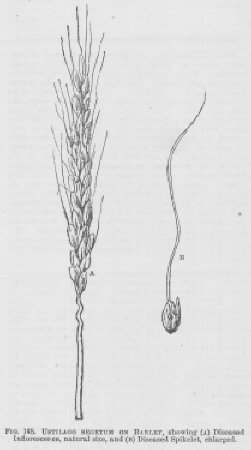
(from ustus, burnt; in allusion to the scorched appearance of the organs of the host-plants in which the spores are developed). A genus of Fungi, belonging to the group Ustilaginei (see Smut). It is distinguished from the other genera in the group by the spores, each being a single, isolated, roundish or angular cell, which germinates by a mycelium filament pushed out at one side. The spores are usually brown, dark purple, or nearly black, when in mass. Ustilago may be regarded as nearly typical of the Ustilaginei. About forty European species are known; many of these occur in the British Islands. A number of them live in the leaves or flowers of Grasses; e.g., U. longissima forms black streaks in leaves of Glyceria fluitans and other swamp-loving Grasses; U. hypodytes grows below the leaf-sheaths of several Grasses, including among others the ornamental species, Stipa pennata and S. capillaris; U. segetum (see Fig. 145) destroys the ovaries of Oats, Barley, and many other Grasses; U. Caricis (U. urceolorum) is very common on many of the species of Carex, infesting the ovaries, and reducing them to the state of balls of sooty-looking powder; U. utriculosa and some allied forms destroy the ovaries of various kinds of Polygonum; U. violacea (U. antherarum) is exceedingly common in the flowers of Lychnis, Silene, Stellaria graminea, and other caryophyllaceous plants, filling the stamens with its reddish-violet spores, and thus destroying the flowers; U. flosculorum acts similarly in the flowers of Scabiosa arvensis, S. Columbaria, and S. succisa; U. Tragopogi-pratensis (U. receptaculorum) destroys all the florets in the heads of Tragopogon pratensis and T. porrifolius, replacing them by a mass of sooty spores. In addition to the above, which are all British species, may be mentioned: U. Ornithogali, which, in Germany, forms swellings, about 1/2in. long, in the leaves of species of Ornithogalum and Gagea; and U. Tulipae, which forms similar swellings on Tulips. When the spores are ripe, the epiderm above the swellings bursts, and exposes the brown spores to view. Treatment. Plants attacked by these Fungi cannot be freed from them, as the mycelium is in the tissues; but frequently only some of the stems on a plant show their presence, and the other parts seem healthy. Such parts as do show the Fungi should be removed and burned, before the spores ripen, in order to prevent their dispersion. To check the ravages of U. segetum, the Smut of corn, the seed, before sowing, is sometimes sprinkled with stale urine, and then raked in quicklime till it becomes white; or it is steeped in a solution of one pound of sulphate of copper in five quarts of water, this quantity of solution being sufficient for four bushels of wheat. The object aimed at is to kill any spores of the Fungi adhering to the seeds, without destroying the vitality of the latter; and the above methods are found to give good results. Perhaps they might prove successful with garden seeds also, and might be employed with advantage against Urocystis and the other genera of Ustilaginei.