Vegetable Marrow
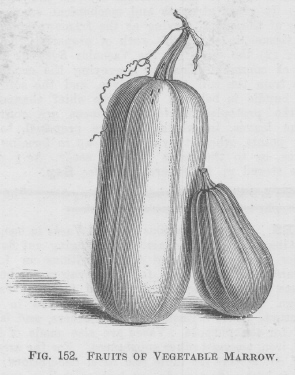
(Cucurbita Pepo ovifera). A half-hardy, trailing annual, of very easy culture, grown in nearly every garden during summer for the fruits, which are chiefly used when about half-grown, or even in a younger state (see Fig. 152), for cooking in various ways. At these stages the flesh is exceedingly tender, but as the fruits get old it becomes drier. Cultivators sometimes allow a portion of their crop to ripen, for the purpose of converting the fleshy portion into jam, or the fruits may be kept in a dry place when ripe until midwinter for cooking. Seeds of Vegetable Marrows should be sown singly, or two in a 3in. pot, towards the end of April, and placed in a gentle heat. So soon as the plants have two rough leaves, they should be hardened by being placed in a situation where air can be admitted. Early in June, they may be planted out where they are intended to remain, and covered for a few days with hand-glasses until re-established, when the glasses may be removed. Old manure heaps are the best positions for the plants, as on these they grow and fruit abundantly. Plenty of water should be supplied throughout the summer whenever the weather is dry, and the fruit should be cut when large enough for cooking, unless required for ripening to produce seed or for using in one of the ways above mentioned. The growths need an occasional thinning during summer when they get too much crowded.
SORTS. The following are amongst the best sorts of cultivated Vegetable Marrows:
BUSH MARROW, of compact, bushy habit, not a trailer; free. CUSTARD, free-bearing and of good flavour. HIBBERD'S PROLIFIC, fruit small, egg-shaped. LONG WHITE, fine cropper; the best for general use, and when only one variety is grown. MOORE'S VEGETABLE CREAM, free-bearing, and of fine flavour. MUIR'S PROLIFIC HYBRID, an oval-shaped, cream-coloured variety; prolific. PEN-Y-BYD, fruit delicate creamy-white, nearly globular, with firm flesh; plant short-jointed and prolific; very distinct.