Important: Safety Warning
This page recommends pest-control substances such as arsenic compounds, strychnine, or cyanide — in some cases applied to food crops. These substances are lethal to humans and animals, and their use is now banned or strictly controlled.
This information has been left in for historical purposes but should not be acted upon.
Veratrum
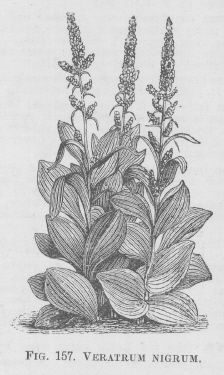
(the old Latin name, used by Lucretius and Pliny, from vere, truly, and ater, black; alluding to the colour of the root). False or White Hellebore. ORD. Liliaceae. A genus embracing eight or nine species of hardy, perennial herbs, inhabiting Europe, Russian Asia, and North America. Flowers numerous in a terminal panicle, shortly pedicellate; perianth purplish, greenish, or whitish, persistent, broadly campanulate or explanate; segments (in hermaphrodite flowers) connate towards the base in a very short tube, in others oblong, spreading, subequal, scarcely contracted at base, many-nerved; stamens six. Leaves often broad, plicate-veined, contracted in an ample sheath, the upper ones rarely all narrow; floral ones bract-like. Stem erect, leafy. Rhizome thick (very poisonous), the root-fibres somewhat poisonous. The best-known species are here described. Gardeners make use of V. album, powdered, to destroy caterpillars. Veratrums thrive in any rich soil. Propagation may be effected by divisions, or by seeds.
V. album (white).* Langwort; Lyngwort. fl., perianth whitish within, greenish outside at base, spreading, 1/3in. to 1/2in. long, the segments crisped-denticulate; pedicels very short or almost wanting; racemes dense, the rachis pubescent; panicle 1ft. to 2ft. long. July. l. rather firm, plicate, puberulous beneath; radical ones oblong, 1ft. long, 5in. to 6in. broad. Stem puberulous, with ten to twelve leaves. h. 3ft. to 4ft. Europe and Siberia, 1548. (F. D. 1120; J. F. A. 335.) The following, formerly classed as species, are regarded, by Baker, as mere varieties:
V. a. Lobelianum (Lobel's). fl., perianth wholly greenish, the segments narrower than in the type; lateral racemes dense, erecto-patent. 1818.
V. a. viride (green). fl., perianth greenish, the segments lanceolate, acute; lower pedicles two to three lines long; lateral racemes loose-flowered, often reflexed. North America, 1742. SYN. Helonias viridis (B. M. 1096). V. Maackii (Maack's). fl., perianth dark-purple, 1/5in. to 1/4in. long, the segments oblong, blackish at base; lower pedicels three to four lines long; lateral racemes ascending; panicle very loose, 6in. to 12in. long. Summer. l., lower ones lanceolate, 6in. long, 1in. broad in the middle, distinctly petiolate; upper cauline ones sessile. Stem slender, 2ft. high, few-leaved, slightly thickened at base. Eastern Siberia, 1883. (R. G. 1070.)
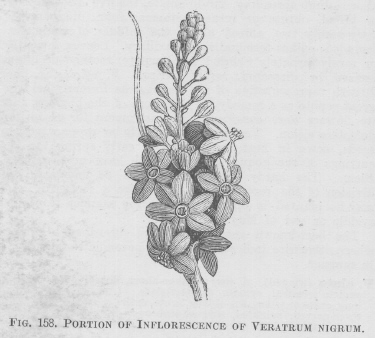
V. nigrum (black).* fl., perianth blackish-purple, two to three lines long, the segments oblong, obtuse; lower pedicels one to three lines long; racemes dense-flowered, the lateral ones short; panicle narrow, 1ft. to 3ft. long. June. l., lower ones oblong, 1ft. long, 6in. to 8in. broad, narrowed at base, plicate. Stem erect, 2ft. to 3ft. high, many-leaved, slightly bulbous at base. Central Europe, 1596. (B. M. 963; J. F. A. 336.)