Verbascum
(the old Latin name used by Pliny). Mullein. ORD. Scrophularinece. A genus embracing nearly 100 species of mostly hardy, biennial herbs, rarely perennials or sub-shrubs, more or less tomentose or floccose-woolly, inhabiting Europe, North Africa, and West and Central Asia. Flowers yellow, fuscous, purple, or red, rarely white, on usually very short and ebracteolate pedicels, spicate or racemose; calyx deeply five-cleft or parted, rarely shortly five-toothed; corolla tube scarcely any, the lobes five, broad, nearly equal; stamens five, affixed at the base of the corolla. Leaves all alternate, often soft, entire, crenulate, sinuate-toothed, or pinnatifid. Few of the species are sufficiently beautiful to claim a place in our gardens. The British Flora embraces five species, V. Blattaria, V. Lychnitis, V. nigrum, V. pulverulentum, and V. Thapsus. A selection of the most desirable kinds is here given. With the exception of V. nigrum and V. pinnatifidum, which may be increased by divisions and cuttings respectively, all are hardy biennials, and only require sowing in any ordinary soil.
V. bipinnatifidum (bipinnatifld). A synonym of V. pinnatifidum. V. Blattaria (Blattaria). Moth Mullein. fl. bright yellow, rarely cream-coloured, 3/4in. to 1 1/4in. diameter; panicles slender, glandular; peduncles 1/4in. to 1in. long. l., radical ones 4in. to 10in. long, oblong-lanceolate, obtuse, crenate, lobulate, or sub-pinnatifid; cauline ones small, sessile, ovate or oblong, toothed or subcrenate. Stem 8in. to 4ft. high, simple or branched. Europe (Britain). (Sy. En. B. 942.)
V. Boerhaavii (Boerhaave's). Annual Mullein. fl. yellow, sessile, fascicled or rarely solitary; corolla ample; raceme simple or rarely slightly branched. l. crenate, woolly; lower ones petiolate, obovate or oblong; upper ones cordate-amplexicaul, rarely very shortly sub-decurrent, acute or long-acuminate. h. 2ft. South Europe, 1731. A pretty species.
V. Chaixii (Chaix's).* Nettle-leaved Mullein. fl. yellow; calyx segments lanceolate, subulate; fascicles loosely many-flowered; raceme paniculate. l. green or tomentose beneath, crenate; lower ones petiolate, cuneate at base, truncate or incised; upper ones sessile, rounded at base. h. 3ft. South and Central Europe, 1831.
V. cupreum (coppery). A hybrid between V. ovalifolium and V. phceniceum.
V. ferrugineum (rusty). A synonym of V. phceniceum.
V. formosum (beautiful). A synonym of V. ovalifolium.
V. Myconi (Mycon's). A synonym of Ramondia pyrenaica.
V. nigrum (dark). Dark Mullein. fl. numerous within each bract, more or less stalked; corolla yellow, with bright purple hairs to the filaments. Summer and autumn. l. crenate, nearly glabrous on the upper side, slightly wooly beneath; lower ones large, cordate-oblong, on long stalks; upper ones nearly sessile, small, and pointed. Stem sparingly clothed with woolly hairs, 2ft. to 3ft. high, ending in a long, simply-branched raceme. Europe (Britain), Western Asia. A pretty perennial.
V. olympicum (Olympian).* fl. bright golden- yellow, 1in. to 1 1/2in. in diameter. l. rosulate, broad, lanceolate, acuminate, woolly. Stem 5ft. to 6ft. high, branched from near the base in a candelabra-like manner. Levant, 1883. Perennial. (R. G. 1078.)
V. ovalifolium (oval-leaved). fl. orange, large, solitary, disposed in a simple or dense spike; upper filaments orange-or purple-woolly. l. ovate; lower ones doubly or incised-crenate; upper ones cordate-amplexicaul. h. 1ft. Tauria, 1804. (B. M. 1037.) SYN. V. formosum (B. R. 558). V. cupreum (B. M. 1226) is a hybrid between this species and V. phceniceum.
V. phlomoides (Phlomis-like). Woolly Mullein. fl. yellow, fascicled; pedicels shorter than the calyx; racemes sub-solitary, elongated. l. crenulate, or the oblong radical ones doubly or sub-incised crenate; upper ones short, obtuse, or the intermediate ones somewhat angular-decurrent. h. 3ft. South Europe, 1739. (S. F. G. 224.)
V. phoeniceum (violet).* fl. violet or red, rather large; pedicels solitary, remote, many times longer than the calyx; raceme glandular-pilose, simple or slightly branched. l. glabrous above, pubescent beneath; radical ones petiolate, ovate or oblong, entire or grossly crenate; cauline ones few, small. h. 3ft. South Europe, 1796. (B. M. 885; L. B. C. 637; R. G. 436, f. 2.) SYN. V. ferrugineum (A. B. R. 163).
V. pinnatifidum (pinnatifid). fl. yellow, in remote, few-flowered fascicles, sometimes sub-solitary; raceme slightly branched, rigid. l. mostly naked, green; radical ones bipinnatifid; cauline ones pinnatifid, with oblong, toothed segments; upper ones serrated or pinnatifid. Stems 1ft. or more high. Tauria, &c., 1813. Sub-shrub. (S. F. G. 228.) SYN. V. bipinnatifidum (B. M. 1777).
V. pyramidatum (pyramidal-flowered). fl. yellow; panicle pyramidal, canescent, 1ft. to 2ft. long, with short, bundle-flowered branchlets (or, in gardens, an often elongated raceme). l. doubly crenate; lower ones ample, long-narrowed to the base; upper ones sessile, cordate-auriculate. h. 3ft. or more. Caucasus, 1804. A pretty species. (S. B. F. G. 31.)
V. rubiginosum (reddish-brown). fl. yellow and red; pedicels bi-or ternate, rarely solitary, twice or many times as long as the calyx; raceme loose, branched, sub-paniculate. l. pubescent beneath, crenate; lower ones petiolate; upper ones sessile or cordate-amplexicaul. h. 2ft. Hungary, 1817.
V. r. tauricum (Taurian). fl. larger, on shorter pedicels; raceme simpler. (B. M. 3799, under name of V. tauricum.)
V. speciosum (showy). fl. yellow; pedicels longer than the calyx; fascicles loose, often many-flowered; panicles very long, branched. l. thick, entire, or the lower ones crenate, oblong, elongated, long-narrowed into the petioles; upper ones sessile or cordate-amplexicaul. h. 6ft. Hungary, 1818.
V. spectabile (remarkable). fl. yellow and purple; pedicels solitary or few together; raceme elongated, nearly simple, viscous-villous. l. doubly crenate, glabrous or pilose above, slightly tomentose beneath; lower ones petiolate, oblong-ovate, cordate at base; upper ones sessile, semi-amplexicaul. h. 2ft. Tauria, 1820.
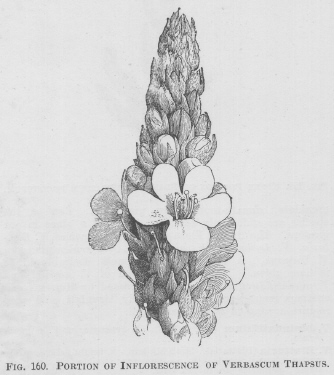
V. Thapsus (Thapsus in Africa). Aaron's Rod; Adam's Flannel; Blanket Leaf; Cow's Lungwort; Hag or Hig Taper; Jacob's Staff; Shepherd's Club; Torches, &c. fl. yellow; corolla 3/4in. to 1in. in diameter, woolly outside; spike 6in. to 10in. long, obovate-lanceolate, entire or crenate; cauline ones oblong, acute, the upper acuminate. Stem 2ft. to 3ft. high stout. Europe (Britain). (F. D. 631; Sy. En. B. 937.)