Viburnum
(the old Latin name used by Virgil, &c.). Including Tinus. ORD. Caprifoliaceae. A genus comprising about eighty species of mostly hardy, deciduous trees and shrubs, indigenous in North temperate and sub-temperate regions and the Andes, rare in the West Indies and Madagascar. Flowers white or pinkish, articulated with the pedicels, one or two-bracteolate, disposed in axillary or terminal, sub-umbellate corymbs or panicles, hermaphrodite, or the outer ones larger and neuter; calyx tube turbinate or ovoid, the limb short, equally five-toothed, persistent; corolla rotate, campanulate, or tubular, the limb of five equal, imbricated lobes; stamens five, inserted in the corolla tube (in one species biseriate); filaments short or elongated; anthers oblong, exserted; disk none. Drupe dry or fleshy, ovoid or globose, terete or compressed, one or spuriously two or three-celled, one-seeded. Leaves opposite, very rarely ternately whorled, petiolate, entire, serrated or dentate; stipules inconspicuous or obsolete, in a few cases ample. The culture is of the easiest description. The species thrive in almost any soil, and may be readily propagated by layering, or by cuttings of the half-ripened shoots, inserted in sandy soil, under handlights, in a somewhat shady position. The best-known species are here described; except where otherwise indicated, they are hardy, deciduous shrubs with white flowers, from North America. V. acerifolium (Maple-leaved). Dockmackie. fl., cymes small, on slender peduncles. May and June. fr. crimson, turning purple, with a flattened stone. l. coarsely toothed and somewhat three-lobed, roundish, the base truncate or cordate, the pointed lobes diverging. h. 3ft. to 6ft. 1736. (W. D. B. 118.)
V. cotinifolium (Cotinus-leaved). Indian Way-faring-tree. fl. small; corymbs 2in. to 3in. in diameter, generally terminal, dense, the branches stellately tomentose. June. l. ovate or elliptic, obtuse at base, nearly entire, rarely coarsely crenate, usually woolly beneath. h. 5ft. to 10ft. Himalayas, 1830. (B. R. 1650.)
V. dentatum (toothed-leaved).* American Arrow-wood. fl. in pedunculate cymes. June. fr. blue or purple, small, ovoid. l. broadly ovate, slightly cordate at base, very numerously and sharply toothed, pale, often with hairy tufts in the axils of the straight veins; petioles slender. h. 5ft. to 10ft. 1763. (W. D. B. 25.)
V. dilatatum (dilated).* fl. 1/3in. in diameter, very shortly pedicellate; cymes sessile or on stout peduncles, much branched, 2in. to 6in. in diameter. June. l. variable, 2in. to 5in. long, orbicular to obovate, usually abruptly and obtusely pointed, coarsely toothed, rounded or cordate at base, slightly hairy; petioles 1/2in. long. h. 10ft. Japan, 1845. A very handsome shrub. (B. M. 6215.)
V. edule (edible). A synonym of V. Opulus.
V. Fortunei (Fortune's). A garden synonym of V. macrocephalum.
V. Keteleeri. See V. macrocephalum Keteleeri.
V. Lantana (pliant). Common Wayfaring-tree. fl. 1/4in. in diameter, all perfect; cymes flat-topped, with stout rays. May and June. fr. black, flattened, 1/3in. long. l. broadly oblong-cordate, 2in. to 4in. long, serrulated, rugose, obtuse, exstipulate. h. 6ft. to 20ft. Europe (Britain). Shrub scurfily pubescent. (J. F. A. 341; Sy. En. B. 640.) V. L. foliis-variegatis (variegated-leaved). l. variegated with white and yellow.
V. lantanoides (Lantana-like). American Wayfaring-tree; Hobble Bush. fl. handsome, in very broad and flat, sessile cymes, the outer flowers much the larger. May. fr, red, turning darker, ovoid. l. round-ovate, 4in. to 8in. across, abruptly pointed, cordate at base, closely serrated, pinnately many-veined, the veins beneath (as well as the stalks and branchlets) rusty-scurfy. 1820. (A straggling shrub, the reclining branches often rooting. (L. B. C. 1570.
V. Lentago (Lentago). Sheep Berry; Sweet Viburnum. fl. all perfect, in a sessile cyme. May and June. fr. black, or with a blue bloom, edible, sweet, oval, 1/2in. or more long. l. ovate, strongly pointed, closely and very sharply serrated; petioles long and margined. h. 15ft. to 30ft. 1761. Tree. (W. D. B. 21.)
V. Macrocephalum (large-headed).* fl. in compound, sub-pyramidal cymes, the neuter flowers large. June. l. ovate, flat, obtuse, denticulate, slightly scabrous, beneath (as well as the branches, petioles and peduncles) stellately furfuraceous-pubescent. h. 20ft. China, 1844. (B. R. 1847, 43; F. d. S. 263, 264.) SYN. V. Fortunei (of gardens).
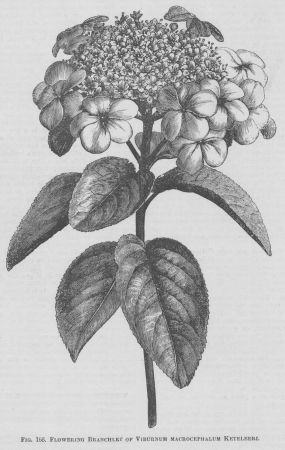
V. m. Keteleeri (Keteleer's). This is the wild type, and bears the same relationship to V. macrocephalum that the wild V. Opulus does to the garden V. O. sterilis. See Fig. 168. (R. H. 1863, 31.)
V. molle (soft). fl. in pedunculate, stellate-pubescent cymes. July. fr. purple or blue, ovoid, small, oily. l. broadly oval, obovate, or ovate, scarcely pointed, slightly cordate at base, coarsely crenate or repand-toothed, the lower surface, as well as the rather slender petioles and branchlets, softly downy. h. 6ft. to 12ft. 1812.
V. nudum (naked). American Withe Rod. fl. all alike and perfect; cyme shortly pedunculate. May and June. fr. black, or with a blue bloom, globose, sweet, round-ovoid, 1/4in. long. l. rather thick, oval, oblong, or lanceolate, not shining, the margins entire, repand, or crenate. h. 6ft. to 10ft. 1752. (B. M. 2281; W. D. B. 20.)
V. n. cassinoides (Cassine-like). l. more opaque, often toothed. 1761. (W. D. B. 24, under name of V. squamatum.)
V. n. Claytoni (Clayton's). l. nearly entire, the veins somewhat prominent beneath.
V. obovatum (obovate-leaved). fl. in small, sessile cymes. May. fr. black, or with a blue bloom, sweet, ovoid-oblong. l. obovate or spathulate, obtuse, entire or denticulate, rather thick, 1in. to 1 1/2in. long, shining. h. 2ft. to 8ft. 1812. (L. B. C. 1476.)
V. odoratissimum (very odorous).* fl. with the scent of Olea fragrans; corymbs 2in. to 4in. high, usually pedunculate. May. fr. ovoid-oblong, 1/3in. by 1/5in., hardly compressed. l. elliptic, 5 1/2in. long, acute, cuneate at base, entire or sparingly sinuate-toothed, coriaceous, glabrous; petioles stout, 1/2in. to 1in. long. h. 6ft. to 10ft. Khasia Mountains, China, &c. 1818. Half-hardy. (B. R. 456.)
V. Opulus (Opulus).* Cranberry-tree; Dog Eller; Dog Rowan-tree; Guelder Rose; Marsh or Water Elder; Snowball-tree. fl., outer ones white, 3/4in. in diameter; inner ones creamy-white, 1/4in. in diameter; cymes sub-globose, 2in. to 4in. in diameter. June and July. fr. red, globose, translucent, 1/3in. in diameter. l. 2in. to 3in. long, three-lobed, stipulate, the young ones downy; lobes unequal, serrated; stipules glandular, adnate to the petioles. Branches slender, lenticellate. h. 6ft. to 8ft. Europe (Britain) and North America. (F. D. 661; Sy En. B. 639.) SYNS. V. edule V. oxycoccos (L. B. C. 1123).
V. O. foliis-variegatis (variegated-leaved). l. variegated with white and yellow.
V. O. nana (dwarf). A very distinct little plant, scarcely 1ft. in height.
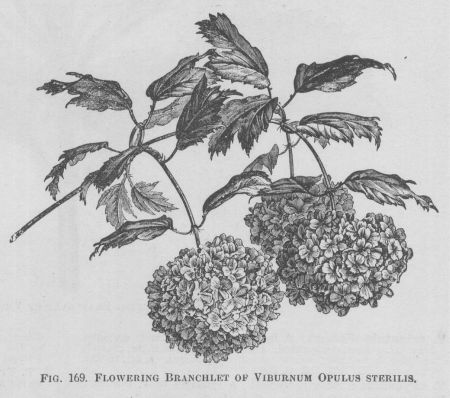
V. O. sterilis (sterile).* Garden Guelder Rose; Snowball-tree. fl., nearly the whole cyme consisting of radiant, sterile flowers, and becoming globular. A very handsome shrub. See Fig. 169.
V. orientale (Eastern). fl. in terminal, not radiant, corymbs. July. fr. oblong, compressed. l. three-lobed, acuminate, coarsely and bluntly toothed; petioles glandless, glabrous. h. 6ft. to 10ft. Caucasus, 1827, 1868. (R. G. 567.)
V. oxycoccos (Cranberry-fruited). A synonym of V. Opulus.
V. plicatum (plaited).* fl. radiant, in the cultivated plant all sterile, dilated, and crowded in globose cymes resembling those of the Guelder Rose. May. l. rounded at base, ovate or somewhat ovate-orbicular, cuspidate, coarsely serrated, somewhat plicate, dark green, glabrous above, tomentose beneath. h. 4ft. to 6ft. Japan, 1846. (B. R. 1874, 51; F. d. S. 278: G. C. n. s.,vi., p. 141; L. J. F. 88; L. & P. F. G. 29; S. Z. F. J. 37.)
V. p. tomentosum (tomentose). This differs from V. plicatum in its more hairy leaves, and in the sterile flower being generally confined to the outer part of the inflorescence. (S. Z. F. J. 38, under name of V. tomentosum.)
V. prunifolium (Prunus-leaved).* American Black Haw. fl. in a sessile cyme. May. fr. similar to, or rather smaller than, that of V. Lentago. l. oval, obtuse or slightly pointed, finely and sharply serrated, 1in. to 2in. long. 1731. A tall shrub or small tree. (W. D. B. 23.)
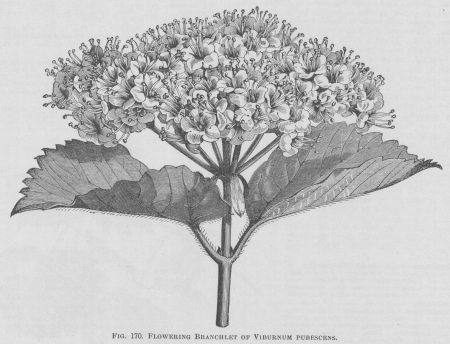
V. pubescens (downy). fl. in pedunculate cymes. June. fr. dark purple, small, ovoid. l. ovate or oblong-ovate, acute or acuminate, the veins and teeth fewer and less conspicuous than in V. dentatum, the lower surface and the very short petioles softly downy, at least when young. 1736. Low and straggling. See Fig. 170.
V. rugosum (wrinkled-leaved). fl. all fertile; corymbs not radiant; general involucre seven-leaved. December to March. fr. ovate-oblong. l. broad, ovate, wrinkled, hairy. h. 4ft. to 6ft. Canary Islands, 1796. A half-hardy, evergreen shrub, very like V. Tinus, but having leaves larger, and hairy all over. (B. M. 2082; B. R. 376; L. B. C. 859.)
V. Sandankwa (Sandankwa). fl., corymbs mostly terminal, sometimes axillary, short, small, erect, trichotomous. June. fr. red, globose. l. shortly petiolate, ovate or ovate-oblong, obtuse or sub-acute, slightly revolute-margined, crenulate-serrulate. Branches terete, erect. h. 6ft. to 7ft. Japan, 1875. (B. M. 6172.) SYN. V. suspensum.
V. suspensum (uncertain). A synonym of V. Sandankwa.
V. Tinus (Tinus).* Laurustinus. fl. white, but rose-coloured before expansion, and sometimes a little time afterwards; corymbs flat. December to March. fr. dark blue. l. ovate-oblong, quite entire; ramifications of the veins beneath, as well as the branchlets, glandular-hairy. h. 8ft. to 10ft. South Europe, &c., 1596. Evergreen. See Fig. 171. (B. M. 38.)
V. T. Froebelii (Froebel's). A compact form, with lighter green leaves and whiter flowers than the type.
V. T. hirtum (hairy). fl. appearing in autumn, and persistent through the winter. l. oval-oblong, hairy beneath and on the margins.
V. T. lucidum (clear-leaved).* fl. and cymes larger than in the type. Spring. l. also larger, ovate-oblong, glabrous, shining. Mount Atlas. There is a form having leaves more or less variegated with white.
V. T. strictum (erect). A variety of somewhat erect and fastigiate habit. Gardens. There is also a variegated sub-variety.
V. T. virgatum (twiggy). l. oblong-lanceolate, pilose below and on the margins. Italy.