Walnut
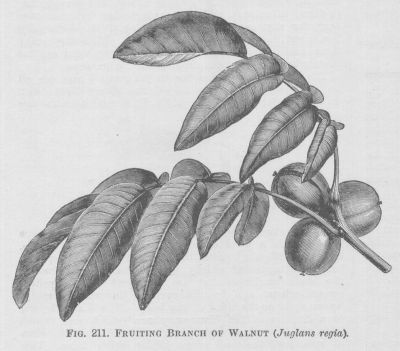
(Juglans regia). The common Walnut is a well-known tree, fine in foliage as an ornamental subject for planting in parks, paddocks, &c., and useful for its fruits, both in the young and ripened state, and for the timber, which is largely employed by cabinet-makers and others, and for the purpose of making gun-stocks. Propagation is effected by seeds; also by budding, grafting, and inarching for perpetuating varieties. Seeds of Walnuts designed for timber-trees, are best sown where the trees are intended to develop, if this is practicable; or they may be stratified through winter, and planted in nursery rows, about 2ft. apart, in February or March following. The young trees may either be transplanted in the autumn, or allowed to remain a year longer; they each form a long tap-root, which proceeds straight down, and if transplanting is intended, it must not be too long deferred in the first place. Ring-budding and shield-budding, with a pushing eye, and also whip and cleft grafting, are successful methods of propation, and all are performed while the sap is in active circulation. Walnut-trees succeed in any fairly good soil; if of good depth and resting on a gravelly bottom, it is to be preferred. The delicate young shoots and fruits are liable to be much injured by late spring frosts.
Walnuts for pickling should be gathered when the shell is quite soft, so that a needle will readily pass through.
The ripe fruits drop, and their husks open and disclose the nut in a way which is generally familiar. Squirrels will collect large quantities and store them; if there are any of these animals about, the crop must be secured as soon as ripe, or the depredators destroyed. Walnuts may be preserved in several ways for use during winter: dried and packed in clean jars or casks, with alternate layers of sand, they keep well; or placed in jars with close-fitting lids, and buried in the ground. Placing them in jars and sprinkling them with salt, and burying in oak sawdust, are other methods of preservation which have been recommended.
DISEASES, &c. The Walnut is not affected by any disease of sufficient importance to call for special remark; though several insects and Fungi attack the tree and fruit, they do no appreciable harm in England. SORTS. Small-fruited varieties are best for growing to produce fruit. Besides the common Walnut, which is an abundant bearer, the following are most desirable:
DWARF PROLIFIC, a dwarf-growing variety which bears abundantly when quite small. HIGHFLYER, early, of medium size, thin-shelled. THIN-SHELLED, an excellent variety, with a thin, tender shell, well filled; of better quality than the common variety.