Wistaria
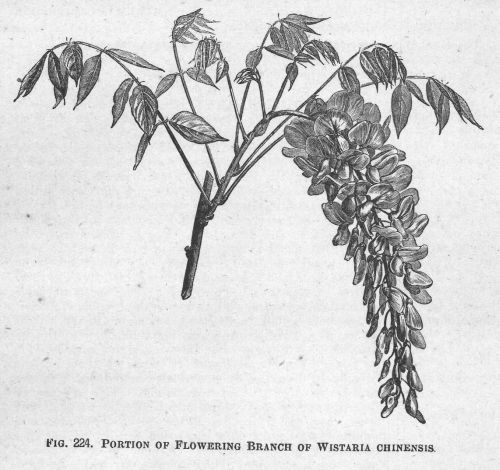
(named in honour of Caspar Wistar, 1761-1818, Professor of Anatomy in the University of Pennsylvania). Grape-flower Vine. SYNS. Diplonyx and Thyrsanthus. ORD. Leguminosae. A small genus (four or five species) of hardy, tall, climbing, deciduous shrubs, natives of North America, China, and Japan. Flowers usually bluish, scattered at the sides of the rachis, two upper calyx teeth short and sub connate, the lower ones usually longer; standard ample, with two parallel ridges at the base; wings oblong-falcate; racemes terminal; bracts very caducous. Pods elongated, torulose, two-valved. Leaves imparipinnate; leaflets entire, penniveined and reticulate-venulose, often stipellate. Wistarias thrive in any good, loamy soil, and grow fast when once established. They are most readily propagated by layering the young growing shoots during the summer months, and detaching them from the parent plant the following year.
W. brachybotrys (short-clustered). fl. violet-purple; standard orbicular; pedicels one-flowered, shorter than the acuminate, caducous bracts; racemes short, erect or loosely spreading. April. l. imparipinnate, four to six-jugate; leaflets petiolulate, truncate or sub-cordate at base, ovate-lanceolate, acuminate, silky-canescent on both sides. Branches tortuous. h. 3ft. to 5ft. Japan. (F. d. S. 880; S. Z. F. J. 45.)
W. chinensis (Chinese).* Chinese Kidney-bean Tree. fl. large, inodorous, produced in great abundance on established plants; wings of the corolla each having one auricle. May and June (sometimes a second crop of flowers in August). l., leaflets ovate, acuminate, in opposite, distant pairs, clothed on both sides with a thin, silky, adpressed pubescence. China, 1816. SYNS. W. sinensis, Glycine chinensis B. M. 2083), G. sinensis (B. R. 650; L. B. C. 773).
W. c. flore-pleno (double-flowered). A handsome variety, with double flowers, 1882. (F. & P. 1882, 557.)
W. c. macrobotrys (large-clustered). fl. white, tinted with bluish-purple, borne in very long racemes. Japan, 1870.
W. c. variegata (variegated). A form with bright silvery-variegated foliage. 1886.
W. frutescens (shrubby). American Kidney-bean Tree. fl. odorous; racemes 4in. to 6in. long, 2in. to 3in. in diameter, on short branches, dense-flowered; bracts large, caducous. April and May. fr., pods one or several-seeded. l., young ones (and branches) silky-pubescent; leaflets nine to thirteen, 1in. long, ovate-lanceolate or oblong; stipels none. North America, 1724. SYNS. Glycine frutescens (B. M. 2103) and Thyrsanthus frutescens. W. japonica (Japanese).* fl. white, in simple, nodding racemes; standard obovate, obtuse, entire; pedicels one-flowered, horizontally spreading, terete; peduncles slender. July and August. l. imparipinnate, four to six-jugate; leaflets pedicellate, ovate or ovate-lanceolate, obtuse, acuminate, entire, petiolulate. Japan. A glabrous, twining shrub. (S. Z. F. J. 43.)
W. multijuga (many-paired). fl. lilac, with purple wings and keel, rather smaller than in W. chinensis, and growing in racemes which are said to be upwards of 2ft. in length. Summer. l. pinnate; leaflets numerous, elliptic-ovate, acuminate. Japan, 1874. (F. d. S. 2002.)
W. sinensis (Chinese). A synonym of W. chinensis.