Woodsia
(named in honour of Joseph Woods, 1776-1864, author of "The Tourists' Flora"). Including Hymenocystis and Physematium. ORD. Filices. A genus comprising about fourteen species of small, much-tufted, stove, greenhouse, or hardy Ferns, mostly inhabiting cold or temperate climates. Stipes often jointed and separating at the joint. Sori globose; involuere inferior, soft-membranous, from the first calciform or more or less globose, and sometimes inclosing the sorus, at length opening at the top, the margin or mouth irregular, lobed or fringed. The best-known species are here described. With the exception of W. mollis, all the exotic species thrive in a cool house. For general culture, see Ferns.
W. alpina (alpine). A garden name for W. hyperborea.
W. Brownii (Brown's). A synonym of Hypoderris Brownii.
W. caucasica (Caucasian). fronds lanceolate, 9in. long, glandular-hirsute on the rachis and midrib, firm-membranous, bipinnate; primary pinnae sessile, nearly opposite, lanceolate, broadest at the base, acuminate-pinnatifid or again pinnate; lobes or ultimate pinnules oblong, acute, serrated. sori large, two on each lobe or pinnule, one on each side near the margin; involucre globose. Caucasus. SYN. Hymenocystis caucasica.
W. glabella (nearly glabrous). sti. short. fr. linear, slightly tapering below, pinnate; pinnae very remote towards the short stipes, all deltoid, very obtuse, cut into from three to seven shortly rounded or sub-cuneate, entire lobes. North America, Norway, 1827. Baker regards this as possible a glabrous form of W. hyperborea. (H. F. B. A. ii. 237.)
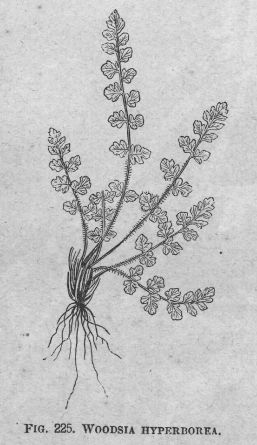
W. hyperborea (extreme-northern). rootstock stout, somewhat elongated. sti. shining, clothed with ferruginous scales. Jronds 3in. to 6in. long, linear-lanceolate, densely tufted; pinnae somewhat distant, ovate-cordate, 1/4in. to 1/2in. long, pubescent and ciliated, with a few broad lobes. sori three to five on each lobe. Arctic Europe (Britain), &c. SYN. W. alpina (of gardens). (Sy. En. B. 1863.)
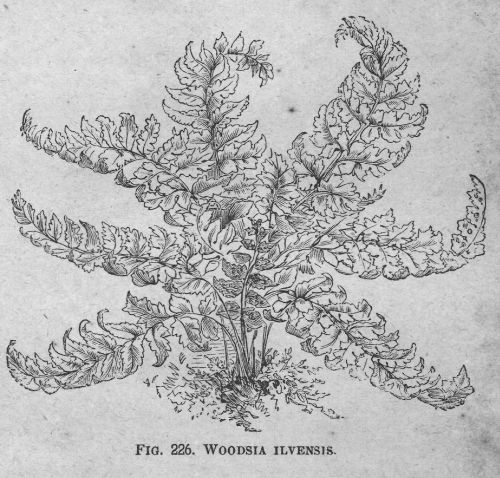
W. ilvensis (Elba). fronds broadly lanceolate; pinnae oblong, obtuse, broader at the base, sessile, deeply pinnatifid with many oblong, sub-crenate lobes. Alpine regions of Northern hemisphere.(Sy. En. B. 1862.) Ilva, whence ilvensis is derived, is the classical name for the island of Elba. The species received the name because Linnaeus believed this Fern to be the same as one figured by Dalechamp, named Lonchitis aspera ilvensis.
W. mollis (soft).* fronds lanceolate, pinnate, generally densely clothed, especially beneath, with short, jointed hairs, scarcely attenuated below; pinnae sessile from a broader base, oblong, obtuse, pinnatifid; lobes approximate, oval or nearly round, entire or crenate. sori marginal; involucre opening with a jagged, circular mouth. Mexico, Guatemala, &c. Greenhouse SYN. Physematium mollis.
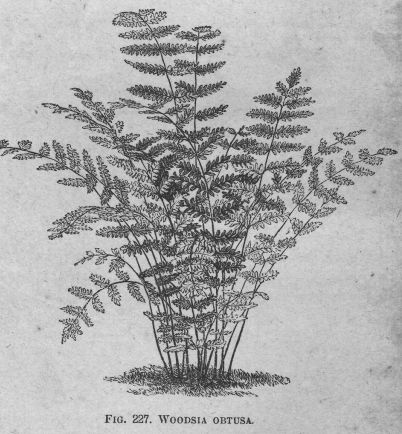
W. obtusa (obtuse).* sti. tufted, not articulated, 3in. to 6in. long, castaneous towards the base. fronds oblong-lanceolate, narrowed to both ends, 6in. to 9in. long, bipinnate or tripinnatifid; central pinnae sessile, lanceolate-deltoid, 1in. to 1 1/2in. long, the lower ones reduced; pinnules oblong, blunt, crenulate, or the lowest sub-pinnatifid, glandular-pilose. sori sub-marginal, six to twelve to the largest pinnules; involucre a small, membranous, lacerated, white cup. United States to Peru. (H. G. F. 43.) SYN. W. Perriniana.
W. oregana (Oregon). sti. densely tufted, not articulated, castaneous, 2in. to 4in. long. fronds oblong-lanceolate, narrowed to both ends, 3in. to 4in. long, bipinnate, glabrous; pinnae lanceolate, sessile, the central ones 3/8in. to 1/2in. long, cut down to the rachis or a narrow wing into blunt, oblong, crenate lobes, the lower ones distant, gradually reduced; rachis stramineous. sori sub-marginal; involucre hidden by the sorus. North America. Closely allied to W. obtusa.
W. Perriniana (Perrin's). a synonym of W. obtusa.
W. polystichoides (Polystichum-like).* fronds 9in. long, opaque, lanceolate, pinnate, sparsely subulate-squamulose; pinnae spreading, approximate, sessile, 6in. to 8in. long, lanceolate, acute, cuneate-truncate at base, acutely auricled at the superior base, entire or obsoletely crenate at the apex, indistinctly costate. sori marginal in a distinct line or series; involucre globose, of four or five ciliated, incurved scales. Japan, 1863.
W. p. sinuata (sinuate). fronds, pinnae broader, more obtuse, lobed-pinnatifid. (H. G. F. 32, f. 3.)
W. p. Veitchii (Veitch's). fronds very villous (H. G. F. 32, ff. 1, 2, 4-6.)
W. scopulina (brush-like). sti. densely tufted, 2in. to 3in. long, castaneous below. fronds 4in. to 6in. long, oblong-lanceolate, bipinnate, narrowed from the middle to both ends; central pinnae lanceolate, sessile, 3/8in. to 1/2in. long, cut down to the rachis or a narrow wing into close, ligulate-oblong, crenate-pinnatifid lobes; upper surface slightly, lower densely, glandular-pilose, with a few minute scales on the ribs. Rocky Mountains, 1884. "Scarcely more than a variety of S. obtusa" (Baker).