Woodwardia
(named after Thomas Jenkinson Woodward, an English botanist). Chain Fern. Including Anchistea and Lorinseria. ORD. Filices. A small genus (about half-a-dozen species) of highly decorative, green-house or half-hardy Ferns, belting the world in the North temperate zone, extending very slightly within the tropics. Fronds usually ample and bipinnatifid. Sori linear or linear-oblong, sunk in cavities of the frond, placed in single rows parallel with, and contiguous to, the midribs of the pinnae and pinnules; involucre sub-coriaceous, the same shape as the sorus, closing over the cavity like a lid. Woodwardias thrive in any well-drained, light, rich soil, and require plenty of water, both at the roots and overhead, during the summer months. They succeed well if planted out in the conservatory border, and grow much more vigorously than in pots. For general culture, see Ferns.
W. angustifolia (narrow-fronded). A synonym of W. areolata.
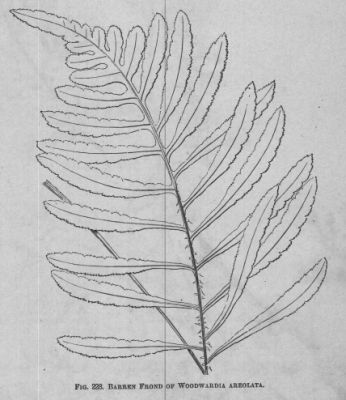
W. areolata (areolate).* barren fronds 9in. to 12in. long, 6in. to 8in. broad, on a slender stipes, deltoid-ovate, with numerous oblong-lanceolate, sinuated pinnae on each side, the lower ones 3in. to 4in. long, 1/2in. to 3/4in. broad, reaching down to the rachis, which above has a broad wing; both surfaces naked. fertile fronds on an elongated, strong, erect, chestnut-brown, naked stem; pinnae 3in. to 4in. long, narrow-linear, 1/2in. to 1in. apart. United States, 1812.(H. G. F. 61.) SYN. W. angustifolia.
W. Harlandii (Harland's). sti. 6in. to 18in. long, erect, nearly naked. barren fronds varying in shape from linear-lanceolate, undivided, to broadly ovate, with one or two spreading, linear-lanceolate lobes, 3in. to 4in. long, 1/2in. to 3/4in. broad, reaching down to a broadly-winged rachis; both surfaces naked. fertile fronds with more numerous and narrower lobes, the lowest pair often quite free of the others. sori in broad lines close to the midrib of the lobes, with short lines branching from these in an erecto-patent direction. Hong Kong.
W. japonica (Japanese). sti. 6in. to 12in. long, erect, scaly below. fronds broadly ovate, 1ft. to 1 1/2ft. long, 9in. to 12in. broad; pinnae lanceolate, often 6in. long, 1in. to 1 1/4in. broad, reaching half or two-thirds of the way down to the rachis, the lines of sori which margin the midrib of the pinnae confined to the upper part of the upper ones. China and Japan.
W. orientalis (Eastern). sti. erect, densely scaly at base. fronds 4ft. to 8ft. long, 1ft. to 1 1/2ft. broad; pinnae lanceolate, sometimes more than 1ft. long, cut down below nearly to the rachis into sinuated or pinnatifid pinnules, sometimes 4in. long, those of the under side shorter, and none at the base of the pinnae; veins copiously anastomosing outside the sori; upper surface often producing copious, gemmiferous buds. Japan to Formosa. Closely allied to W. radicans.
W. radicans (rooting).* sti. strong, erect, naked, scaly at base fronds 3ft. to 6ft. long, 1ft. to 1 1/2ft. broad; pinnae lanceolate, the lower ones often 1ft. long, cut down below within a short distance of the rachis into finely-toothed, lanceolate pinnules 1in. to 1 1/2in. long, those of the under side the shortest; veins anastomosing once outside the line of fruit; gemmae few and large, placed at the base of the upper pinnae. Canaries, South Europe, &c., 1779.
W. r. cristata (crested).* A handsome variety, with regularly and symmetrically crested pinnae. 1878.
W. virginica (Virginian). sti. strong, erect, 1ft. to 1 1/2ft. long. fronds oblong-lanceolate, 1ft. to 1 1/2ft. long, 6in. to 9in. broad; pinnae linear-lanceolate, 4in. to 6in. long, 3/4in. to 1in. broad, cut down within one line or less of the rachis into linear-oblong lobes, which are two to three lines broad at the base, the lines of sori which margin the midrib of the pinnae often reaching low down in the lower ones. Canada, southward, 1774. See Fig. 229.