Home › C › Coniferæ (Sp or my Ap N Amer L co Mi arb)
Coniferæ (Sp or my Ap N Amer L co Mi arb)
Sp. 4-9. or 25 my Ap N. Amer. 1596. L co Mi.arb.3.p.29.t.3 or 25 my Ap China 1752. S co Dend. brit. 149 13537 13534 13539 13535 History, Use, Propagation, Culture, 13536 13542 The hemlock spruce is a very elegant tree, and grows in some situations to an enormous size: its bark is a fine substitute for oak-bark in tanning. 2014. Larix. This has also for its root the Celtic word lar, which signifies fat, in allusion to the abundance of resin afforded by the plant. Even Dioscorides remarks, that Larix is the Gallic name for resin. The authors of the Dictionary of Trevona make the word Cedrus come from κuωδης, sweet-scented, on account of the balsamic odor exhaled by the wood when burned.
L. Cedrus, Cédre, Fr., Cederbaum, Ger., and Cedro, Ital., is unquestionably the most celebrated tree of the genus, and not less remarkable for the irregular grandeur of its form. The general character of its shoot, even when the tree is young, is singularly bold and picturesque, and quite different from that of every other species of the tribe. It is a native of the coldest parts of the mountains of Libanus, Amanus, and Taurus; but it is not now to be found in those places in great numbers. Maundrell, in his journey from Aleppo to Jerusalem, in 1696, could reckon only sixteen large trees, though many small ones; one of the largest was twelve yards six inches in the spread of its boughs. The forest of Libanus never seems to have recovered the havoc made by Solomon's forty score thousand hewers: so that we have now, as Professor Martyn observes, probably more cedars in England than there are in Palestine. From the branchy head of this tree, and its aversion to pruning, it is not likely ever to become valuable as timber in this country. When planted for that purpose, it should, as Sang recommends, be sown in groves, and thus by proximity drawn up with few branches. Much has been said of cedar timber, which borders on the miraculous; as far as experience has gone, it is greatly inferior to that of the common larch, or the wild pine. The great use of the cedar is to plant singly on lawns, or in the margin of plantations, where one or two specimens will give force and character to the dullest front of round-headed trees. L. Communis, Méleze, Fr., Lerchenbaum, Ger., and Laricio, Ital., is a deciduous tree, and there are two or three species or varieties not yet distinctly ascertained. There is a variety with red and another with white flowers; one with cinerous bark, called the Russian larch, and one with pendulous branches. L pendula and L. microcarpa are considered species or subspecies; the timber of both is said to be harder than that of the common white larch; but these trees have never yet had a fair trial in this country. As there are a few large specimens at Dunkeld and Athol, seeds will probably soon be obtained, and from their progeny a practical estimate may be formed of their merits in this country. The red larch trees on the Athol estates do not contain one-third as many cubic feet of timber as the white larch of the same age. The wood is so ponderous that it will scarcely swim on water. (Hort. Trans. iv. 416.) The timber of the white larch has been as much extolled as that of the cedar, and with much more reason. The rapidity of its growth is not less remarkable than the durability of the timber. Both have been experimentally proved in the Highlands of Scotland. It is stated by the Duke of Athol, that on mountainous tracts there, at an elevation of 1500 or 1600 feet, the larch, at eighty years of age, has arrived at a size to produce six loads (300 cubic feet) of timber; appearing in durability and every other quality to be likely to answer every purpose both of civil and naval architecture. (Hort. Trans. iv. 416.) The tree will arrive at a timber size in almost any situation or soil. Sang, a forest manager of extensive practice, has paid great attention to this tree. " It bears," he says, " the ascendancy over the Scotch pine in the following important circumstances: that it brings double the price, at east, per measureable foot; that it will arrive at a useful timber size in one-half, or a third part of the time, in general, which the pine requires; and, above all, that the timber of the larch, at thirty or forty years old, ORDER VIII.
MONECIA MONADELPHIA. 13532 Leaves solitary subulate, Cones oblong blunt, Scales rounded somewhat 2-lobed entire at edge 13533 Leaves solitary 4-cornered erect straight, Cones ovate, Scales elliptical wavy at edge erect 13534 Leaves fascicled deciduous, Cones ovate-oblong, Edges of scales reflexed lacerated, Bractes panduriform 13535 Leaves fascicled deciduous, Cones oblong, Edges of scales inflexed, Bractes panduriform sharply acumin. 13536 Leaves fascicled deciduous, Cones roundish few-fl. Scales reflexed, Bractes panduriform bluntly acuminate 13537 Leaves fascicled rigid evergreen acute, Cones roundish, Scales truncate appressed 13538 Leaves distichous spreading 13539 Leaves solitary lanceolate remote 13540 Leaves whorled linear falcate 13541 Leaves lanceolate, Branches whorled 13542 Leaves solitary linear cuspidate remote 13543 Branches quadrang. Lvs. imbric. in 4 rows blunt appr. convex, Cones glob. Scales unarm. Branches straight 13544 Branches quadrang. Lvs. imbric. in 4 rows appr. glauc. keel. Cones subglob. Sc. mucron. Branches pendulous 13345 Branches compressed, Leaves imbricated 4 ways ovate warted at base 13546 Leaves linear much spreading decussate 13547 Leaves linear crossing appressed, Branches very slender 13548 Branches 2-edged, Leaves imbricated in 4 rows ovate rhomboid appressed naked warted, Cones obovate 13549 Branches 2-edged, Lvs. imbricat. in 4 rows ovate rhomboid appressed furrowed in middle, Cones elliptical 13543 13548 13564 13549 13545 and Miscellaneous Particulars. when it has been planted in a soil and climate adapted to the production of perfect timber, is in every respect superior in quality to that of the pine at 100 years old. In short, it is probable, that the larch will supersede the Scotch pine in most situations in this island, at no very distant period." The chief objections to the timber of the larch are its liability to warp and twist; but this Monteath and others have proved may be effectually prevented by barking the trees in spring while growing, and not cutting them down till the following autumn, or even for a year afterwards. This is also said to prevent the timber from being attacked by the dry rot. The bark of the larch is more than half as valuable as that of the oak in tanning; turpentine is extracted from it in the Tyrol by incision; but that being always injurious to the timber, can never be recommended for adoption in this country. (See Encyc. of Gard. 7053. Monteath's Forester's Guide, 2d edit. p. 234.) Like all other trees, and especially the resinous tribe, the timber of the larch is much affected by climate and soil. A certain elevation of surface, coldness of climate, and inferiority of soil, is absolutely necessary to produce the timber in perfection. Sang has known it in many places make the most rapid progress for thirty or thirty-five years, and though there was no external signs of disorder, yet when it was felled, the wood had begun to rot in the hearts of the trees, and some were quite hollow a good way upwards. (Plant. Kal. 59.) Larix pendula, black larch, Tamarack or Hackmatack of the Americans, is a beautiful tree, resembling the European larch in appearance, as well as in the excellent qualities of its wood and bark. 2015. Schubertia. Named in honor of M. Schubert, a Polish botanist. The deciduous cypress grows in extensive swamps, and on the banks of large rivers, from Indian river, Delaware, to Florida, and on the Mississipi; it is one of the largest trees of the new continent, and one of the most valuable timbers that country produces; it grows to a considerable height in this country, though the extremities of the young shoots are almost every autumn destroyed by frost. The finest specimens are at Sion-house and Blenheim. 2016. Podocarpus. From πες πoδoς, a foot, and κaρπoς, fruit; in allusion to the stalk of the fruit. The species are increased by ripened cuttings in sand under a hand-glass. 2617. Cupressus. In Greek κuπaρiσσoς, from the isle of Cyprus, where this tree is very abundant. Cupressus sempervirens is a common timber tree in some parts of the Levant. It was employed by the Moors round their palaces, and both by the ancient and modern Romans in their villas and gardens. The timber of this tree is said to resist the worm, and to be of great durability. The doors of St. Peter's church at Rome were formed of this material, and have lasted eleven hundred years. The Greeks made their coffins of it; and the mummy chests of Egypt are many of them of this wood. In Crete, Malta, and other places, it is used for the common purposes of building, and when imported into this country it is employed by the cabinet-maker and turner. Near buildings, where the prevailing architectural lines are horizontal, it forms very suitable combinations: it is also considered an appropriate tree for burial places. C. Thyoides is an abundant tree in the swamps of New Jersey and Pennsylvania. It is used for fencing and house-building, and is in the highest esteem for shingles and pipe staves. C. lusitanica is a native both of Goa and Japan, and the handsomest tree of the genus. It is easily distinguished from all the evergreens of the Coniferæ by its abundance of very long dichotomous pendent branchlets. The culture of the hardy species of this genus, and also of Thuja, is the same as that of Pinus. 2018. Thuja. An alteration of thya, its real name; from θuω, to sacrifice. Its wood, which gives out when burnt an agreeable perfume, was used in sacrifices. Thuja occidentalis, Cédre blanc, Fr., is a well known 3F4 MONŒCIA MONADELPHIA. 13550 articuláta W. jointed 13551 cupressoídes W.
African 오오 Ap or 15 f.my Ap Barbary 1815. S co or 10 CLASS XXI.
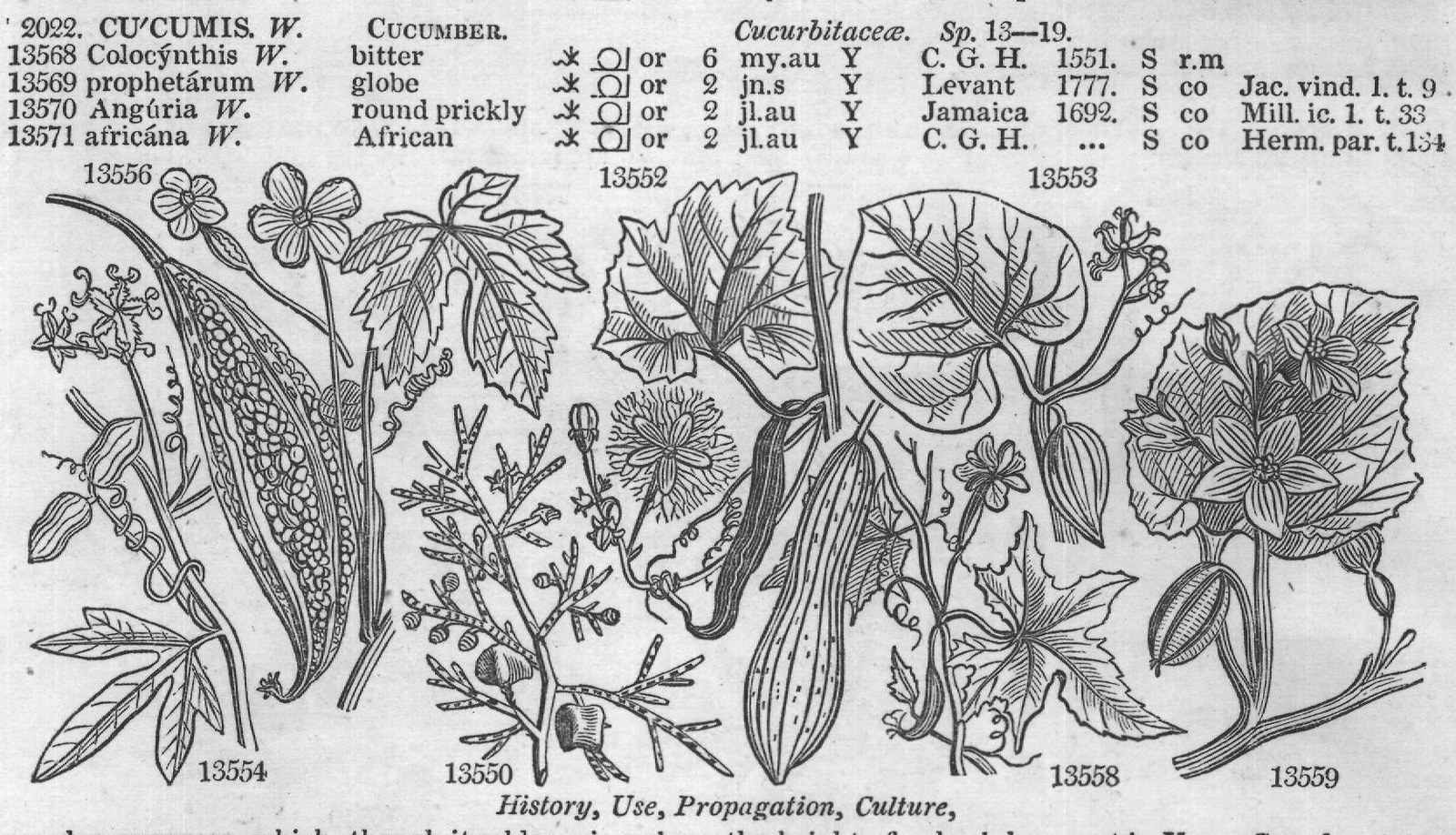
Bot. cab. 844 C. G. H. 1799. S p.l 2019. TRICHOSAN'THES. W. SNAKE GOURD.